
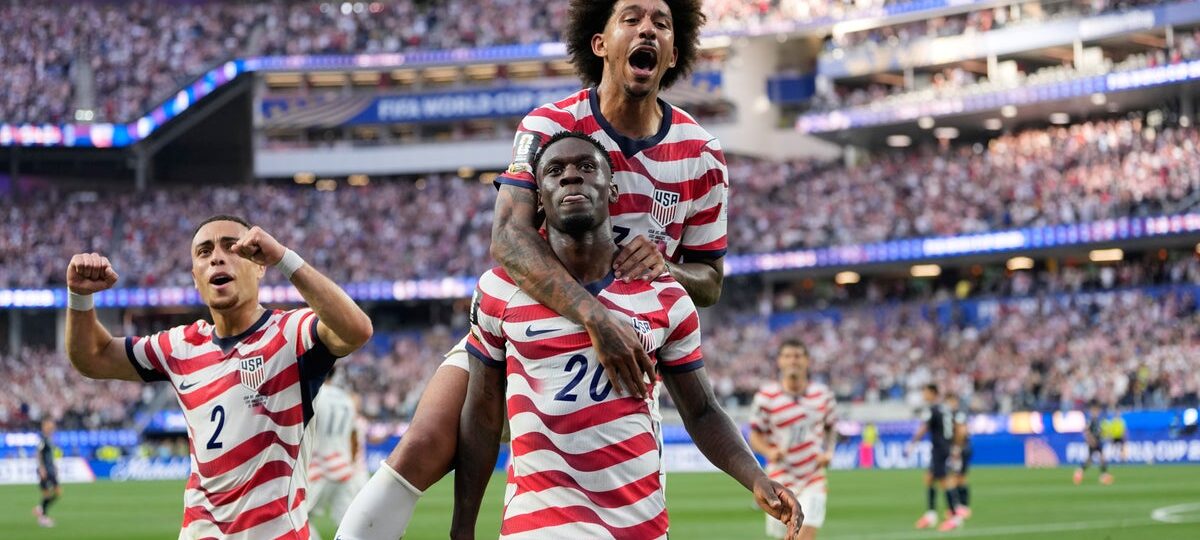
Twenty days into the World Cup and the figures are in. The main takeaway? A star-spangled soccer popularity surge is engulfing this 50-state land and, so long as the No 1 act is in town, it shows no signs of relenting.
FOX Sports, who spent $485m to acquire the American television rights for the biggest World Cup of all time, have made no secret of their lofty viewership statistics after the group phase. Even withstanding the contrived punditry from the much-maligned Alexi Lakas, the numbers across the board tell the story of a nation gripped by football in an unprecedented manner.
USA‘s opening-game triumph against Paraguay, primetime on Friday night, raked in 19 million viewers, topped up to 26 million when including Spanish-language viewers on Telemundo and Peacock. For their other two group games, that total number did not drop below 23 million. For context, Donald Trump’s presidential inauguration last year drew in 24.6 million viewers across all 15 major US networks. And the New York Knicks’ NBA Finals series win, clinched the day after the US victory over Paraguay, drew in 20.6 million per game across ABC and ESPN.

Of course, Super Bowls are always the unassailable Everest for American TV viewership figures; 19 of the 20 most-watched programmes in US broadcast history are the NFL’s annual extravaganza, which regularly tops 120 million viewers. But this summer’s fever of footballing patriotism, intertwined with a natural boom from hosting the event, is only heading one way, so long as business is taken care of on the pitch. The reward for the United States – or USMNT [United States Men’s National Team] as they’re known in these parts – finishing top of Group D is a last-32 match-up against Bosnia and Herzegovina in Santa Clara.
The temporarily renamed 75,000-seater San Francisco Bay Stadium, home to the 49ers NFL franchise, will be a sea of red-and-white as day gives way to dusk on Wednesday evening, with a pocket of boisterous blue-clad Bosnian supporters in the lower tiers. Tickets are priced at $1,200 which makes it the third-most expensive event ever at the stadium, behind two Super Bowls.
And at this stage of the competition, taking on a team ranked 64th in the world is as pleasant a knockout tie as Mauricio Pochettino could have hoped for.
“A game like tomorrow is 85 per cent, maybe 90 per cent emotional,” said Pochettino in his pre-match press conference, which he started by apologising for his bizarre outburst after the US defeat to Turkey.
“If we can reduce that, to 70, 60, 50, in order to play and wait to put in the emotional side at the end, I think it’s much better. But it’s difficult to reduce for both teams. In soccer, unpredictable things can happen but we’re trying to reduce that. To play free, and enjoy it.
“I don’t believe we are the favourites. We see in the last few days how difficult it is for all teams.”
Bosnia are not to be underestimated. They were just five minutes from play-off elimination when 40-year-old ex-Man City striker Edin Dzeko poached an equaliser in the semi-finals. They beat both Wales and Italy in penalty shoot-outs, so Pochettino’s men will want to avoid this one going the distance. However, the Argentine will take comfort from the knowledge that he will pick a side that’s mostly had 12 days off, given the nine changes he made for the dead-rubber defeat to Turkey in Los Angeles.
Most pivotally of all, Christian Pulisic – USA’s star man who shone so brightly in the first-half onslaught against Paraguay – is fit to start, making the US overwhelming favourites to set up a last-16 tie against either Belgium or Senegal in Seattle next Monday.

“I felt great in the game, the last game against Turkey,” Pulisic told the media on Tuesday. “So feeling good this week and definitely ready for tomorrow.”
The United States’ record World Cup finish has stood for nearly a century. Coach Robert Millar and his players were one of 13 teams who took part in the inaugural 1930 World Cup in Uruguay, beating Belgium and Paraguay (where forward Bert Patenaude scored the first-ever World Cup hat-trick) before coming a cropper to Argentina in the semi-finals.
As depicted in sports writer Jonathan Wilson’s excellent new World Cup book, The Power and the Glory, the US’ style of play was dismissed by Spanish-language newspaper El Diario as “monotonous and sometimes childish.” No such accusation can be thrown at the effervescent 2026 squad.
In more recent times, the likes of Landon Donovan, Brian McBride and Brad Friedel were household names as the US reached the quarter-finals in 2002 in South Korea/Japan, losing 1-0 to finalists Germany. Their last-16 win against Mexico that year is the US’ only-ever knockout win. This group, however, have the opportunity to leave a special legacy. The first knockout round was as far as the 1994 squad went, losing to champions Brazil in what constituted an unfortunate draw. No similar excuses can be made here.

So, how far can this group ride the wave of fever-pitch momentum over the next fortnight? Overall, the USA’s knockout bracket is relatively tough. Looking ahead, a potential last-16 tie against Belgium (a top-tier European nation, even if they are not the high-flying squad of a decade ago) or Senegal (AFCON finalists, demoted from winners after that crazy final) is tricky. And a likely quarter-final match-up against European champions Spain is a daunting prospect on the horizon in Los Angeles.
Yet Pochettino has got his players, and subsequently the nation at large, believing in the unbelievable. Aggressive and free-flowing football has epitomised his side’s run thus far; their dismantling of Paraguay was one of the performances of the tournament so far, before a more mature victory over Australia in a cacophony of noise in Seattle.
A similar atmosphere is expected on Wednesday, as the US complete their west coast triumvirate on the San Francisco Bay.

And the impact of the US team is bigger than just FOX television metrics. From conversations between strangers in airport terminals to masses congregating at fan parks and sports bars across this vast land, soccer fever is gripping the nation.
While the US president may be staying away – at least, until the final – the World Cup is unifying a country indisputably polarised and divided in the political sphere. The US is waking up to what the World Cup is all about.
“For us it’s the final of the World Cup tomorrow,” Pochettino said. “If we don’t think in this way, we are going to struggle.
“We saw yesterday that no game is easy for anyone. It’s all in. If we go through, then it’s another final”
After fellow co-hosts Canada and Mexico progressed to the next stage, it’s now over to you, USA.
Discover more from NAIRAVOICE.COM.NG
Subscribe to get the latest posts sent to your email.