
We tend to think of college teams gearing their schedules toward NCAA Tournament inclusion, and for most power conference programs that’s so. There’s much talk throughout the season, especially come March, of analytics and arcane formulas that include strength of schedule in rating teams. By the time league play commences in January, many nonconference slates already have doomed squads to also-ran national status.
But many other factors come into play in crafting an optimal major-college schedule besides attractiveness for securing an NCAA berth. There’s the desire to honor old intra-state rivalries (Clemson-South Carolina, Florida-Florida State, Georgia Tech-Georgia); chances to have games televised; a need to protect a head coach’s job security; and seizing opportunities to participate in multi-team, in-season tournament promising two or three games.
Coaches sometimes offer a matchup with a friend’s team, a guy they used to sit with in the bleachers scouting high school talent when they were assistants, or to give a boost to a mid-major program roaming the country to raise its profile and collect hefty financial guarantees.
Roamers aren’t necessarily low-profile aspirants. This season, for instance, Houston, a national power that reached the Final Four just two years ago, will face ACC members Cal, Florida State, and perhaps Notre Dame in the Players Era 8 Tournament in Las Vegas as well.
To its credit Florida, top-ranked at the season’s outset, takes on five ACC teams – Duke, FSU, Georgia Tech, Miami, and Notre Dame. The Hurricanes open with the Gators on a neutral Tampa site.
SEC member Mississippi (alias Ole Miss) takes on Clemson in the Southwest Maui Invitational (no more Rainbow Classic berth for the ACC in Honolulu), Virginia Tech in Blacksburg in the ACC/SEC Challenge, and NC State in Jackson, Mississippi, an off-campus, in-state venue dubiously listed as a neutral court.
Clemson gets a second, mis-labeled neutral site game against Cincinnati of the Big 12 in, of all places, Cincinnati.
One useful measure of an ACC team’s schedule is how many of these power conference opponents it willingly faces. The Devils lead the ACC with eight such tests in 2026-27, followed by Clemson, Louisville, and Pitt with seven each.
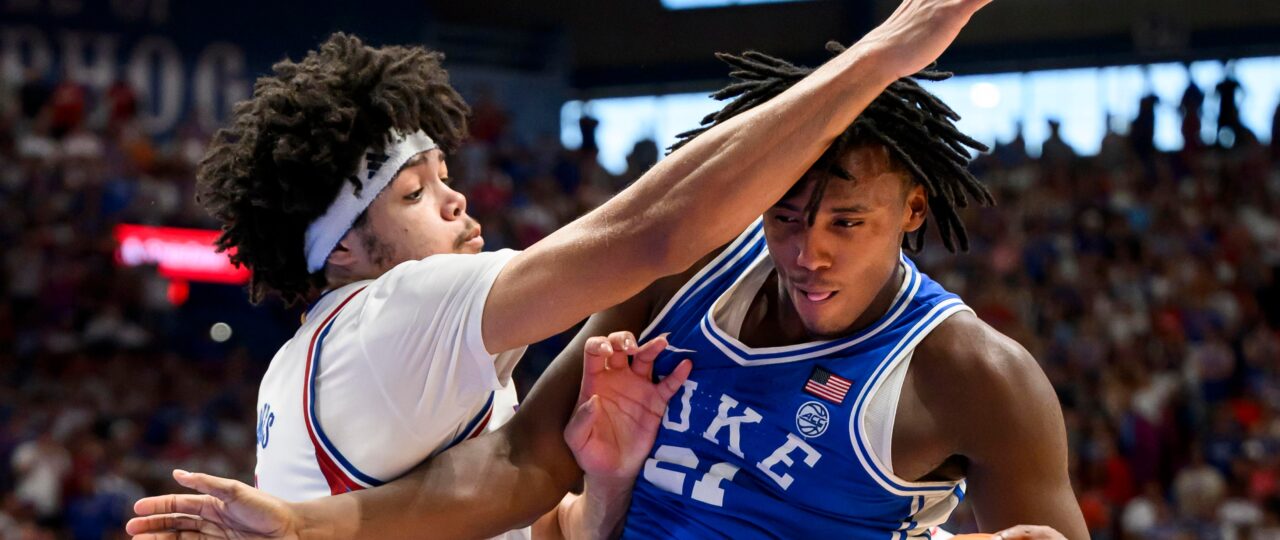
This go-round Duke hosts Illinois, takes on heavyweights UConn in Las Vegas, Georgia and Texas Tech two weeks apart at Madison Square Garden, and Gonzaga, a new member of the rebuilt Pac-12, in Detroit in February. (Connecticut plays Virginia in the Garden in December as well.) There’s also a Blue Devil meeting with Michigan State in Chicago, clearly Big 10 country but home turf for coach Jon Scheyer and Mike Krzyzewski before him.
Other ACC teams besides Duke have decided to step outside the conference after the turn of the year, long a Blue Devil specialty. In January Louisville meets Baylor in historic Hinkle Fieldhouse in Indianapolis – also called “iconic Hinkle Fieldhouse” in the land of cliches; UNC faces Illinois a week later at Nashville; and on Feb. 6 Syracuse takes on Rutgers in Brooklyn.
Note that we’ve counted the Big East, home of UConn, Georgetown, St. John’s, et al., as a basketball power league. We’ve also left the Pac-12 (or was it the Pac-10?) in that category despite retaining only Oregon State and Washington State from the old configuration. (Added were Boise State, Cal State, Colorado State, Gonzaga, San Diego State, Texas State, and Utah State.)
POWER PACKED
Teams From Power Conferences
On 2026-27 ACC SchedulesBC3Cal5Clem7Duke8FSU4GTech4UL7Miami6UN6NCSU5NDame6Pitt7SMU5Stanf2Syrac5Va4VTech5Wake5 Pending results, in-season tournament.
Go to the DBR Boards to find Blue Healer Auctions || Drop us a line
Discover more from NAIRAVOICE.COM.NG
Subscribe to get the latest posts sent to your email.