That is the question local politicians are asking themselves as Big Tech’s push to develop enormous AI data centers runs up against a growing number of Americans revolting against them.
That’s especially true in Republican-controlled states, where much of the data center boom is taking hold.
Republican governors and state lawmakers, as the midterms fast approach, are beginning to acknowledge voters who are concerned about the proliferation of large data centers, even if that means breaking with President Donald Trump.
For some Republicans, that acknowledgment came too little too late.
Stuart Adams lost the state’s Republican primary in June after he approved a data center development backed by “Shark Tank” investor Kevin O’Leary.
Lee Perry, a former commissioner in Box Elder County, where O’Leary’s development hopes to land, said supporting that project cost him his election race, too. “Do I think that the data center vote cost me the election?
Yes, I do,” Perry told The Salt Lake Tribune in June.
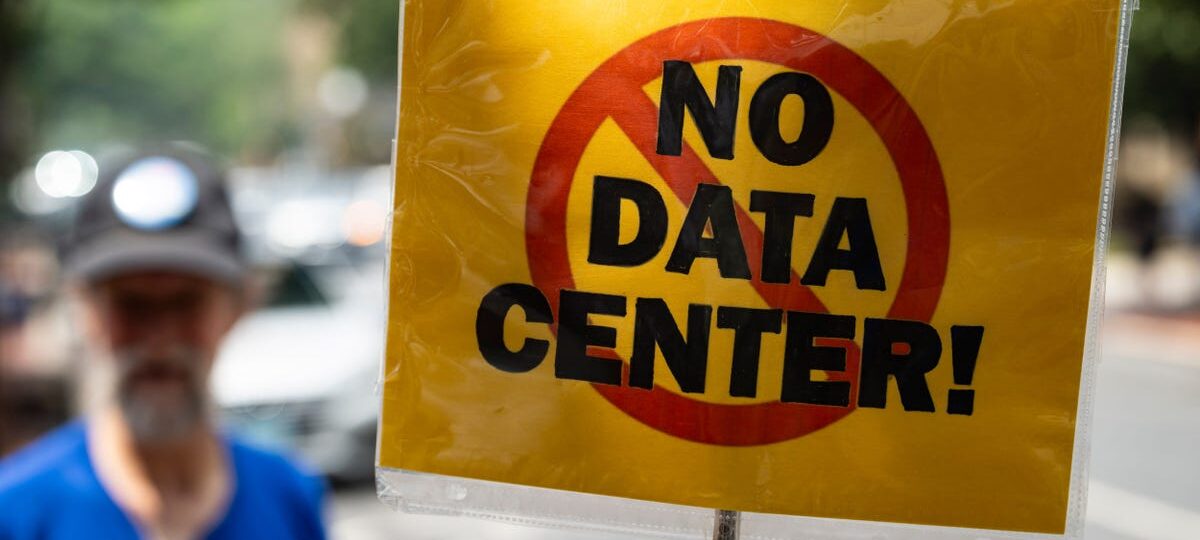
All across the country, Americans are rallying against AI data centers.
They have swarmed local planning meetings, launched petitions, held protests, and taken legal action to bar new developments.
Straining power grids, water use, noise, and rising utility costs are just a few of their concerns.
Although surveys conducted this year by Gallup and The Pew Research Center show that Democrats account for the majority of the opposition, Republicans aren’t far behind.
The data center issue is increasingly a bipartisan one. “Seven in 10 Americans oppose constructing data centers for artificial intelligence in their local area, including nearly half, 48%, who are strongly opposed,” the Gallup survey said.
That’s a dilemma for Republicans, who must balance the will of their constituents with that of both Trump, who is the leader of their party, and the big-spending tech companies looking to build in their districts.
Winning the AI race has been a central focus of the Trump administration.
The White House has largely backed Big Tech’s efforts to build data centers by accelerating federal permitting and supporting the $500 billion Stargate Project, an OpenAI initiative to expand AI infrastructure in the United States. “Simply put, we need to ‘Build, Baby, Build!'” the White House’s 28-page AI action plan, published in July, says.
That same month, however, Americans attended a nationwide protest against AI data centers hosted by Humans First, a conservative nonprofit led by Amy Kremer, a MAGA activist who has been at the center of most major conservative movements of the last two decades, including the “Stop the Steal” rallies that culminated in a riot on Capitol Hill. “This technology has been built on American data with American taxpayer dollars invested into these companies with American energy and American land,” Kremer earlier told Business Insider. “We have no voice in how the technology is used or how it impacts our lives, and that’s not right.” Trying to avoid a similar fate to their colleagues in Utah once November rolls around, Republican governors and legislators across the country are now breaking with the Trump administration and enacting restrictions on data center development.
Greg Abbott is walking the tightrope in Texas, where available land, access to an electricity grid, and potential tax breaks have made it a popular choice for companies building data centers.
Abbott, a longtime ally of Trump, initially went all in to expand data center construction in the state.
In November 2025, Abbott announced a $40 billion investment from Google to boost AI infrastructure.
Meta, Microsoft, OpenAI, Amazon, and SpaceX are all building massive AI data centers in Texas.
Residents in places like Abilene, Texarkana, and Lubbock have all held protests against data centers in recent months.
In June, San Marcos became the first city in Texas to enact a data center ban.
One month later, locals in Henderson County pushed back so fiercely that officials ultimately axed a planned project.
And so Abbott has now changed course, directing the local utility commission and the state’s electrical grid operator to shield residents from data center infrastructure costs.
He’s called for a ban on data centers in rural Texas communities and, most recently, said all projects must undergo an audit before moving forward. “Governor Abbott’s top priority is to protect Texans’ safety and quality of life and ensure the integrity of our power grid and water supply,” a spokesperson for Abbott told Business Insider.
Abbot’s choice to essentially freeze data center projects may gain him favor with his constituents, but not with Trump, who last week said rejecting data center development was a “mistake.” Other Republican governors and lawmakers are similarly changing course on the data center build-out.
In April, Pennsylvania Republican Sen.
Jamie Walsh proposed bills to repeal a state tax break for data centers and impose a moratorium on data center development applications.
Ron DeSantis signed a bill in May implementing new regulations around data center developments that give local governments the authority to approve or reject data center proposals.
Jim Pillen signed an executive order ending data center tax breaks and called for a pause on new data center construction.
Vivek Ramaswamy, the Republican nominee for governor of Ohio, pledged on Thursday to implement an “Ohioans-first” policy for AI data centers.
He said that if a data center is built in a community, residents would not have to pay for electricity at home, they’d pay lower property taxes, and the data center would be required to comply with certain environmental requirements. “To ensure urgency, I will further issue an executive order on my first day in office to immediately halt the approval of any new data center project announcements in Ohio, until the above-mentioned data center legislation takes effect.” Even Trump himself has made some small concessions.
Last month, his administration expanded the Ratepayer Protection Pledge, which is meant to keep electricity bills for American households and businesses low. “The United States never settles for second, and we don’t under this administration… we live by the motto ‘America First,'” Trump said in a press release about the pledge. “Thanks in part to this incredible [AI] technology boom, investments are pouring into the United States from all over the world.”
Discover more from NAIRAVOICE.COM.NG
Subscribe to get the latest posts sent to your email.