
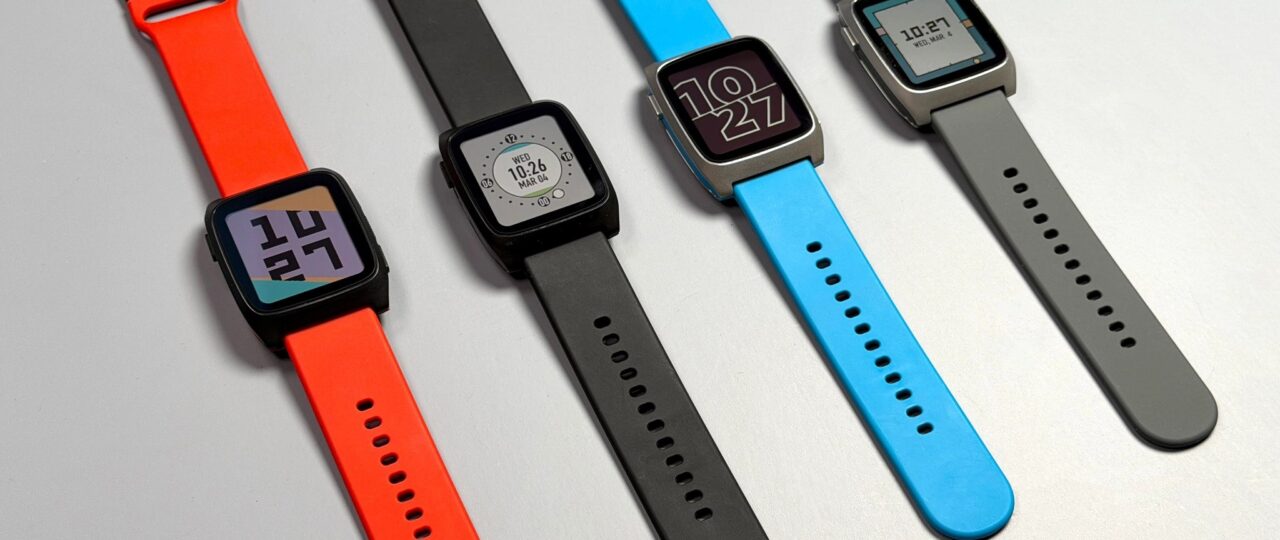
While Migicovsky hopes the do-over will give him a chance to correct the mistakes of the past, what hasn’t been left behind is Pebble’s spirit.
Still very much sustained by its hacker community, the device already ships with over 2,120 watch faces and apps built by Pebble developers, including over 500 new ones from a spring developer contest. This is where things start to get fun. Since the first thing many people do is customize their watch face, this large, whimsical selection showcases the community’s playful vibes.
Using the Pebble companion mobile app, you can choose from simple analog or digital displays, or you can pick from those featuring silly characters, like cartoon dogs, cats, or axolotls; various backgrounds and scenes; pixelated retro displays; giant, brightly colored numbers; text shown styled in creative fonts, like those from comic books or sci-fi; and more.
You can set the screen to be a favorite meme, like Nyan Cat, or to a watch face with characters from classic video games like Mario, Kirby, Pokémon, and more. (Don’t ask about the licensing — just enjoy it while it lasts.)
Despite a much smaller user base than the Apple Watch, the Pebble app store is full of creative and often niche applications across categories like health and fitness, games, tools and utilities, remotes, and others. There are many useful tools here — timers, Spotify controls, weather apps, to-do lists, calculators, navigation aids, stock trackers, a Strava activity tracker, medication reminders, health apps, calendars, and many fun, often retro-inspired, games.
What’s incredible about the selection is that many of these were created by individuals who simply wanted an app for a specific purpose, so they built it themselves. That could be an app for tracking a local train schedule, or their tennis score, their Claude AI usage, when to apply more sunscreen, or a thousand other things that would never make sense for an indie developer to build as a business.
There are also newer AI-powered apps for those who want access to a chatbot or agent on their wrist.
There are many playful apps, too, like the PebGoBrrrr app that tells time by vibrating the watch, or one where you can whack a mole for fun. (I don’t know, why not?). Among the most popular apps is the self-described “pointless” Pixel Miner game, where your little character mines for treasure. Another popular creation offers a FitCat virtual pet and activity tracker.
There’s even an app you can use to make other apps.
If there’s any complaint to be made here, it’s that there’s almost too much to explore. The Pebble app store could benefit from more search and discovery tools, similar to Apple’s App Store — subcategories, lists, editorial selections, or personalized recommendations. You could spend hours, weeks, or months browsing the app store and still find new things.
However, even if you used the Pebble Time 2 without installing extra apps, the watch is still very functional. It mirrors the notifications sent to your phone, which you can individually toggle on and off in the Pebble companion app. Plus, you can control your music playing on your phone, set alarms and timers, and more. While the app doesn’t market itself as a fitness tracker, it does offer some basic functions, like tracking steps, sleep, and heart rate.
The watch also offers a classic Pebble feature known as the timeline, accessed by the down button on the right side. This lets you scroll through your day, including past and upcoming calendar events, reminders, weather, and pins added by other apps. It’s an at-a-glance look at what you have coming up next, which is handy.
The Pebble Time 2’s buttons are intuitive to use. The watch comes with four buttons, more than you’ll find on the Apple Watch, but they make sense. The top button is the up button, the bottom one is down, and the middle is select. The button on the left side of the watch is back. What’s more, you can customize any button to launch a favorite app with a tap or long press. (By default, a long press on the back button launches Quiet Time, which silences your notifications.)
Further specs are available on Migicovsky‘s blog. Note that the watch has some water resistance — 30 m / 3 ATM — which means it can handle everyday water exposure like rain or handwashing, but don’t go swimming or diving with it.
Where the watch falls short is mainly in areas the company can’t control, like its compatibility with iOS. Apple’s rules restrict the watch from being able to do many things, like taking actions on notifications, responding to texts, or making various iOS apps work with the watch. That means even basic features, like your daily alarms, won’t sync over automatically to the Pebble — you’ll have to set them up directly on the watch.
But there’s a silver lining to this. Because Pebble is more limited, it doesn’t become another thing you have to pay attention to and engage with. You can stay connected without feeling an obligation to immediately respond or take some sort of action. Though it took some adjustment, I’ll admit, after a while I found it easier to simply glance at the watch and look away without feeling the tug to do something.
What’s worth watching here is where this goes next. The company ships new firmware every few weeks and updates its companion mobile app. It’s been adding new APIs and other improvements after launch and still plans to add features in the future, like enabling the second mic for noise cancellation.
Discover more from NAIRAVOICE.COM.NG
Subscribe to get the latest posts sent to your email.