
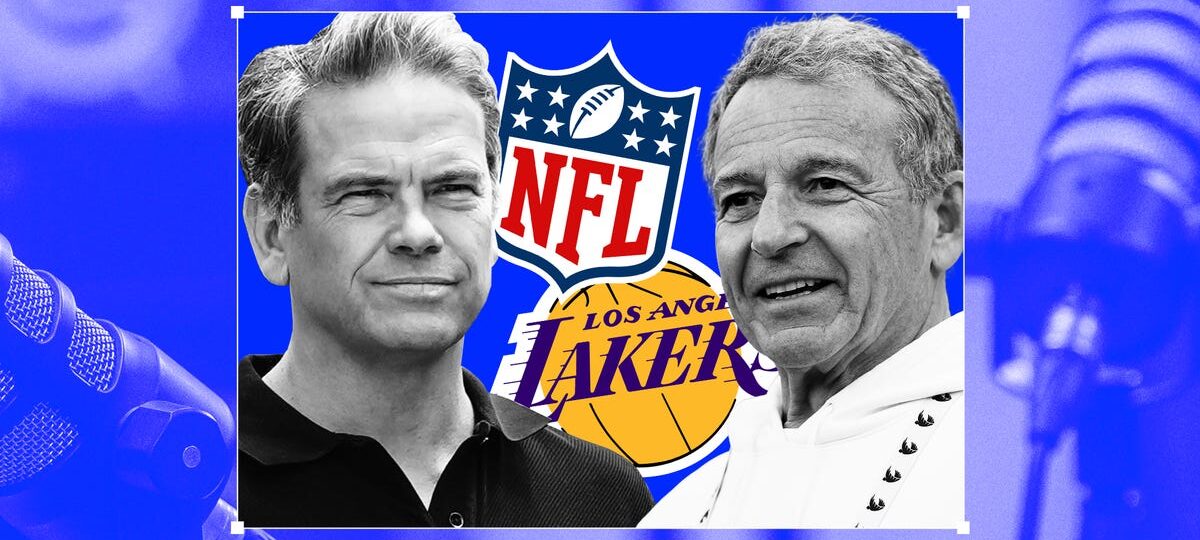
Bob Iger and Josh Kushner plan to buy the Los Angeles Lakers at a record-setting price of $12.5 billion.
The best argument for that price: The value of sports TV deals is the one thing that keeps going up, even as the rest of TV contracts.
But even though that’s been true for years, it doesn’t mean it will always be true.
One hint that things might be changing: The all-powerful NFL — the thing that keeps TV afloat — is starting to see some pushback from its TV partners, led by Rupert and Lachlan Murdoch’s Fox.
In 2026, it is very hard to imagine a world where the NFL isn’t the most powerful force in media.
But John Ourand, who covers sports media for Puck, makes a case that its power could at least be checked in the years to come.
You can listen to our entire conversation, which also includes a look at Apple’s sports strategy, and the WNBA’s approach to media deals, on my Channels podcast.
The following is an edited excerpt of our chat: Peter Kafka: If Bob Iger and Josh Kushner are buying the Lakers at a $12.5 billion valuation, that means they think it will be worth even more in the future.
John Ourand: In the past, all the valuations of [pro sports] teams were heavily weighted by the fact that media rights deals keep going up by 10%, 20% per year.
But media executives I talk to say, “If they’re basing [the Lakers] valuation on future media rights deals, that’s a mistake.” The Lakers make $200 million a year from their local rights.
And the NBA just got a new deal (for national rights) that pays $7.6 billion a year.
Their point is those numbers aren’t going to go up anytime soon?
They’re saying, “The NFL will get more money.
They’re not seeing nearly as much money coming from streaming.
So the media companies are saying, you know, “We could be at the apex of it.” But when you talk to bankers and PE folks — this won’t surprise you — they say, “No, it’s still going to keep going up.” This is the question people have been debating for years — how much longer can sports rights go up, when everything else in TV is contracting?
It is still mainly an advertising play.
Sports is the last bastion of people watching live.
It’s been that case for a while, and it’s the reason that broadcast networks and even cable networks are still profitable right now.
So the bull case for sports rights continuing to move forward is … maybe the broadcast networks don’t stay healthy, but they still exist.
We’re seeing another version of this debate right now with the NFL, where Fox CEO Lachlan Murdoch recently made news by saying he’s not currently negotiating a new deal with the league.
As of a few months ago, most people in the media world thought the networks were going to renegotiate their existing deals with the league and pay more per year, for more years, so they could keep the NFL locked up.
What Lachlan finally said was, “You know what?
We’re gonna see this through to the end.
So we can negotiate now, but we’re not opening our deal up early.
It’s gonna run through to the end of the decade.” That seems like a pretty reasonable stance, but it’s being treated like a bombshell.
Is the NFL’s grip on media rights weakening?
There were some early numbers of, like, an [rights fees that would cost an] extra billion per year per network that were floated.
That number would put some of the networks out of business.
1, and none of the networks want to live without the NFL.
But one thing that’s interesting is that the NFL is talking to Paramount/CBS about their deal because of the change of control.
So let’s say the NFL says, “OK, you know what?
This package is open for bidding.” And it’s a package of Sunday afternoon games with up to six games each afternoon.
Who’s stepping up for that package?
There aren’t a lot of other networks.
Every single broadcast network has a package, and there’s nobody else that’s bidding it up.
And even as powerful as the NFL is, that’s a problem.
You need more than one bidder for the price to go up.
They have just enough bidders for just enough packages.
And I think right now we’re seeing where the limits of that power lie a little bit.
The NFL is still going to get what it needs to get.
It just isn’t going to get its reach goal, I think.
After the NFL did $110 billion in TV deals in 2021, the networks were crying poor.
But then they paid the NBA $76 billion.
And the NFL said: “Wait, I thought you were crying poor?” And then they see that Fox finds like a couple quarters in the cushion to buy Roku.
So they’re like, “Wait: How can you be crying poor on one hand, and then, then on the other hand, you do have this money?” So the NFL wants to test those limits.
Discover more from NAIRAVOICE.COM.NG
Subscribe to get the latest posts sent to your email.