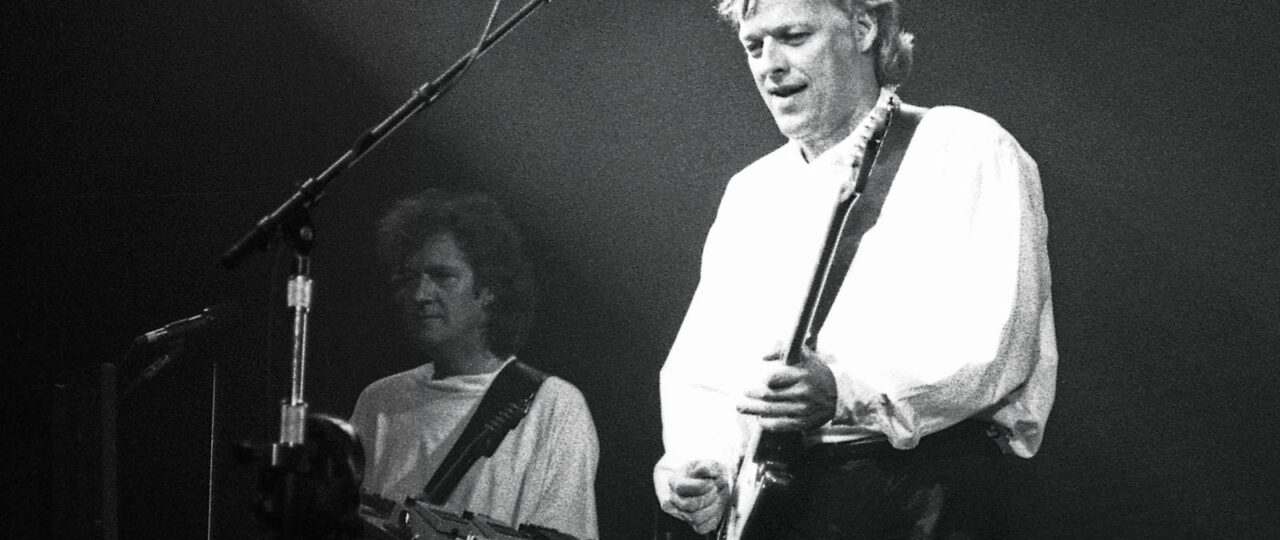
Pink Floyd is one of the most innovative bands to emerge from London’s music scene in the late 1960s. The group formed in 1965 with Syd Barrett on guitar and vocals. Roger Waters on bass and vocals, Richard Wright on keyboards and vocals, and Nick Mason on drums. Iconic guitarist David Gilmour joined the band in 1967, as Barrett’s mental health deteriorated, eventually leading to his departure later that year. The London quartet stood out amid the musical experimentation and creative freedom of the late 60s, gaining an underground following as one of Britain’s premiere psychedelic rock groups. They dazzled audiences with elaborate live performances featuring extended improvisation, psychedelic visuals, and exceptional musicianship.
One of the most commercially successful bands of its era, Pink Floyd has sold over 250 million albums worldwide. Their landmark albums The Dark Side of the Moon and The Wall were inducted into the Grammy Hall of Fame and the band was inducted into the Rock and Roll Hall of Fame in 1996. Pink Floyd scored four number one albums and released many memorable songs including “See Emily Play,” “Money,” “Another Brick in the Wall (Part 2),” “On the Turning Away,” and “High Hopes.” Despite a handful of major hits, Pink Floyd was primarily an album-oriented progressive rock band. The group used instrumental compositions as vehicles for experimentation and improvisation, as well as to develop and connect musical themes throughout their concept records. Across 15 studio albums, Pink Floyd recorded dozens of predominantly instrumental compositions, ranging from movie soundtracks to psychedelic improvisations to experimental rock epics. Excluding vocal-led compositions, such as the ubiquitous “The Great Gig in the Sky,” but allowing brief chants, spoken passages, and unconventional vocal effects, here are Pink Floyd’s 10 greatest instrumental tracks, ranked.
10
“Mudmen”
‘Obscured By Clouds’ (1972)
“Mudmen” is a captivating instrumental from Pink Floyd’s 1972 album Obscured by Clouds, the soundtrack to Barbet Schroeder‘s French film La Vallée. The four-minute composition was written by David Gilmour and Richard Wright and begins with delicate keyboards before unfolding into a series of soaring blues guitar leads. Gilmour’s expressive string bends and sustained notes float over Wright’s lush piano and organ sounds, creating a dramatic contrast between peaceful reflection and emotional intensity. “Mudmen” features a repetitive and hypnotic arrangement allowing the keyboards and guitar melodies to shine through one of Pink Floyd’s more underappreciated gems.
9
“It’s What We Do”
‘The Endless River’ (2014)
“It’s What We Do” is a hypnotic six-minute instrumental from Pink Floyd’s 2014 farewell compilation The Endless River. Built around the late Richard Wright’s atmospheric synthesizers, David Gilmour’s soaring guitar melodies, and Nick Mason’s understated drumming, the composition recalls the dreamy, expansive sound of “Shine on Your Crazy Diamond.” The track originated from recordings made during the sessions for 1994’s The Division Bell and showcases the band’s musical chemistry and penchant for improvisation. The spacious and simple arrangement, along with its melancholy atmosphere and mesmerizing groove create an incredible mood. “It’s What We Do,” serves as both a nostalgic return to Pink Floyd’s progressive and psychedelic rock roots and a fitting tribute to Wright, who died in 2008.
8
“Terminal Frost”
‘A Momentary Lapse of Reason’ (1987)
“Terminal Frost” is an icy instrumental from Pink Floyd’s 1987 album A Momentary Lapse of Reason, the band’s first studio release following Roger Waters’ departure. David Gilmour’s six-minute composition combines his soaring, blues-influenced guitar work with layered synthesizers and melodic saxophone solos performed by Tom Scott and Supertramp‘s John Helliwell. The polished ’80s production, spacious arrangement and smooth jazz vibe distinguish it from the band’s more experimental and progressive recordings. Gilmour’s celestial guitar tones and the saxophone’s fluid melodies intertwine over shimmering keyboards, creating a cinematic soundscape that makes “Terminal Frost” one of the most compelling and overlooked instrumentals.
7
“Obscured By Clouds”
‘Obscured By Clouds’ (1972)
“Obscured By Clouds” is an immersive and mesmerizing instrumental that opens Pink Floyd’s 1972 album of the same name, which served as the soundtrack to Barbet Schroeder’s French film La Vallée. The three-minute composition emerges from the ether with a haze of oscillating synthesizers that sound way ahead of its time. The song builds into a steady, driving groove with Richard Wright’s swirling electronic textures, Nick Mason’s rhythmic drumming and Gilmour’s distorted pedal steel guitar tone, creating a mysterious atmosphere. “Obscured by Clouds” highlights the band’s growing fascination with synthesizers and electronic experimentation before transitioning into the guitar-driven “When You’re In,” another powerful instrumental that completes an epic opening sequence to the classic album.
6
“When You’re In”
‘Obscured By Clouds’ (1972)
“When You’re In” is a hard-driving instrumental that follows “Obscured by Clouds” on the band’s 1972 album of the same name. The brief track launches into a thunderous groove powered by David Gilmour’s gritty guitar riff, Roger Waters’ pulsating bass and Nick Mason’s pounding drums. The heavy-riff focused composition has a bluesy, hard-rock edge reminiscent of The Allman Brothers Band, revealing a heavier, more straightforward side of Pink Floyd. It demonstrates that the band could deliver a powerful instrumental without relying on sprawling arrangements or lengthy solos.
5
“Careful With That Axe, Eugene”
‘Relics’ (1971)
“Careful With That Axe, Eugene” is one of Pink Floyd’s most unsettling instrumentals, originally released as the B-side of the band’s 1968 single “Point Me at the Sky.” The composition builds slowly around Roger Waters’ hypnotic bass line, Richard Wright’s eerie organ, Nick Mason’s percussion and David Gilmour’s atmospheric guitar. The minimalist arrangement creates an ominous sense of dread and anticipation before erupting into a chaotic burst of sound, triggered by Water’s piercing scream. “Careful with That Axe, Eugene” became a centerpiece of Pink Floyd’s early concerts, with an extended version appearing on 1969’s Ummagumma and a memorable performance featured in the concert film Pink Floyd: Live at Pompeii. The band released the studio version on the 1971 compilation LP Relics. Its dramatic contrasts, haunting atmosphere and explosive climax make this one of the band’s most transcendent recordings.
4
“Interstellar Overdrive”
‘The Piper at the Gates of Dawn’ (1967)
“Interstellar Overdrive” is the groundbreaking psychedelic instrumental from Pink Floyd’s 1967 debut album, The Piper at the Gates of Dawn. The nearly ten-minute composition opens with Syd Barrett’s heavy, descending guitar riff before launching into a sprawling, free-form improvisation. The unpredictable track highlights Barrett’s distorted guitar work, Richard Wright’s swirling organ, Roger Waters’ pulsating bass, and NIck Mason’s drumming, which culminates in a chaotic explosion of dissonance, unusual rhythms and bizarre sounds. “Interstellar Overdrive” remains one of the band’s most adventurous recordings and captures the experimental spirit that fueled London’s psychedelic underground scene in the late 60s.
3
“Marooned”
‘The Division Bell’ (1994)
“Marooned” is a haunting instrumental from Pink Floyd’s 1994 effort The Division Bell. The composition highlights the improvisational interplay between guitarist David Gilmour and keyboardist Richard Wright. It unfolds through shimmering synthesizers and soaring guitar melodies with a somber atmosphere and spacious arrangement. Gilmour uses a DigiTech Whammy pedal to create dramatic pitch-shifting effects, making his guitar mimic a human voice. “Marooned” earned the band its only Grammy Award for Best Rock Instrumental Performance in 1995. The combination of Gilmour’s soulful guitar playing and Wright’s lush keyboard sounds makes “Marooned” a memorable instrumental and a standout moment on The Division Bell.
2
“Any Colour You Like”
‘Dark Side of the Moon’ (1973)
While Pink Floyd’s 1973 album The Dark Side of the Moon has three different instrumentals, “Any Colour You Like” stands out as a hypnotic composition that effectively serves as a musical interlude. Positioned between “Us and Them” and “Brain Damage,” the track provides a psychedelic passage driven by Richard Wright’s swirling synthesizers, David Gilmour’s intense guitar work, and a laid-back rhythm section. The song gradually unfolds into a mesmerizing tapestry of electronic textures, shimmering guitar effects, and bluesy improvisation. “Any Colour You Like” offers a brief musical escape before the album’s haunting conclusion.
1
“One of These Days”
‘Meddle’ (1971)
“One of These Days,” is a thunderous instrumental that opens Pink Floyd’s 1971 album Meddle. The nearly six-minute composition is built around a hypnotic and pulsating bass riff, played on two different basses by Roger Waters and David Gilmour, with one processed through a Binson Echorec delay unit. Richard Wright’s swirling keyboards, Nick Mason’s powerful drumming and Gilmour’s slide guitar work create a fierce and energetic atmosphere that builds toward an explosive climax.
Based on your personality, energy, and taste, the classic rock band that matches your soul is…
You are pure, undiluted rock energy. You don’t need tricks, trends, or theatrical gimmicks — you have something more powerful: a riff that hits like a thunderbolt and an attitude that never wavers. Like AC/DC, you understand that simplicity executed with absolute conviction is its own form of genius. You’re the person in the room who doesn’t overthink it, doesn’t pretend, and never turns the volume down. The highway to hell is a state of mind — and you’ve been on it since day one.
You’ve got swagger that can’t be taught. Rooted in the blues and soaked in street-level attitude, you move through life with a loose, dangerous elegance that draws people in without ever trying too hard. Like the Stones, you’ve seen it all, done most of it, and somehow look better for it. You’re not chasing perfection — you’re chasing truth, groove, and that electric moment when everything clicks. Can’t always get what you want? You tend to get it anyway.
You go hard or you go home — and you almost always go hard. Intense, dedicated, and fiercely loyal to what you believe in, you don’t do anything halfway. Like Metallica, your passion runs deeper than most people’s will ever go, and when you care about something, it shows in every detail. You’re drawn to darkness not because you’re cynical, but because you’re honest — and honest people know the world isn’t always pretty. Enter Sandman. Nothing else matters. That’s your philosophy.
You are magnificent, and you know it — not from arrogance, but from an unshakeable sense of self that has never needed anyone’s permission. Like Queen, you defy every category people try to place you in. You blend the epic with the intimate, the operatic with the anthemic, the serious with the playful. You live boldly, love fiercely, and perform every aspect of your life as though the whole world is watching. Because sometimes it is. We are the champions — and so are you.
You have the rarest of gifts: the ability to make something that feels both deeply personal and universally human. Like The Beatles, you’re a natural connector — someone whose warmth, curiosity, and creative instincts draw people together across every divide. You believe in melody, in craftsmanship, and in the quiet power of a song that says exactly what someone needed to hear. You’ve changed the people around you just by being who you are. All you need is love — and you give it generously.
Who’s Your Perfect Classic Rock Band?
The song features a single spoken line delivered by Mason through electronic processing: “One of these days, I’m gonna cut you into little pieces.” The ominous threat arrives as the song peaks with its experimental production, driving rhythms and aggressive guitar work. “One of These Days” is Pink Floyd’s greatest instrumental and helped establish the progressive rock sound Pink Floyd would develop throughout the 1970s.
Discover more from NAIRAVOICE.COM.NG
Subscribe to get the latest posts sent to your email.