...NASS verifies approval by 28 states
…Presidency tasks OPS to develop financing framework
..Constitution amendment must protect IGP, CPs from abuse — Okiro
By Clifford Ndujihe & Gift Odekina
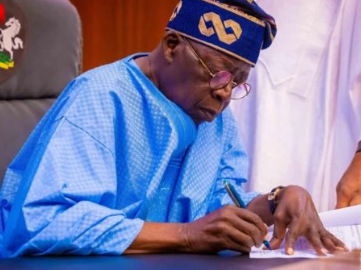
LAGOS — After months of legislative action, the National Assembly is set to transmit the State Police Bill to President Bola Tinubu for assent.
Vanguard gathered yesterday that the federal lawmakers will transmit the bill between now and next week.
At the last count, no fewer than 30 of the 36 states houses of assembly in the country had approved the bill, which exceeds the constitutionally-required threshold of 24 states, representing two-thirds of the 36 state legislatures, paving the way for transmission of the bill to President Tinubu for assent.
Clerk to the National Assembly, Kamoru Ogunlana, disclosed yesterday that NASS had received reports from 28 state legislatures and verified their respective votes and proceedings.
According to him, the Constitution of the Federal Republic of Nigeria, 1999 (Sixth Alteration) Bill, which seeks to provide for the establishment of State Police Services and related matters, was transmitted to the 36 State Houses of Assembly on September 16, 2026, for consideration and approval.
The state legislatures were initially given 30 days, ending October 15, to communicate their decisions to the National Assembly.
However, Ogunlana said his office will continue to receive reports from the state houses of assembly until the bill is transmitted for presidential assent.
He said: “Following receipt and verification of the reports, the office confirms that 28 State Houses of Assembly have approved the Bill.
“This represents more than the constitutionally-prescribed threshold of not less than two-thirds of the 36 State Houses of Assembly, equivalent to 24 states, as required under Section 9 of the Constitution of the Federal Republic of Nigeria, 1999.”
The clerk explained that the National Assembly had undertaken administrative verification of the reports and accompanying votes and proceedings to establish their authenticity and ensure they accurately reflected decisions taken by the respective state legislatures.
He also clarified that Section 9 of the Constitution did not expressly prescribe a Third Reading for a Constitution Alteration Bill, unlike the procedure applicable to ordinary bills.
Presidency tasks OPS to develop financing framework
Last week, the Presidency, which also raised a committee headed by Chief of Staff to the President, Femi Gbajabiamila, requested the Organised Private Sector, OPS, to develop a financing and implementation blueprint for the proposed State Police system.
It said businesses have compelling reasons to support the reform because insecurity imposed costs beyond private security expenditure, including abandoned investments, delayed expansion and disrupted commercial activities.
During a plenary session on “security, stability and economic resilience” at the 32nd Nigerian Economic Summit in Abuja, Gbajabiamila said insecurity is driving away investments, disrupting supply chains, delaying factory expansions and undermining employment opportunities.
He urged business leaders to engage governors and legislators, contribute expertise in institutional management, expenditure control and risk assessment, and identify security failures preventing viable investments.
28 states that have okayed state police
The 28 states that have approved the proposed establishment of state police are Adamawa, Delta, Edo, Kwara, Ogun, Osun, Oyo, Plateau, Rivers Taraba, Zamfara, Imo, Ekiti, Kebbi, Akwa Ibom, Bayelsa, Enugu, Anambra, Benue, Cross River, Abia, Yobe, Kaduna, Lagos, Kano, Sokoto, and Ebonyi
Constitution amendment must protect IGP, CPs from abuse — Okiro
Meanwhile, former Inspector-General of Police and one-time Chairman of the Police Service Commission, Sir Mike Okiro, has offered suggestions on safeguards against possible abuse of state police by state governors.
With the backing of more than 30 state legislatures, if the amendment receives presidential assent, the dual police structure will come into effect.
Okiro said from then on, state governments will have to fund police forces in their states, stressing that they had, afterall, been supporting the Nigeria Police Force all these years.
Okiro said: “As a Commissioner of Police in Lagos and Benue states, and later as the IGP, I can attest to the operational and funding support given to the Police by state governments. A number of them purchase patrol vehicles for most of the state, area commands and divisions in their respective states. “Some, like Lagos, have set up State Security Trust Funds for this purpose. So, I have no doubt in my mind that they will do this effectively.
“Lagos State, which established Operation Sweep 30 years ago, has demonstrated that it is possible. It has the Lagos State Security Trust Fund, a state-of-the-art surveillance system, as well as a world-class Forensic Analysis Centre.
“For over 30 years, Lagos has been equipping Operation Sweep, which morphed into the Rapid Response Squad, RRS, with modern vehicles and communication equipment. It even has drones and, I think, a helicopter for policing. So, the state is ready.
“Similarly, Enugu State also has a state-of-the-art Command and Control Centre, known as the Enugu State Digital Surveillance Control Centre, for effective surveillance of the state. The sophisticated security infrastructure, which comes with facilities for DNA analysis, is aimed at promoting scientific, evidence-based justice and the war against crime.”
Okiro noted that security is essential to all aspects of development, and is “the pivot around which all aspects of development, social, educational and economic, revolve. No investor will invest resources in an unsafe state, and that makes security very crucial.
“Besides, Chapter Two of the Nigerian Constitution says that the security and welfare of the people shall be the primary purpose of government. That makes it incumbent on federal and state governments to ensure this to the letter.
“I agree that some governors are grappling with the regular payment of salaries to teachers and nurses. I know state police will be one of the essential services in any state. If a governor cannot pay teachers, he must still pay the police. Should a governor face difficulties, the Federal Government can step in to help with salaries and other obligations.
“The fact is that many governors have been providing operational vehicles to the police for many decades. These governors also have security votes, and federal allocations to states have been on the rise for some time now. So, I think we can be hopeful because the decentralisation of policing will enhance the security and welfare of the people, the major reasons for the existence of government.”
On how the issue of training can be addressed, he said: “The current police force has its curriculum at the police colleges, Police Academy and specialised training institutions across the country. Since this dual structure will come into effect, the course content can be harmonised. Besides, that means each state has to set up its police colleges while retaining the existing course curriculum.
“There is no doubt that Nigeria is under-policed by all international standards, and with this decentralisation, the manpower requirement can be met in no time. Nigeria has many qualified but unemployed school certificate holders, National Diploma and degree holders in such areas as Criminology, Sociology, Psychology and Law who can be absorbed into the respective state police forces.
“More importantly, Nigeria has thousands of qualified lecturers, including retired police officers, who are ready to teach at, and manage these proposed police colleges. Interestingly, under the amendment, the State Police Council will formulate policing policies in their respective states, manage recruitment and training of new intakes, and ensure accountability to the people.”
On how abuse by state governments, especially during elections, should be addressed, he said: “Provisions should be made in the law to ensure that the offices of the Inspector-General of Police and Commissioners of Police are insulated from abuse.
My recommendations on tenure, by Okiro
”I had recommended that the office of the IGP be tenured, which is now contained in the Police Act Amendment 2024. The amendment empowers the IGP to complete his four-year term, instead of the previous civil service requirement of retiring at the age of 60 or after 35 years in service.
“In that regard, the IGP cannot be removed from office except for reasons of misconduct or gross violation of the Constitution. That should be extended to Commissioners of Police. Their removal should be approved by a two-thirds majority of the Senate or the State House of Assembly for the IGP and CPs, respectively.
“As contained in the amendment, the State Police Council should have direct oversight, while the Commissioner of Police, who will be appointed by the governor, will be the secretary of the council. He will serve a single term of four years.
“Here lies the fear of abuse by state governors, as was the case during the First Republic, when regional premiers used the police against the opposition. But there must be safeguards in this case. Governors could become so powerful that they exploit their positions.
”There should be checks and balances to make it impossible for a governor to have 100 per cent control. This is a federation, and no governor should be able to take actions detrimental to other states. If such actions occur, there must be clear consequences written into the law.
“The legislation clearly bars governors from deploying state police for partisan, ethnic, religious, sectional or personal purposes. It stipulates that the President and governors may issue only lawful, general policy directions in writing and prohibits any directive targeting named persons, political parties or groups, or requiring violations of rights.
“Of course, there are also tight restrictions on the deployment and removal of police chiefs to prevent abuse. This is in addition to the Complaints Response Unit in each state, which will handle complaints against the police. This is also a check. All these fears are anticipated and addressed in the bill.
“Interestingly, the National Assembly will prescribe national minimum standards for recruitment, training, vetting, promotions, discipline, use of force, firearms, complaints procedures, accountability, data management and professional conduct. States may set higher standards but cannot go below the federal baseline.”
Discover more from NAIRAVOICE.COM.NG
Subscribe to get the latest posts sent to your email.