
- Route 66 is one of the US’s most iconic highways, connecting Chicago to Santa Monica, California.
- However, when Interstate I-40 was built, many towns along Route 66 were forgotten.
- For Route 66’s 100th birthday, I drove part of it. Its ghost towns stayed with me the most.
Along the way, I met people who’ve kept the road’s legacy alive and their businesses afloat.
However, for every store that has survived, I was surprised to see even more motels, gas stations, and restaurants boarded up.
They stood as phantoms of a forgotten era. Their neon signs went dark long ago.
One of Route 66’s most famous ghost towns: Glenrio.
The moment you exit the highway, a shattered Chevron station, lost to graffiti, greets you. It’s the first sign of what once was here.
The town was never huge, peaking at 100 people.
Beginning in the early 1900s, it was a robust railroad community, with multiple grocery stores, a post office, and service stations.
Today, abandoned buildings dot the town.
The only sign of life was a man sitting in his truck at the abandoned gas pump, watching what I could only assume were very funny YouTube videos.
Crossing over the interstate, we arrived at the main stretch of Route 66 through Glenrio.
This was once a bustling corridor along the state line. Texas had lower gas prices than New Mexico, so stations were built on the Lone Star side of the border.
Joseph Brownlee opened this Texaco in 1950.
What’s left of it is overwhelmed in eerie silence. The former Texaco and the 1969 Pontiac Catalina out front sit unmoving, riddled with rust.
Brownlee’s daughter is the only remaining resident of Glenrio. Her husband was killed during a robbery while working in the neighboring town. That’s the 1969 Pontiac Catalina that he drove to work every day.
Brownlee also opened up the Brownlee Diner next door in 1952, serving burgers, fries, and milkshakes.
I could only imagine how cozy the chrome details and the small footprint of the diner would’ve felt after a long drive in the 1950s.
After a short stint as an antique and oddities shop, the diner permanently closed in the 1970s.
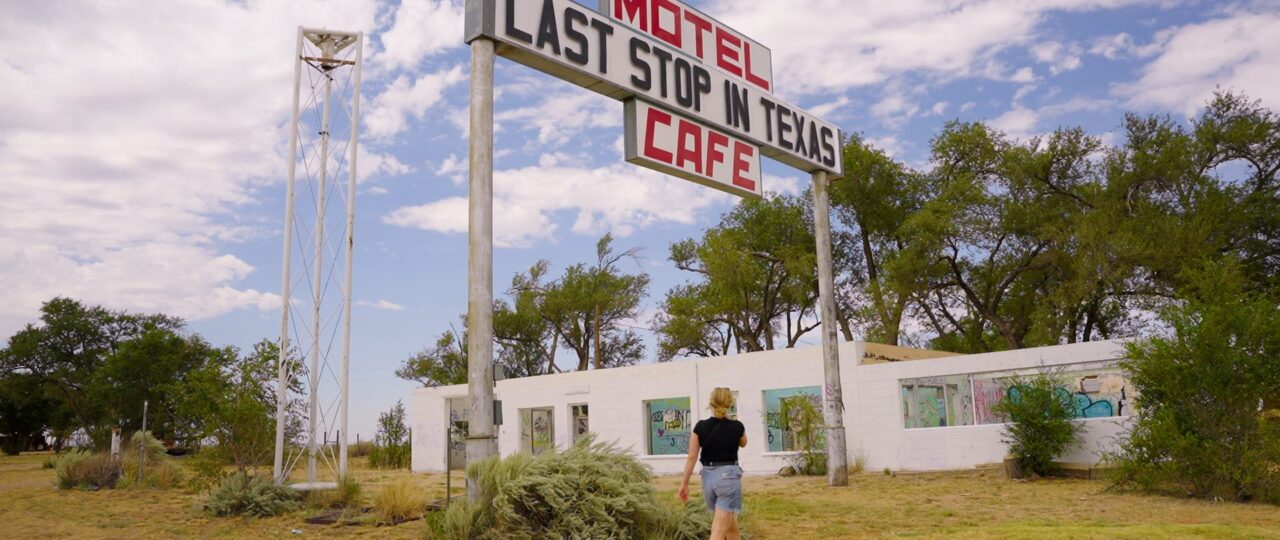
Right next door is what’s left of the State Line motel, opened in 1955.
On one side, it reads “Last Stop in Texas.” The verbiage added to the ominous feeling lingering in this place.
On the other side, the sign says “First Stop in Texas.”
Texas had many dry counties at the time, but this part of New Mexico allowed alcohol. So the motels and bars were cleverly built on the New Mexico side of the border, and loads of folks came here to drink.
The abandoned motel has become a canvas for artists.
Nature was also overtaking the space.
Could a smoke shop save this town?
The only thing left standing in this town is a new smoke shop that opened in 2023.
The lively energy and the presence of people were disorienting after wandering the ghost town.
I asked Harrah, the shop’s general manager, what it’s like to work in a town that essentially doesn’t exist.
“Time doesn’t exist either here. Texas is in Central, and New Mexico is in Mountain [time]. So it’s an hour difference depending on where you are. And then it’s exit zero. So it’s really just its own entity, its own energy, its own everything,” she said.
Abandoned businesses dot Route 66 through Texas and New Mexico.
The construction of the interstate hurt the economies of the other towns along this section of the old road, too.
This old Shell station in Vega, Texas, lay in ruins.
This station in Adrian, Texas, dates back to 1948.
The pumps are likely around 75 years old.
It soon became known as the Bent Door Cafe because it was constructed from a former WWII air strip control tower.
Tucumcari, New Mexico’s rundown motels were the saddest of all.
When we finally arrived in Tucumcari, New Mexico, where we planned to stay the night, I thought the haunting, empty buildings along Route 66 were behind us. Tucumcari is, I figured, a much bigger town.
But I was wrong.
So many neon lights were dark here.
Motel after motel was overgrown with weeds, their pools long drained.
But unlike Glenrio, there are actually people left living in Tucumcari who’ve had to witness the change.
We met a lifetime resident who cruises Route 66 in his old car to reminisce.
At night, we were filming one of the town’s last neon signs when a beautiful blue car drove by.
We flagged him down and met Rocky Chavez, a lifetime resident of Tucumcari. I joined him in his 1966 Chevy Impala, cruising down Route 66. Over the roar of his engine, he told me all about how the town used to be.
“Back in the heyday, this whole town was nothing but neon lights. It was so beautiful, every business was open. We had 2,000 motel rooms. We had 36 gas stations. We had like 32 restaurants,” he said.
As we drove, he pointed out where old tire shops, theatres, steakhouses, drug stores, and banks had once glowed. They’re all rundown lots now.
“There were almost 20,000 people at one time here. We had the railroad, the trucking companies, Levi Strauss used to be here,” Chavez said. “Driving down this boulevard when I grew up here was so full of life. Now, you pass, and all the buildings are boarded up. There’s nothing left.”
On one hand, there’s beauty in these buildings lost long ago.
The mere fact that they’re still standing in any form means they haven’t been forgotten.
They can’t be. They’re forceful reminders of this route through American history. And as I drove down Route 66, it felt like I was driving through a living museum.
But on the other hand, they tug at my heart.
I can’t help but think about the family who spent their lives keeping these businesses open, only for them to fall into disrepair.
What would they think now? Would they, like Chavez, be quiet, lost in thought, as they speed by what little is left? Maybe in that way, they’re cruel reminders of what was and likely will never be again.
I found hope in the businesses that have lived to see the 100th anniversary.
While those rusted-out hot rods and boarded-up buildings still haunt me, I have settled on a semblance of optimism as I think back on this road trip.
We came across so many people who are still fighting to keep this stretch of cement alive. And to each person I asked, “Why should people care about Route 66?”
One woman told me, “People think it’s just a road, but it’s not. It’s the path to people.
And the more I drove, the more I realized she was right.
Soon, the dilapidated motels were replaced in my memory by the Chicago couple who run the coral-colored Blue Swallow Motel.
Rob Federico and his wife, Dawn, drove down Route 66 until they ran out of gas in Tucumcari. They bought the motorcourt in 2020. They welcomed me with open arms and a killer cup of coffee.
In the end, it was less about the ghost gas station in Tucumcari and more about Chavez, who’d picked up a weary journalist and given her the cruise of a lifetime.
Read the original article on Business Insider
Discover more from NAIRAVOICE.COM.NG
Subscribe to get the latest posts sent to your email.