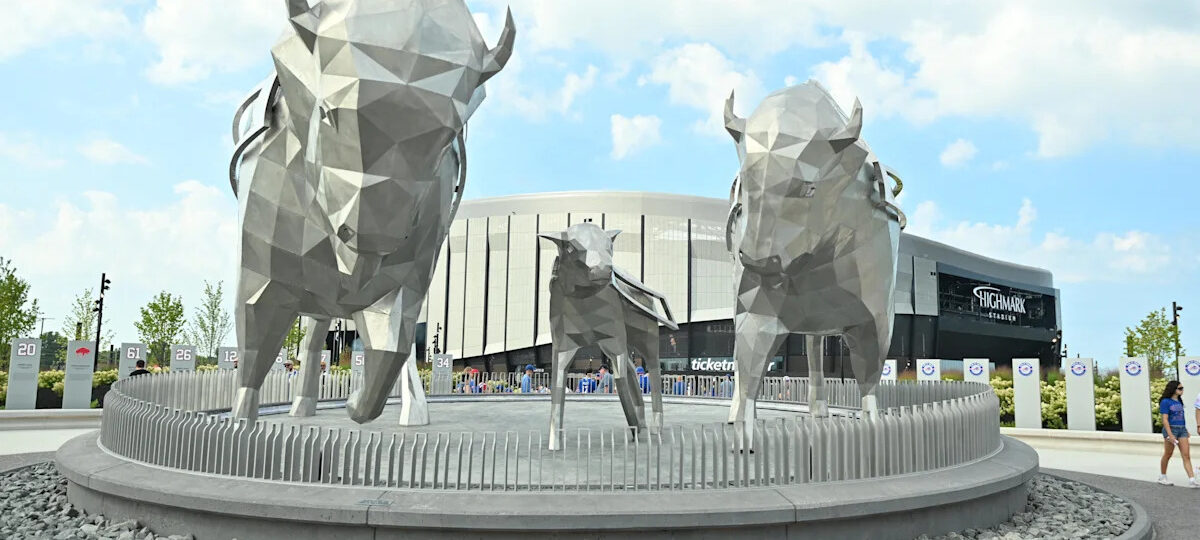
ORCHARD PARK, NY — For the first time in six years, an NFL team will move into a new football palace, the 2026 Buffalo Bills set to cross the street and officially open their new Highmark Stadium to kick off Week 2 of the regular season.
With a fixed seating capacity of 60,108, Highmark becomes the league’s smallest venue. But that’s completely by design. The standing-room only crowd can increase the headcount by roughly 6,000 for a place built to be intimate. And, despite some seemingly overblown criticism about some of the obstructed-view seats that were spotlit for the Bills’ first practice in the building earlier this month, players and most fans seem to love their new surroundings.
They include gorgeous views of the field from the concourses (like a baseball stadium interior); a roof that will shield most of the crowed from lake-effect weather during winter; many design homages to Bills Mafia and creature comforts the players simply didn’t have at the old Ralph Wilson Stadium (also known as Highmark Stadium before it closed following the 2025 campaign) – chief among them a grass playing surface.
“It’s so nice,” Bills general manager Brandon Beane recently told USA TODAY Sports. “There’s some really nice stadiums, I don’t think I’ve walked into one nicer. It’s very intentional about things.
“The players are very excited about it.”
Yet many players around the league will soon be sharing the Bills’ enthusiasm for new digs. The Titans will christen a new building next season. The Browns, Broncos, Chiefs and Commanders should all be in new, state-of-the-art environs by the end of the decade or shortly thereafter, while other clubs are in the process of seriously upgrading their current homes. (As for the Bears … who knows?)
But the 2026 season marks the outset of what should be another transformational phase for NFL football. Yet, with the regular season almost here, it’s also a good time to assess the current fields and stadiums as you plan your next football road trips – even at a time when this list is about to undergo some dynamic changes. So, while giving Highmark Stadium a grace period to settle in, we’ve ranked the other 29 regularly used stadiums (two of them shared by a pair of teams) as we head into the upcoming campaign:
One of the league’s most raucous and loud venues, the sound reverberating off the cantilevered roof back down to the field, it also offers spectacular views of downtown Seattle and its gorgeous surroundings. And though the roof covers about 70% of the spectators, players still have to perform in the region’s rainy environs – and if the home team does so to an elite level, it might even set off the Richter Scale. The interior shrine to Washington state high school football − also very cool. Hosting 2026 World Cup matches only added to Lumen Field’s reputation, while also bringing it $20 million worth of upgrades. Unrelated, it’s also a helluva place to see a concert – especially if, say, Pearl Jam’s Eddie Vedder shows up to front a song or two at a U2 show.
▶ Year opened: 2002
▶ Capacity: 68,740
▶ Surface: FieldTurf
▶ Seahawks’ record there: 140-68 (12-2 in playoffs)
▶ Super Bowls hosted: 0

No NFL team has called a building its home longer than the Pack, who moved into Lambeau in 1957. It’s about the closest thing the NFL has to a Fenway Park or Wrigley Field, combine decades of history with the amenities of a modern facility – Lambeau’s capacity nearly tripling from its original 32,000 while adding suites, massive video boards, the Lambeau Field Atrium and Packers Hall of Fame over the years. The heating pipes under the field have also made frozen tundra a thing of the past. And you can’t beat the tailgating, the food provided there or the ever-friendly fan base, some in the neighborhood surrounding the stadium offering their lawns as parking spaces. But you might wind up sitting on a metal bench once you get to your seat.
▶ Year opened: 1957
▶ Capacity: 81,041
▶ Surface: SISGrass
▶ Packers’ record there: 287-143-6 (18-7 in playoffs)
▶ Super Bowls hosted: 0
The aboveground portion of it is architecturally stunning, the futuristic, teardrop-shaped stadium and adjoining YouTube Theater covered by a translucent roof – it’s embedded LED system spouting graphics and messages to airplanes above – but open at the sides to embrace SoCal’s temperate climes. The double-sided Infinity Screen suspended above the field is the slickest video board west of Texas. Being situated in Inglewood and its nightmare traffic is suboptimal, though who wants to be in downtown L.A., either?
▶ Year opened: 2020
▶ Capacity: 71,500
▶ Surface: Artificial Turf (Hellas 44oz. Matrix System)
▶ Chargers’ record there: 26-24 (0-0 in playoffs)
▶ Rams’ record there: 35-19 (3-0 in playoffs)
▶ Super Bowls hosted: 1 (56/LVI, 2022)
▶ Future Super Bowl site: (61/LXI, 2027)
While playing in inclement weather should ideally be football law, if you’re going to take the game indoors – and we are talking about downtown Minneapolis and the sub-freezing and even sub-zero temperatures that often descend there late in the season – it doesn’t get much better than this. The partially translucent roof and façade allows spectators to see the elements without actually being subject to them. And the Norse ambience? From the crowd’s Skol chant, to the fake snow that falls from the rafters, to the Gjallarhorn suspended above the field that a special guest sounds before the game, to the pervasive feeling that you’re in a massive Viking longship or mead hall … you wonder how the locals ever put up with the Metrodome for so long.
▶ Year opened: 2016
▶ Capacity: 66,468
▶ Surface: Act Global Xtreme Turf
▶ Vikings’ record there: 53-30 (1-1 in playoffs)
▶ Super Bowls hosted: 1 (52/LII, 2018)
It still has that new-stadium smell and offers a cool – literally – spot to watch a game in the Sin City desert yet still offers a speed pass to the Strip, Mandalay Bay Resort & Casino not even a 15-minute walk away. You’ll eat well here and have a good view of the game – played on a grass surface that can roll outside the venue when not in use. But while the “Death Star” features the Al Davis Memorial Torch with the Vegas skyline as a backdrop, this doesn’t exactly feel like the intimidating Black Hole.
▶ Year opened: 2020
▶ Capacity: 65,000
▶ Surface: Natural Bermuda
▶ Raiders’ record there: 21-30 (0-0 in playoffs)
▶ Super Bowls hosted: 1 (58/LVIII, 2024)
▶ Future Super Bowl site: (63/LXIII, 2029)

Now one of the league’s older buildings − and its eldest dome − it’s been witness to quite a bit of NFL history by hosting a record eight Super Bowls. The Superdome has also been nicely renovated in recent years, though it can still be tricky to get around the interior in spots. This place gets loud, and it’s hard to find a more spirited and eclectic crowd than at a Saints home game − and that includes unique tailgating. And once the game’s over, the heart of the French Quarter is about a 20-minute walk away.
▶ Year opened: 1975
▶ Capacity: 73,000
▶ Surface: Turf Nation-M6
▶ Saints’ record there: 209-197 (8-6 in playoffs)
▶ Super Bowls hosted: 8 (12/XII, 1978; 15/XV, 1981; 20/XX, 1986; 24/XXIV, 1990; 31/XXXI, 1997; 36/XXXVI, 2002; 48/XLVII, 2013; 59/LIX, 2025)
The “Window to the City” is a glass wall beyond one end zone that frames downtown Atlanta. You might also see the sky … if the retractable roof’s signature oculus is working properly, though that’s not always the case. Architecturally, it does feel like you’re entering a giant, metallic birds nest. You’re not going to find more affordable food anywhere in the NFL, though Chick-fil-A isn’t open on Sunday here, either. As for the football product on the field? Meh, though fun to catch the highlights on the 360-degree HD Halo Screen.
▶ Year opened: 2017
▶ Capacity: 72,000 (expandable to 75,000)
▶ Surface: FieldTurf
▶ Falcons’ record there: 34-39 (0-0 in playoffs)
▶ Super Bowls hosted: 1 (53/LIII, 2019)
▶ Future Super Bowl site: (62/LXII, 2028)
The weather is likely to be terrible. The field is likely to be torn up. You’re likely to get whacked in the face by a Terrible Towel. Ain’t it grand? Take a riverboat to the North Shore. Sample the local cuisine. Enjoy the view of downtown Pittsburgh through Acrisure’s open end. Mingle with the (mostly very kind) Steelers fans. And let it all build before you get amped up for “Renegade” in the fourth quarter. When you get home, watch Bane blow up “Gotham City Stadium” in “The Dark Knight Rises” … and props to ex-Pittsburgh receiver Hines Ward for scoring through the shrapnel.
▶ Year opened: 2001
▶ Capacity: 68,400
▶ Surface: Natural grass
▶ Steelers’ record there: 149-66-2 (8-7 in playoffs)
▶ Super Bowls hosted: 0
Though it resembles a basketball fieldhouse from the outside, the Colts have yet to achieve a “Hoosiers” ending since moving into it. But it’s a great place to see a game – or watch the scouting combine – and tucked into downtown Indy, a place you can fall for in just a few visits. We’d like to see the north window wall and retractable roof opened more frequently.
▶ Year opened: 2008
▶ Capacity: 63,000
▶ Surface: Matrix Helix Turf
▶ Colts’ record there: 92-59 (4-1 in playoffs)
▶ Super Bowls hosted: 1 (46/XLVI, 2012)
It basically anchors a reimagined sports complex almost unrecognizable from its footprint from 40 years ago − and the stadium now provides shade … if you sit in the right spots. Come here and you can see Dolphins games, college games, elite tennis and even Formula One. And there are affordable family options − if you’re watching the Fins or ‘Canes anyway. Traffic in and out can be brutal. Also you’re in the heart of Miami Gardens … not Miami itself.
▶ Year opened: 1987
▶ Capacity: 65,585
▶ Surface: Grass
▶ Dolphins’ record there: 190-128 (5-3 in playoffs)
▶ Super Bowls hosted: 6 (23/XXIII, 1989; 29/XXIX, 1995; 33/XXXIII, 1999; 42/XLI, 2007; 44/XLIV, 2010; 54/LIV, 2020)
Though its lifespan is winding down, Arrowhead currently remains the AFC’s senior stadium – and the world’s loudest after the crowd reached 142.2 decibels in 2014, according to Guinness. The barbeque available in the vast parking lot makes the tailgating arguably rival Lambeau as the league’s best. And the raucous fans, noise and complete exposure to K.C.’s often brutal weather make this as tough a place as any for visiting teams to succeed. Should be interesting to see what the next Arrowhead is like when it opens across state lines in Kansas … with a roof on it.
▶ Year opened: 1972
▶ Capacity: 73,426
▶ Surface: Grass
▶ Chiefs’ record there: 271-172-1 (14-8 in playoffs)
▶ Super Bowls hosted: 0
Plenty of parking spaces in Arlington’s Entertainment District and stadium complex, though don’t expect the tailgating experience you’d find in Wisconsin or Kansas City. Once you get inside, enjoy the respite from Texas’ heat while consuming the fine dining options and checking the contemporary art the Jones family has curated inside. And when you get to your seat … you might have to rely on the massive (160 feet long and 72 feet wide) video board hanging 90 feet above the field if you feel too far removed from the action in this cavernous space or are struggling with the glare that comes through glass walls bracketing the end zones.
▶ Year opened: 2009
▶ Capacity: 80,000 (expandable to 100,000)
▶ Surface: SoftTop Matrix Turf
▶ Cowboys’ record there: 83-60-1 (3-3 in playoffs)
▶ Super Bowls hosted: 1 (45/XLV, 2011)
Low key, one of the better joints in the league – and the one that most resembles an old Ford automotive plant. The Lions’ resurgence in recent seasons has also put a spotlight on how fervent the Motor City fan base is. And once the final gun fires, you can walk right out the door into the heart of downtown Detroit’s best food and entertainment options.
▶ Year opened: 2002
▶ Capacity: 64,500
▶ Surface: FieldTurf
▶ Lions’ record there: 93-104 (2-1 in playoffs)
▶ Super Bowls hosted: 1 (40/XL, 2006)
Nestled near Baltimore’s beautiful Inner Harbor, “The Bank” also provides one of the league’s best game-day experiences – and it should really be something when the Ravens wear their new “Darkness” uniforms in prime time this season. And now that a half-billion dollar renovation has just been completed, fans can enjoy a unique open-air music stage inside the gates, expanded upper level hospitality space plus expanded and enhanced video boards. An even better space through which the CGI Ravens can fly after kickoff and to listen to fans break out chanting “Seven Nation Army.”
▶ Year opened: 1998
▶ Capacity: 70,765
▶ Surface: Grass
▶ Ravens’ record there: 161-76 (5-5 in playoffs)
▶ Super Bowls hosted: 0
This ain’t Pittsburgh, where you can feel fairly comfortable wearing an opposing team’s jersey – definitely think twice about doing that in Philly. Still, it’s not so bad that the Linc needs an on-site judge to deal with unruly fans the way predecessor Veterans Stadium did. And the overflowing passion, especially if you enjoy a strong tailgate, and aesthetically pleasing viewing experience will certainly give Philly fans who have never been here a rush. Extra credit is conferred given the long-standing commitment of this facility insofar as being as environmentally friendly as possible.
▶ Year opened: 2003
▶ Capacity: 69,879
▶ Surface: Natural grass
▶ Eagles’ record there: 123-77-1 (11-5 in playoffs)
▶ Super Bowls hosted: 0

How many yards have a 103-foot pirate ship – one that sets off its cannons to celebrate Bucs scores – beached above the end zone? Its the signature, dominant design aspect of this place, though there’s really not a bad seat to be had here, either. The grass playing surface is also first rate.
▶ Year opened: 1998
▶ Capacity: 65,844
▶ Surface: Grass
▶ Buccaneers’ record there: 123-109 (5-5 in playoffs)
▶ Super Bowls hosted: 3 (35/XXXV, 2001; 43/XLIII, 2009; 55/LV, 2021)
No pirate ship here. Instead? A 22-story lighthouse in the north end zone that’s the country’s tallest … if not functionally keeping ships (or New York Jets) from getting dashed against the Patriots’ coastline. Trying to kill some time before or after the game? Go shop or eat at adjacent Patriot Place. As for the football? Gillette has provided the Pats one of the league’s premier home-field advantages over the years, the elements dashing the playoff hopes of many aspirants to the AFC throne. But dress warmly. And budget enough time to sit in Foxborough traffic, which isn’t remotely close to Boston.
▶ Year opened: 2002
▶ Capacity: 64,628
▶ Surface: FieldTurf
▶ Patriots’ record there: 164-55 (21-4 in playoffs)
▶ Super Bowls hosted: 0
Ever wondered about its distinctive silhouette? Per its website, the silvery stadium is supposed to evoke a snake coiled around a barrel cactus … can’t say that about any other football forums. When the roof is closed to block out the desert heat, you will remain cool in the air-conditioned interior – though the grass field can live outside for most of the week while getting sunlight and water. Make a point of visiting the Pat Tillman Freedom Plaza if you visit.
▶ Year opened: 2006
▶ Capacity: 65,000 (expandable to 73,000+)
▶ Surface: Grass
▶ Cardinals’ record there: 85-78-2 (4-0 in playoffs)
▶ Super Bowls hosted: 3 (42/XLII, 2008; 49/XLIX; 2015; 57/LVII, 2023)
It’s no “mistake by the lake,” but the only home the Browns have known since their NFL return in 1999 has certainly seen its share of mistake-ridden football … but none in a postseason game. But, hey, if the weather gets too bad or the score gets out of hand, decamp and walk over to the Rock & Roll Hall of Fame. Or wait a few years until the Browns decamp to their new suburban palace.
▶ Year opened: 1999
▶ Capacity: 67,827
▶ Surface: Grass
▶ Browns’ record there: 89-127-1 (0-0 in playoffs)
▶ Super Bowls hosted: 0
Opened in 1924 and home to the Bears since ’71, it doesn’t provide much sense of either nostalgia or new-stadium modernity in its current incarnation. The league’s second-smallest venue in the country’s third-most populous city, Soldier Field lacks overall capacity and the inventory of suites and club settings that have become customary in contemporary stadia. The turf is also subpar, little surprise for a venue without a cover and subject to the region’s brutal winters. But at least it doesn’t take long to relocated to downtown Chicago … though the long-ish walk might be quicker than mass transit. Just won’t be the same in Hammond.
▶ Year opened: 1924
▶ Capacity: 61,500
▶ Surface: Bermuda Grass
▶ Bears’ record there: 251-192-2 (8-9 in playoffs)
▶ Super Bowls hosted: 0
Tucked between the Mile High City itself and the Rocky Mountains, you can’t beat the scenery. And playing at elevation in front of their typically full-throated fans have always been inherent home-field advantages for the Broncos. However, the stadium is far enough behind the times that the team’s ownership is focused on moving into a new one by 2013.
▶ Year opened: 2001
▶ Capacity: 76,125
▶ Surface: Kentucky Blue Grass
▶ Broncos’ record there: 135-79 (7-4 in playoffs)
▶ Super Bowls hosted: 0

Heading into its 25th season, it’s starting to seem a bit tired … though maybe it helps having the decrepit Astrodome across the way and/or having a roof that actually opens. It would also be nice if there was more going on outside the turnstiles. Heck, even the Texans are leaving soon − during the work week − to base themselves at the new mixed-use “Toro District” that’s in the works in the ‘burbs.
▶ Year opened: 2002
▶ Capacity: 71,995
▶ Surface: Artificial Turf (Hellas Matrix)
▶ Texans’ record there: 105-97-1 (6-2 in playoffs)
▶ Super Bowls hosted: 2 (38/XXXVIII, 2004; 51/LI, 2017)
Reliant North? It probably wouldn’t feel so antiseptic if it wasn’t rooted in the Jersey swamps, but New Yorkers didn’t want a downtown stadium. The city might seem close from your upper-deck seat, but it can feel a world away as you try to commute back across the Hudson River – or, worse, upstate. As for the building itself, it lacks character but is still a decent place to watch a game … as long as you’re not a player putting your limbs at risk on MetLife’s notorious turf.
▶ Year opened: 2010
▶ Capacity: 82,500
▶ Surface: FieldTurf CORE
▶ Giants’ record there: 59-73-1 (1-0 in playoffs)
▶ Jets’ record there: 59-73 (0-0 in playoffs)
▶ Super Bowls hosted: 1 (48/XLVIII, 2014)
It lacks distinctive architectural panache … unless you like erector sets. Being located nearly 50 miles from San Francisco doesn’t help. And frankly, it hasn’t provided much of a home-field advantage to the Niners over the years. But if you like a good rooftop garden and the Wi-Fi bandwidth to research next season’s crops, this is your football nirvana.
▶ Year opened: 2014
▶ Capacity: 68,500
▶ Surface: Natural Grass
▶ 49ers’ record there: 55-46 (6-0 in playoffs)
▶ Super Bowls hosted: 2 (50, 2016; LX, 2026)
Being integrated into uptown Charlotte is a plus … as are the panther statues guarding the entrances. Otherwise? This venue is currently in the midst of a years-long renovation that will cost more than a $1 billion. Put a pin in it.
▶ Year opened: 1996
▶ Capacity: 73,778
▶ Surface: FieldTurf Tri-co
▶ Panthers’ record there: 126-123 (5-3 in playoffs)
▶ Super Bowls hosted: 0
The league’s other 1995 expansion team is undergoing an even more radical transformation, its seating capacity reduced by about one-third for this season’s six home games before the Jags temporarily set up shop in Orlando in 2027. When they return, this should be a wildly different structure with huge steel trusses already being installed that will support a transparent canopy, which seems a lot more impressive than … swimming pools. Put a pin in it.
▶ Year opened: 1995
▶ Capacity: 67,838 (42,500 for the 2026 season)
▶ Surface: Grass
▶ Jaguars’ record there: 127-118 (4-2 in playoffs)
▶ Super Bowls hosted: 1 (39/XXXIX, 2005)
Meh. Sitting on the banks of the Ohio River, you might decide you’d rather be in Kentucky when wintry winds start whipping through. You might also find yourself doing your own snow removal after a storm or slowly navigating the interior amid a dearth of escalators. But, hey, no one said living in a Jungle would be easy.
▶ Year opened: 2000
▶ Capacity: 65,636
▶ Surface: FieldTurf CORE
▶ Bengals’ record there: 113-100-2 (2-4 in playoffs)
▶ Super Bowls hosted: 0
If you choose to vacate the options available in downtown Nashville for an aging football stadium, one needs to merely span the Cumberland River by walking over the the John Seigenthaler Pedestrian Bridge. If you’re a stadium snob who’d rather watch the Titans from a local watering hole, then just wait until 2027, when their swanky new yard opens. It’s already slated to host Super Bowl 64 to cap the 2029 season.
▶ Year opened: 1999
▶ Capacity: 69,143
▶ Surface: Matrix Helix Turf
▶ Titans’ record there: 119-105 (2-4 in playoffs)
▶ Super Bowls hosted: 0
It’s ugly. It’s inconvenient. It’s typically packed with opposing fans. It’s nowhere close to the nation’s capital … or even the club’s suburban Virginia training facility. And fan ambivalence at the end of former owner Dan Snyder’s reign of terror led to a capacity reduction of roughly 25,000. But there is plenty of parking if you’re willing to make the drive. Thankfully, the Commanders should be moving back into a new D.C. stadium in 2030.
▶ Year opened: 1997
▶ Capacity: 67,617
▶ Surface: Natural grass
▶ Commanders’ record there: 109-128-1 (1-3 in playoffs)
▶ Super Bowls hosted: 0
All the NFL news on and off the field. Sign up for USA TODAY’s 4th and Monday newsletter.
This article originally appeared on USA TODAY: Ranking 29* NFL stadiums from best to worst – with an exemption for Bills’ new one
Discover more from NAIRAVOICE.COM.NG
Subscribe to get the latest posts sent to your email.