
The debate on AI doom has crossed the Pacific, and Chinese internet users are sharing their own takes.
Over the past week, prominent AI leaders, including Anthropic’s Dario Amodei, OpenAI’s Sam Altman, and Elon Musk, have called for the industry to better manage the pace of AI development, warning that safeguards may not keep up with its rapidly growing capabilities.
On Weibo, China’s version of X, “China AI, US AI” was among Weibo’s top trending topics, drawing a flood of posts that touched on national ambition, competition, and employment.
Several users questioned whether Silicon Valley’s calls for caution were really about preventing catastrophe, or about keeping China from catching up. “Publicly, there are calls to pause AI development and warnings about its potential risks.
But in reality, US companies and institutions are still pouring money into it.
Put simply, they’re not really afraid of AI’s dangers — they’re afraid their competitors are moving too fast,” one user in Beijing wrote.
Another user from Hebei compared it to a long-distance race: “What if you’re about to burn yourself out and still want to widen the gap?
Make everyone slow down — and start spreading running advice: Going too fast is bad for your knees, and it might even hurt your dating prospects.” Other Weibo users saw the global AI race as evidence that China was taking the more practical path.
Several bloggers on Weibo waxed patriotic about the power that Chinese labs already have, citing models like Ox Alpha. “While the US debates whether to stop when AGI arrives, China is putting large models into factories, warehouses, and food delivery.
Don’t judge by what people say — judge by who turns AI into productivity first,” one user from Guangdong wrote.
That confidence extended to the supply chain, too.
Another Weibo user in Guangdong said that the US still relies too heavily on Chinese manufacturing to impose restrictions without slowing its own AI buildout, but warned that US companies could eventually catch up and erode that advantage. “By creating uncertainty, it could force supply chains to move faster and buy US companies time to expand production.
But for the next several years, US AI infrastructure simply cannot do without Chinese capacity,” the user wrote.
Others saw the calls to slow down as a chance for China to forge ahead. “If the US stops improving its AI software, that would be a historic opportunity for us.
If they don’t move forward, we will.
In 10 years, they’ll be irrelevant.
Do they dare?” a Weibo user from Hebei wrote.
Some users acknowledged that AI would displace workers, but argued that the gains could still be shared more broadly. “Every technological revolution has eliminated some jobs,” another user in Guangdong wrote.
Instead of resisting AI, he said that companies profiting from the AI boom should be taxed, with the revenue redistributed to society. “If a Fortune 500 company opens in your area, the local government gets richer, roads become cleaner, public parks multiply, and public facilities improve.
That is how technological development can increase overall social welfare,” the user wrote.
Others said China is particularly well placed to benefit from the AI boom. “China’s productive strength lies in hard skills and hands-on work, which are harder for AI to replace.
Instead, China is benefiting from a new boom driven by AI, including AI infrastructure and computing power, with many industries gaining from it,” one user in Zhejiang wrote.
Despite calls for caution from AI executives, political leaders in both the US and China have shown little appetite to slow the race.
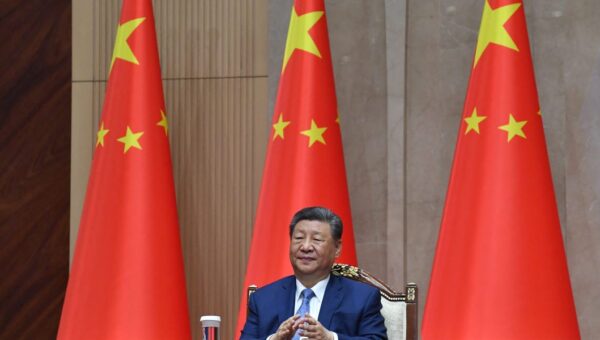
This week, President Donald Trump dismissed apocalyptic warnings and said that “whoever wins AI, wins.” Meanwhile, Chinese leader Xi Jinping said AI should continue to progress and be developed for the public good under a people-centered global governance framework.
Still, as releases from DeepSeek and Moonshot AI have put a spotlight on Chinese labs’ rapid progress in frontier AI, Beijing has also made clear it is not dismissing the technology’s risks.
Chen Yixin, China’s minister of state security, warned on Sunday that deepfakes, AI-generated misinformation, and “intelligent online armies” could threaten political stability and fuel cognitive warfare.
He also called for more state oversight to ensure AI develops in a “healthy and orderly” way, “with the wellbeing of all humanity as its guiding principle.”
Discover more from NAIRAVOICE.COM.NG
Subscribe to get the latest posts sent to your email.