

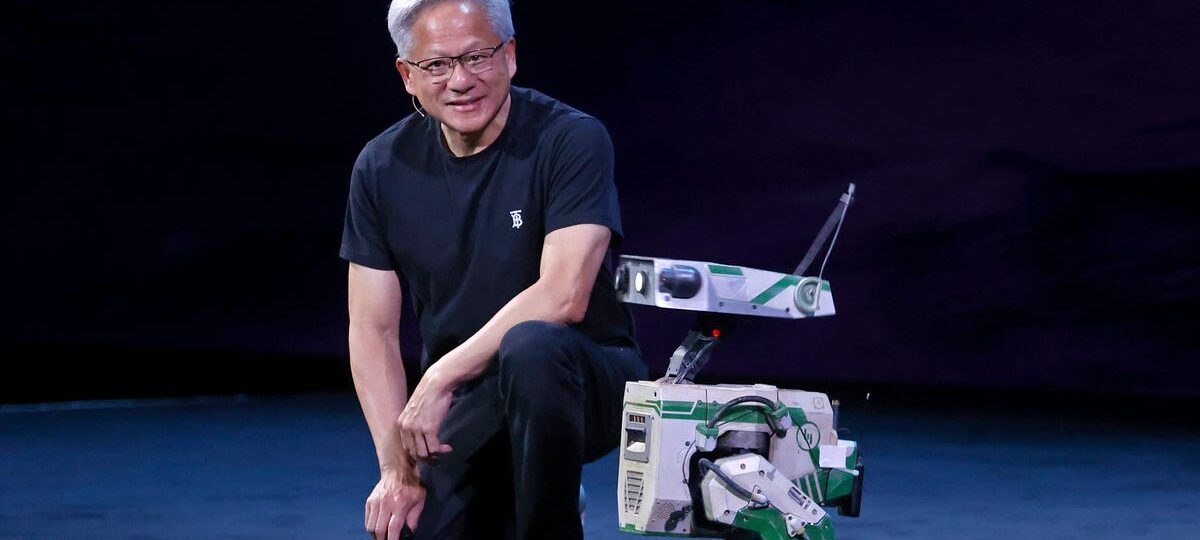
Nvidia helped build the foundation for physical AI.
Now, many of its veterans are launching the next wave of robotics startups.
The chip giant has poured billions into robotics, and Nvidia CEO Jensen Huang helped popularize the term “physical AI, ” which enables machines to interact with the real world.
As with AI agents and other applications, Nvidia’s strategy is to build underlying technology — the chips that power robots and the software used to train them.
That ecosystem has become fertile ground for founders.
In recent years, some who helped build the foundations of robotics inside Nvidia “are spinning out to build companies of their own,” said Amulya Vishwanath, who left the company last year to start Techable Ventures, a venture firm focused on physical AI.
Nvidia’s former vice president of AI research, Sanja Fidler, left in July to found Veeda AI alongside other ex-Nvidians.
The startup builds simulated worlds to train robots — an extension of the research Fidler worked on at Nvidia.
Former Nvidia researcher Joel Jang founded Dream Labs, another startup working in that industry, the Information reported.
Nvidia alums are attacking different areas in robotics, from software for deploying robots in warehouses to those that perform physical tasks for businesses.
Nvidia has invested in some, including Flexion Robotics and Dyna Robotics.
Flexion CEO and cofounder Nikita Rudin said that Nvidia maintains close ties with the startup, holding biweekly meetings and access to early tools for testing. “We’re still doing the same thing we were doing before,” Rudin said. “We were the beta testers — and now again, just from the outside.” Rudin and his cofounder, David Hoeller, left Nvidia after becoming convinced robotics technology had reached an inflection point and was ready for deployment. “We were not necessarily convinced that staying at Nvidia was the fastest way to actually go and deliver that,” Hoeller said.
Former Nvidia robotics researcher Arsalan Mousavian cited a similar motivation.
He described Nvidia as a “hardware-first” company centered on AI chips, and he wanted to be “laser focused” on building useful robots.
Mousavian’s startup, founded last year, remains in stealth.
Siddhant Haldar, a former Nvidia robotics intern who considered joining the company before founding Index Robotics, said the field has long been held back by a lack of real-world training data.
Now that powerful AI models can pick up some of the slack and robotics venture funding is booming, he said it was the right time to strike out.
Physical AI companies raised $33.4 billion globally in the first half of 2026, already surpassing the $28.7 billion raised in all of last year, according to PitchBook.
Startups can also take risks and deploy imperfect robots because large companies have “more to lose,” Haldar said.
Nvidia isn’t alone in producing a new crop of robotics founders.
Former Google DeepMind engineers launched Reimagine Robotics and Generalist, while Waymo veterans have gone on to build Bedrock Robotics, as researchers from fields like autonomous driving are pouring into the space.
Nvidia’s growing startup diaspora creates a cycle: The more startups that emerge, the more Nvidia stands to benefit by selling them the infrastructure needed to build.
Contact this reporter via email at gweiss@businessinsider.com or Signal at @geoffweiss.25.
Use a personal email address and a nonwork device; here’s our guide to sharing information securely.
Discover more from NAIRAVOICE.COM.NG
Subscribe to get the latest posts sent to your email.