The first time Notah Begay III understood that golf could become something bigger than a game, he wasn’t standing on a tee box.
He was driving.
He was 17, heading to To’Hajiilee High School, located about 30 minutes west of Albuquerque on the Navajo Nation, to address a graduating class of roughly 15 students after being chosen as its commencement speaker.
“What on Earth could I tell these kids that’s going to help them because I’m in the same boat that they are,” Begay recalls.
Then the realization came.
Golf had already begun to take him somewhere few Native American athletes had gone. And if he continued down that road – from Stanford University to the PGA Tour to NBC Sports and Golf Channel – he understood that his success would make him more than a golfer.
Notah Begay III honored for his charitable legacy with 2026 Payne Stewart Award

He would become a representative, a trailblazer, a voice. A person young Native American kids could point to and say, Someone like me belongs here.
“It was very clear to me that through golf and the road that I was on, this was going to be part of my life,” says Begay, the first full-blooded Native American to play on the PGA Tour. “I was always going to be a de facto spokesperson for the American Indian people.”
He didn’t know then how heavy that responsibility would become. Nor could he have known how many times his understanding of that responsibility would change.
It would change when, after winning four times in a 10-month span on the PGA Tour, he realized that winning golf tournaments wasn’t enough. It would change when he sat in a jail cell in an orange jumpsuit and confronted the consequences of his choices after being arrested for drunken driving. It would change when injuries took away the career he had spent his childhood building. It would change when depression made a game he once loved feel like a source of pain. And it would change when he began to understand that his greatest impact might have very little to do with his golf score.
The Notah Begay III Foundation (NB3), which is celebrating its 21st anniversary, became the embodiment of that realization. Its mission is rooted in health, wellness, leadership and opportunity for Native American children through a game that few of them play and as a vehicle for others to understand the issues facing the Native American community. Golf is part of the vehicle, but it has never been the destination.
For Begay, access matters because he knows exactly what access can mean. He remembers the hole in the fence at Ladera Golf Course, the municipal course in Albuquerque, where he grew up at a home adjacent to the 14th green.
“Little Notah would just appear, like a puppy,” Don Zamora, the course’s longtime director of golf, once told ESPN. “Finally, his dad came around one day and said, ‘My kid has a fetish for the game’ and wanted to know if we could do anything about it.”
Begay remembers Zamora hiring a young boy who saved up money to buy practice balls but whose urge to practice exceeded his piggy bank. During summers from age nine to 17, he rose before sunrise, opened the pro shop and finished his chores before spending the rest of the day practicing and playing. Someone had given him a chance. By the time he was 14, he had won the Junior World Golf Championships in San Diego, and a few years later would earn a golf scholarship to Stanford, the first in his family to go to college.
“Without Don Zamora, I never make it to the Tour,” Begay says. “He gave me the access, which is why the access initiatives are so important to me in our foundation’s work and our junior golf initiative. Sometimes kids just need a chance.”
Now Begay, 53, wants to make sure other kids get that chance. That is why the story of Lance Christensen Jr. resonated with him. Christensen came from the Pine Ridge Lakota reservation in South Dakota, one of the poorest communities in the country, and where access to golf was non-existent. Christensen had to drive 90 minutes just to reach his nearest course – in Nebraska – yet he became a state high school champion. Begay offered him the only exemption he’s ever given into his NB3 Junior Championship in Louisiana in 2020.
In the midst of the COVID-19 shutdown, Christensen drove 24 hours to the host venue and when he arrived, he launched a 357-yard drive to beat current two-time PGA Tour winner Nick Dunlap among the blue-chip prospects in the boys’ 14-18 Long Drive competition.
“All these kids who had been playing against each other all summer were looking at each other going, who is this kid? I couldn’t believe it, like, I didn’t know he had that kind of heat,” Begay says.

Begay recognized what could happen if someone simply opened a door. Christensen’s subsequent success — from college golf to a Division II national championship runner-up finish last year and All-American honors — validated the opportunity. But Begay doesn’t tell the story as a triumph for himself. He tells it as evidence of what can happen when a kid gets a chance.
“That’s a huge win,” Begay says. “I promise you he’s going to go back and be a strong leader in his community for the next generation.”
The younger Begay measured himself in victories, rankings and achievements. The older Begay measures success differently.
“You don’t do the work because there’s something waiting for you at the end; you do the work because that’s who you are,” he says. “Through my work now, it’s always about how can I serve other people?”
It is a philosophy that connects the most difficult chapters of his life to the most meaningful ones.
On Jan. 19, 2000, he fell right into a classic stereotype: “I was the drunk Indian,” he says.
That night he was arrested for aggravated driving while intoxicated, after his vehicle struck an unoccupied parked car in a bar parking lot. Rather than lawyer up and fight it, Begay pleaded guilty, disclosing that he had a prior DWI conviction from 1995, and served seven days in jail. He admitted he needed to make serious changes in his life and it forced him to confront who he was becoming.
Sobriety taught him that changing his life required “accepting the thing he could not change, the courage to change the things he could, and the wisdom to know the difference.” [He still reads the Serenity Prayer daily.] Injuries to his back forced him to find an identity beyond competitive golf – he jokes that his accountant informed him that his pro days were done when the checks got so small they didn’t need any commas – and he segued into a second career in television broadcasting. His work with Native American youth gave that identity a purpose larger than himself.

And the stories he carries with him — his grandfather’s service as a Marine and World War II Code Talker who used Navajo language to transmit strategic information over the airwaves, the stranger at a Korn Ferry Tour event who hugged him, tears strolling down his face, and thanked him for men like his grandfather making sure he got to come home from war, the young kids who need access to a golf course and the health and wellness challenges Native Americans face — have continued to remind him that his platform isn’t really his. It belongs to the people he can help with it.
Notah means “almost there” in Navajo.
For much of his life, Begay chased the feeling that he was almost there — almost good enough, almost accomplished enough, almost the person he wanted to become. Now, at this stage of his life, he sees the destination differently. Almost there was never about reaching the end. It was about becoming the person who could help someone else get there.
The Payne Stewart Award honors character, charity and sportsmanship — qualities that Stewart became known for and that Begay has spent decades trying to embody in his own way as a community advocate. Begay will officially be honored Tuesday, Aug. 25, at the Payne Stewart Award Ceremony in conjunction with the 2026 TOUR Championship. Golf Channel televises the ceremony as part of a “Golf Central” special from 7-8 p.m. ET.
He didn’t set out to win it. Indeed, that’s precisely what made receiving it so meaningful.
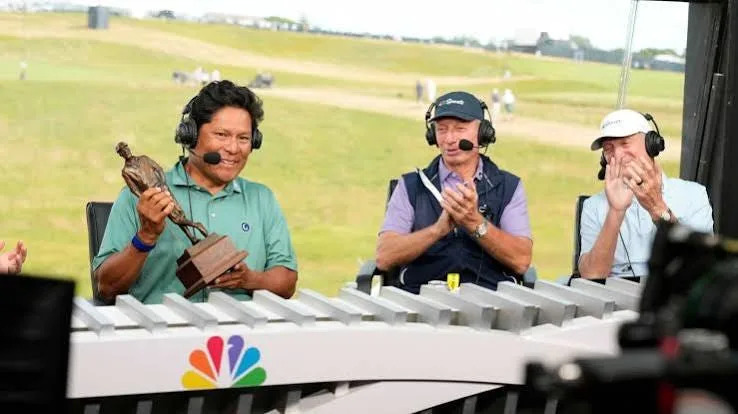
Begay sat on the set at the U.S. Open in June at Shinnecock Hills, surrounded by colleagues who had spent years working alongside him. NBC’s Dan Hicks sat to his right. Brad Faxon was to his left. Mike Tirico, Terry Gannon and executive producer Tommy Roy were all in on the secret. That’s when Aaron Stewart, the son of Payne Stewart, approached with the statue of his father in hand and delivered the news on set with cameras rolling.
“Are you serious?” Begay said.
A surprise of a lifetime 🥹
Notah Begay III is this year’s recipient of the Payne Stewart Award presented by @SouthernCompany, honoring his character, sportsmanship and commitment to charitable giving. pic.twitter.com/I5FTPwfzqa
— PGA TOUR (@PGATOUR) July 20, 2026
“The shock was real,” he says. “The fact that I was so surprised by receiving this award tells you that my sole intention was only to impact the lives of these kids.”
Impacting the lives of kids is something he’s been doing ever since he delivered that graduation speech. For a man who once wondered what he could possibly say to them, perhaps the answer was never something he needed to put into words. It was the life he went on to live.
He has gone from being the kid looking for a chance to being the person creating them.
And that, more than any award, may be the measure of how far he has come.
Adam Schupak is a senior writer for Golfweek, covering the PGA Tour.
This article originally appeared on Golfweek: Notah Begay III trades PGA Tour glory for a new mission
Discover more from NAIRAVOICE.COM.NG
Subscribe to get the latest posts sent to your email.