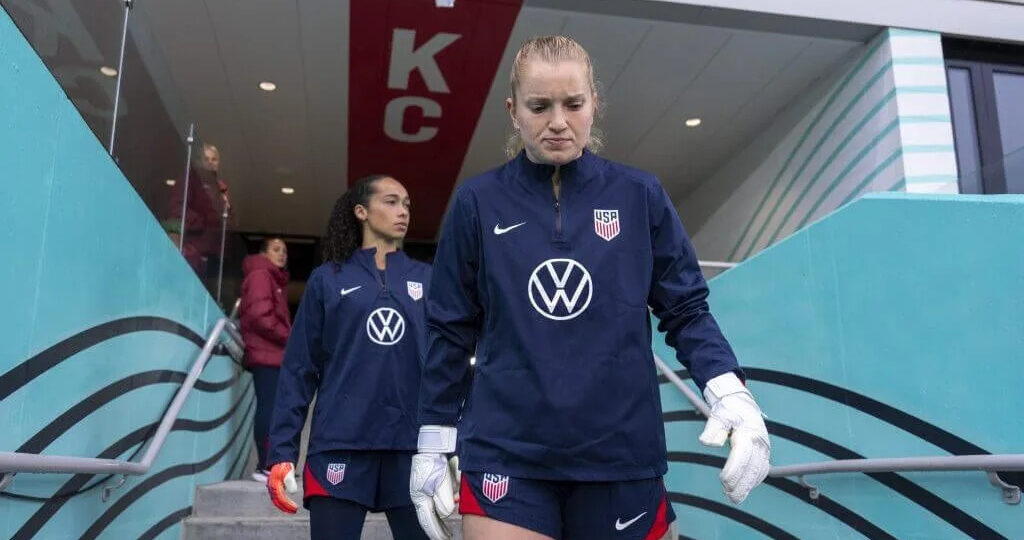
 The U.S. women’s national team has always had a clear No. 1 goalkeeper, with the position following an obvious line of succession since the program’s beginnings. Yet, since Alyssa Naeher retired from international soccer in 2024, who her permanent replacement is remains anyone’s guess.
And that, national team coaches say, is all part of their plan.
Constant competition for the top spot in net is by design, with U.S. women’s head coach Emma Hayes and her coaching staff intentionally using the last two years to focus on developing a pool of players, goalkeepers in particular, in anticipation of the 2027 World Cup and beyond. Hayes has long preached about wanting at least two options in every position, especially in net.
“It blew my mind that there’s only ever been five No. 1s, ever,” said U.S. team’s goalkeeping coach Stuart Searle from U.S. Soccer’s National Training Center last week. “When I came in, I’m looking at it and I go, ‘Well, what’s going to happen when Alyssa Naeher retires?”
The former Chelsea goalkeeping expert followed Hayes to the U.S. team, joining towards the end of Naeher’s legendary career. Naeher, a two-time World Cup winner retired four months after winning gold at the 2024 Paris Games. Since then, Seattle Reign’s Claudia Dickey and Manchester United’s Phallon Tullis-Joyce have stood out as the top two prospects to fill the role in the build up to Brazil, as the goalkeeper pool continues to grow.
With the U.S. women’s national team preparing to face World Cup champions Spain in a pair of friendlies over the next four days, this is as crucial a time as ever for Hayes and her coaching staff to re-assess their options for next summer and for players to step up.
Twenty years ago, Searle said, the American goalkeeper was “on top of the world.” The women’s team had Naeher and, before that, Hope Solo. The team also had Briana Scurry, who was immortalized as part of the 1999 World Cup-winning team, playing every minute of the tournament. On the men’s side, the team had Tim Howard as their starting keeper for close to two decades before he retired from international play in 2017.
“We had this group of super goalkeepers that everyone saw around the world as, ‘Yeah, these are the best goalkeepers,'” Searle said. “The game’s evolved. We’ve not evolved how we coach our goalkeepers, so we have to think differently in relation to the game. The demands of the game and the goalkeeper then is very different to the demands of the game and the goalkeeper now.”
Searle, a former professional goalkeeper, described how players in the position have long been valued for their shot-stopping ability. Being a good shot-stopper and generating the most saves meant you were one of the best. But the game has changed — and so have the skills needed to be the best.
“A goalkeeper now touches the ball 76 percent of the time with their feet; it’s no longer about keeping the ball out the back of the net,” Searle said. “You’ve got to be the spare player in the way that we play. So, you’ve got to be comfortable in those situations. Could Hope Solo still play now? Probably because she was so uber-talented at what she did, but she would have had to evolve, and that, for me, is where we’ve kind of stood still a little bit.”
Having a singular starter across decades can stagnate development if the entire focus is on the team’s No. 1, he stressed. Tullis-Joyce and Dickey only received their first caps with the senior team on April 5, 2025 and June 26, 2025, respectively. Tullis-Joyce has since earned seven caps with five clean sheets, while Dickey has recorded 11 caps and nine clean sheets.
Hayes has said 26-year-old Dickey “leads the way” in the goalkeeper race, at least for now, having earned more minutes in recent months than her former Reign teammate. Tullis-Joyce, 29, who last year felt like the presumed No. 1, missed a crucial window against Brazil in June, after being recalled from camp due to injury. She was also previously sidelined after fracturing her eye socket last year.
Meanwhile, Hayes called Dickey “probably the best performing goalkeeper in the NWSL” in 2025. The keeper seems at ease when distributing the ball to defenders and midfielders out the back, completing nearly twice as many successful passes as Tullis-Joyce last year, per Fotmob.
Now, though, Tullis-Joyce is “fit and available,” recently putting on a show for Man United last weekend. Her critical double save helped her Women’s Super League club earn a massive three points in their 1-0 win over Liverpool, sparking speculation once more about who the USWNT’s next No. 1 goalkeeper will be heading into camp.
“I’ll say this, in the best way, it’s what I expect,” Hayes said on Sunday, when The Athletic asked about Tullis-Joyce’s clean sheet the day prior. “You want to become world champions, everybody’s got to put performances in. It’s their job to make my decisions really, really difficult. Not sometimes, all of the time, and I really can’t stress that enough. To be the very best, it’s got to be that.
“Phallon is an unbelievable student of the game. Her application is first-class. It’s undeniable, her quality as a shot stopper. But we want to play too, and that’s her next step: being able to deliver what the team requires in the build-up. Because to dominate games, you have to be good at that, and I think I made it clear. I think that’s why it’d be nice to have her back, but I won’t shy away from the areas she needs to grow in her game.”
“We’ve not developed goalkeepers. We’ve developed a goalkeeper to win,” Searle said. Now the goal is “to have a pool of goalkeepers that we’re developing, so that at any one point in time we can go, ‘You’re playing well’ or ‘You fit the playing style for this opponent, we’re going to bring you in and play.’ My job is to make sure that they’re all very rounded, so it’s not just about, ‘Well, your strength hits that game, so we’re going to play you.’ You’ve got to be good at all aspects of the game now.”
The team has been developing this pool with eyes beyond next summer’s World Cup in Brazil. That is largely why the team called Bay FC’s 26-year-old Jordan Silkowitz into this camp against Spain. The intention, Hayes has said, is for Silkowitz to get a taste of the senior national team environment. The keeper has been training regularly with the Under-23s as an overage player to receive more caps against high-level international competition. Similarly, Angel City FC goalkeeper Angelina Anderson, 25, was also called up as an overage player for this month’s U-23 camp.
“If we think she’s got the potential to compete, let’s have a look at her now,” Hayes said of Silkowitz. “I think it’s fair to say it’s pretty likely that next camp she will go back to the 23s, and it’s got nothing to do with just form. It’s got to do with player development, and what’s best for that individual.”
That player development has been key.
“What we’re trying to develop, and what my task is for the future, is to ensure that we’ve got a steady flow of goalkeepers that are able to meet the demands of the game and step into Claudia Dickey’s shoes in 3, 4, 5 years’ time,” Searle said.
The U.S. is without some of its regular starting defenders this window, including starting center-backs Naomi Girma and Emily Sonnett, making the goalkeeping assessment that much more crucial. Girma is expected to be out for several weeks after receiving a knock at training with Chelsea, while Sonnett is out for the remainder of the season following a season-ending knee injury suffered while playing for Gotham FC.
The team has called up several uncapped players into this camp, including Silkowitz, defender Kate Del Fava, midfielder Evelyn Shores and forwards Pietra Tordin and Trinity Byars. More experienced players like NWSL Golden Boot leader Ashley Sanchez and midfielder Jaelin Howell also received call-ups, while USWNT regulars Jaedyn Shaw and Ally Sentnor were called into the Under-23 camp. Shaw, however, recently left camp for “precautionary reasons due to a minor injury.”
“I don’t ever want to face that period again where we have to develop a whole generation after the World Cup,” Hayes said, referring to the post-2023 World Cup shake-up. Hayes arrived a few months later and reimagined the entire player development pipeline, focusing on the free flow between Under-23s and the senior team.
That same emphasis on development has been intended for the goalkeeper pool, too. Searle described Tullis-Joyce, Dickey and Silkowtiz as “three completely different athletes (with) three completely different skill sets.” But other goalkeepers remain in the mix, like Utah Royals’ Mandy McGlynn and Houston Dash’s Jane Campbell. McGlynn was called in for the June camp in Brazil, and Campbell replaced Tullis-Joyce in the line-up when she was injured.
“Mandy demonstrated some unbelievable things in that game in Brazil. But I also want consistency from her in her club environment,” Hayes said. “Jane Campbell’s had a brilliant season and is a tad unlucky to not be in, but I think Jordan Silkowitz is a goalkeeper for the future that can really rival for the No.1 spot.”
That No. 1 spot remains up for grabs, with these next games against Spain a critical moment in assessing where things stand with nine months to go before the World Cup.
This article originally appeared in The Athletic.
US Women’s national team, NWSL, Women’s Soccer, FIFA Women’s World Cup
2026 The Athletic Media Company
Discover more from NAIRAVOICE.COM.NG
Subscribe to get the latest posts sent to your email.