
 In 364 days, the 10th edition of the FIFA Women’s World Cup will kick off in Brazil. The significance of the tournament, however, extends far beyond a date on the calendar.
As the first Women’s World Cup staged in South America, Brazil 2027 represents a rare opportunity to accelerate the growth of the women’s game across an entire region. It also raises a larger question: Can a World Cup hosted in a football-obsessed nation do for women’s soccer in Latin America what the 1999 tournament did for the sport in the United States?
With one year to go, the infrastructure is in place, the host cities are set, and the rollout campaign is already leveraging some of Brazil’s biggest stars and cultural figures, including Marta, Debinha, futsal legend Amandinha, Vinícius Júnior, Kaká, supermodel Adriana Lima and fashion blogger Camila Coutinho, trying to reach audiences who might not yet follow the women’s game. Matches will be played across eight cities in a country with a population of 220 million.
When Brazil was granted the hosting rights for the 2027 FIFA Women’s World Cup on May 17, 2024, some doubted a country whose soccer identity has long been shaped by machismo could fully embrace the biggest event in women’s sports.
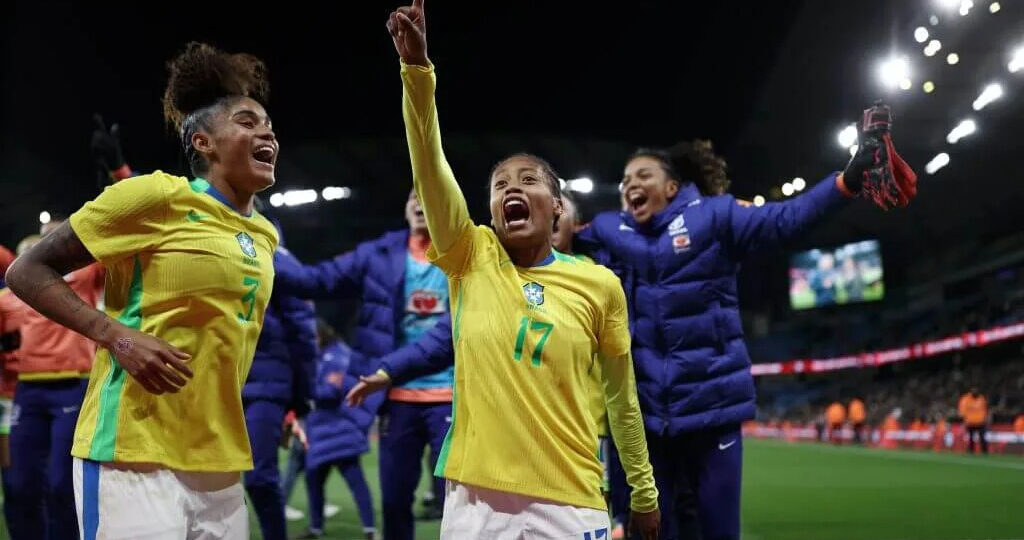
However, if May’s friendlies against the U.S. women’s national team are a benchmark, there is growing evidence that the appetite is already there. More than 30,000 fans attended each of Brazil’s matches against the USWNT, transforming what were technically exhibition matches into a preview of the atmosphere organizers hope to generate in 2027. The audience has been building. In 2023, more than 42,000 fans filled Arena Corinthians in São Paulo to watch Corinthians win the league title, setting a South American record.
The real question is whether the tournament can leave behind more than packed stadiums and memorable matches and become a catalyst for lasting change in a region where women’s football has historically fought for recognition (women were banned from playing until the 1980s), investment and visibility.
“I truly believe the legacy will be one of cultural change,” Aline Pellegrino, former captain of the Brazilian national team and the executive director of legacy and institutional relations for the FIFA Women’s World Cup 2027, said in a video Brazilian Football Federation (CBF) shared with The Athletic.
“I’ve been saying this for a long time. I was still playing for the national team when I spoke about this dream of seeing women’s football truly take root in Brazil, where all the institutions that govern the sport see women’s football deserving the same opportunities as the men’s game.
“We are already on that path and have been doing good work in that direction. But obviously, we also need the clubs and the passion that Brazilians have for their teams to extend to women’s football. We need fans to embrace the women’s game as well.”
View this post on Instagram
Luckily, there’s a blueprint, too.
The 1999 Women’s World Cup, which took place in the United States, did more than break attendance records; it fundamentally altered the trajectory of women’s soccer in the U.S.
It generated unprecedented television audiences, attracted sponsors and turned players such as Mia Hamm, Brandi Chastain and Briana Scurry into mainstream celebrities. The Women’s United Soccer Association, the first professional women’s league backed by major corporate partners, launched two years later. Though it folded in 2003, for the first time, it showed women’s soccer was no longer viewed solely as a participation sport for girls. The ripple effects of that summer continue to shape the economics of the NWSL nearly three decades later.
“The legacy that we left is the fact that the money and investment and the resources eventually found all these other great players around the world,” Scurry told ESPN in 2024. “From organizations and governing bodies watching us do what we did here in the United States and then deciding, ‘Yes, I’m going to turn on the resource firehose and give them some oxygen and some water and some nutrients.'”
The decision to award Brazil the 2027 tournament, determined by an open vote of FIFA’s 211 member associations during the 74th FIFA Congress in Bangkok, was never really on whether the country could host a major tournament. Brazil answered that question a decade ago with the 2014 Men’s World Cup. The stadiums are there. The airports are there. The hotels, highways and public transportation networks are there. Few countries on the planet are better equipped to handle a month-long influx of international visitors. If any city in South America knows how to welcome millions of people at once, it is Rio de Janeiro, a city that effectively rehearses for mega-events every year during Carnaval.
Even though women’s soccer was officially banned in Brazil from 1941 until 1979, the country not only produced legends such as Marta, Formiga, Sissi and Cristiane, but it also has an extensive women’s soccer pyramid, perhaps financially underdeveloped compared with Europe and North America but robust in terms of talent development.
Today, the CBF organizes nine official women’s competitions, a stark contrast to a decade ago; five competitions at the senior level (the Women’s Super Cup, the Women’s Brazil Cup, and the Women’s Brazilian Championships in Division One, Two and Three). A total of 66 clubs compete in women’s national competitions across the country, the league said. At the youth level, there are the Women’s U-20 Brazilian Championship, the Women’s U-17 Brazilian Championship and the Women’s Development Leagues at the U-16 and U-14 levels.
Still, many of the country’s top players continue to leave in pursuit of better salaries, facilities and professional opportunities abroad. Catarina Macario, one of the most gifted players eligible for Brazil through birth, developed entirely within the American system before becoming a star.
“When society is evolving and increasingly recognizing women’s place in it, this World Cup can have a profound social impact. It can help us become a more equal society. Football has the power to drive change and transformation. The greatest legacy that could emerge from this tournament is a cultural shift,” Pellegrino said. “During the lead-up to the tournament, there is still a lot we can do to build solid foundations that will allow more girls to access the sport, whether simply for participation and social development or for those who dream of one day representing Brazil.”
View this post on Instagram
If Brazil not only hosts a successful tournament but also wins on home soil — something its male counterparts have not been able to do on two occasions — the opportunity for Brazilian women’s soccer to have its watershed moment is even bigger.
According to Pellegrini, the national team has a chance to bring home the trophy, and as the federation, it has an opportunity over the next year, and during the tournament itself, to create something that will last the next decade and beyond.
“We just saw, during the most recent FIFA window, Brazilian fans supporting the women’s national team,” she said. “A lot of this comes down to communication and storytelling. We need to tell the stories of these women and women who were invisible in the past, who played, fought and represented Brazil under much more difficult circumstances.
“We need to recover those stories from the past while also telling the story of the future. Who are the new talents in women’s football? Who are the next generation of promising players? Their faces should be everywhere, in all the host cities and across Brazil. These are stories that can inspire all Brazilians, men and women alike. They are stories of struggle, achievement, perseverance and refusing to give up on your dreams.”
This article originally appeared in The Athletic.
NWSL, Women’s Soccer, FIFA Women’s World Cup
2026 The Athletic Media Company
Discover more from NAIRAVOICE.COM.NG
Subscribe to get the latest posts sent to your email.