The Lord of the Rings: The Rings of Power is about to enter uncharted territory — but that’s exactly why creators J.D. Payne and Patrick McKay are excited.
When Prime Video’s blockbuster fantasy series returns for Season 3, it won’t be resuming right where viewers last left off in the Second Age, with Galadriel (Morfydd Clark) and the Elves announcing their fight against Sauron (Charlie Vickers) and his encroaching army of Orcs. Instead, the story jumps ahead by five years, to a point when the era known as the War of the Elves and Sauron is already in full swing. The new Dark Lord’s influence is slowly but steadily skulking across Middle-earth, with only a few regions still untouched by the encroaching evil. While Payne and McKay admit the show’s time jump represents a “jolt of energy” in moving the story forward, they also hope it’ll serve as a different opportunity for any potential viewers who haven’t tuned in to the show before.
“It is, in some ways, starting afresh,” Payne admits. “All you really need to know is: these guys are at war.” With Sauron taking even more diabolical steps to recruit potential allies (more on that later), the number of individuals who are not just willing but able to withstand his invasion seems at an all-time low. Yet eagle-eyed fans may have noticed one character in particular who’s already being positioned to face off against Middle-earth’s greatest threat — sometimes literally in the marketing itself.
“We’ve been slowly building this character from a tabula rasa into one of the most iconic heroes in Tolkien’s legendarium,” Payne says. It’s an evolution that’s taken years of work on and offscreen, likely testing some fans’ patience in the process, but Season 3 represents a big step forward in a much greater odyssey for Middle-earth’s most renowned wizard. Below, Payne, McKay, director Sanaa Hamri, and actors Daniel Weyman, Ciarán Hinds, and Zubin Varla break down what to expect from The Rings of Power‘s most powerful and personal storyline yet for Gandalf.
‘The Rings of Power’ Season 3 Is a Turning Point for Middle-earth
Given where The Rings of Power‘s story picks up, “darkness” feels like a perfectly succinct description — and not just because the third season begins with a snapshot of the evil creeping across Middle-earth. While the series has never shied away from the murkier corners of Tolkien’s world, Payne and McKay wanted Season 3’s narrative shift into distinctly heavier territory to feel as earned as any other aspect of the show.
“It is a darker season, but I don’t know that we approached it self-consciously wanting to be darker so much as trying to take seriously a world that is at war, where the heroes are losing, where evil is ascendant,” McKay explains. “Evil in Tolkien is not simple. It is complex. It corrupts good. That means you’re going to have characters who fall to evil forever, and it means you’re going to have characters who can die. By taking that seriously and treating it authentically, it’s going to lend itself to a darker season.”
While those life-and-death stakes are rising for every character who’s been swept up in this war, nowhere do they feel more apparent than in the company of Sauron, who has finally embraced his truest self after two seasons of deception and manipulation. That unmasking set the tone for everything across Season 3, including behind-the-scenes details big and small.
“I really allow the story and what the characters are going through to influence the direction and the tonality,” Hamri, who returns to direct several episodes this season, explains. “If you look at the season, Sauron, for the first time, is now embodying the Dark Lord. First, he was Halbrand, then he was an Elf. Now, he’s in his full glory. He’s no longer hiding.”
The Dark Lord, now capable of replicating Celebrimbor’s (Charles Edwards) greatest triumph in Season 2 to the best of his own abilities, has some powerful rings to “hand out,” as Payne puts it — and sends missives out across Middle-earth with the promise of awarding them to those men he deems most deserving. If that invitation sounds too good to be true, that’s because it is; Sauron’s rings of power are in short supply, and anyone who puts themselves in a position to claim one may have to pay a deadly price.
Lest you think that this means Season 3 is all doom and gloom, however, The Rings of Power‘s creators emphasize that the War of the Elves and Sauron only makes up one piece of the larger puzzle. This is an epic fantasy world, after all, but one that has always maintained a delicate balance between good and evil.
“Middle-earth is a place where people are dealing in life and death. The stakes are real. That’s one of the reasons we were excited about adapting this material,” McKay says. “It’s got real dramatic stakes to it, but it’s also balanced with wonder and awe and beauty and humor. The way we approach making that stew with the right ingredients every season is we just try to commit to every one of these stories and the characters, and really try to treat them seriously.'”
“It’s really easy for things to get too grim, especially in a world in which there’s war and death around every corner,” Payne adds. “There’s got to be something that’s going to bring you back to the light.”
Gandalf’s Mission in ‘The Rings of Power’ Season 3 Takes a Personal Turn
<<img src="https://static0.colliderimages.com/wordpress/wp-content/uploads/2026/11/the-rings-of-power-season-3-daniel-weyman-sanaa-hamri.jpg?q=49&fit=crop&w=1300&dpr=2" />
Image via Prime Video</figure>
Enter: The Rings of Power‘s worst-kept secret. If you’ve been watching the show from the beginning, the reveal that “The Stranger,” who first crash-lands on Middle-earth in a flaming meteor, is actually Gandalf likely didn’t land as any great twist. Now, after two seasons and 16 episodes, the secret is officially out, but if you ask Weyman, the entire ride to date has been one big gift of a role, with much of his journey off-screen paralleling the path his character has taken.
“I started with nothing; the character started with nothing,” Weyman admits, referencing his time in New Zealand during production on The Rings of Power‘s first season — in which The Stranger finds his footing in Middle-earth, so to speak, with the help of some nomadic precursors to the Hobbits, known as Harfoots. “In some ways, I was mirroring the journey of The Stranger, and that meant that, as I came to play different scenes with different communities, or understand different things that he had to learn, they were amassing in my version of The Stranger; they were layering his character as I went.”
Since filming happened mostly in chronological order, by the time Season 2’s finale rolled around — otherwise known as the moment when The Stranger finally has a revelation about his true name — Weyman says he didn’t feel any added pressure or weight he wasn’t prepared to take on, regardless of any actors who preceded him in the role. “When the showrunners said, ‘You’re going to say, ‘They’re going to call me Gandalf, aren’t they?’ which was spine-tingling and wonderful, at that moment, I felt, ‘All they’re doing is labeling a character who I’ve already created.'”
It’s understandable, then, that Weyman goes on to describe his time filming The Rings of Power Season 3 in only one word: fun. On a broader level, though, he explains that his approach to performance had to change, simply by virtue of the fact that the character he was playing had transformed too.
“It was really interesting how different filming as Gandalf was from filming as The Stranger, both on set and off-set. How I carried myself as an actor was different because Gandalf, in this season, has arrived; his feet are firmly wizard-on-the-floor. I think he understands the connections to the gods up above and the earth and nature below,” Weyman says. “He’s understood, through his relationship with Tom Bombadil, his purpose and what he’s trying to achieve, and that means that he has a lighter touch. Not everything is so dreadfully, immediately, importantly terrifying to him. Whereas The Stranger may have been very reactionary and just feeling like he’s got to solve everything straight away, Gandalf understands he won’t be able to control or solve certain things, and that’s part of the journey. Being okay with that really changed how I played him and how I was on set.”
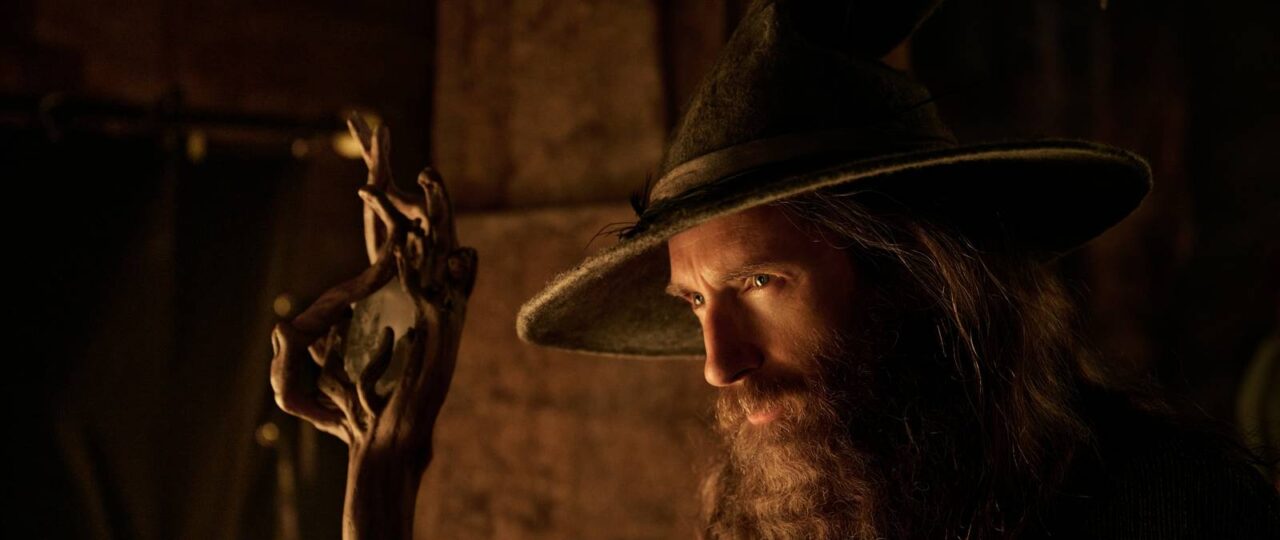
Within that mindset of grounded acceptance came the addition of what Weyman describes as another “important artifact” on Gandalf’s journey. It’s an element that has already been revealed in promotional material leading up to the season’s premiere, but this particular gift, courtesy of Tom Bombadil (Rory Kinnear) himself, is merely the latest in a series of items Gandalf has collected that hold personal meaning for him.
“The staff we see in Season 2 has been picked out of a fallen tree out of the awful thing that the Dark Wizard has done to the Stoors and moved by Nori from this broken tree onto [Gandalf’s] path, effectively. I don’t know how many people picked that up when they watched it, but the fact that that has come through her hands is monumentally important.” Similarly, Weyman explains, Gandalf’s new wizard’s hat is significant in more than one sense.
“Not only is it a part of Tom with him, which is really important, but also it’s got a completely massive practical use. It’s part of his armor. He goes outside; he hasn’t put it on yet, but when he’s out there, the sun starts to beat down on his head, and he remembers Season 2, and what an awful journey it was across this desert with Nori and Poppy, and how near to the end they all got. He suddenly realizes he’s got this bit of armor in his hand. He puts it on his head, and it’s protecting him from this incredible power that the sun brings.”
Finding the right hat for Gandalf was a “Goldilocks” process in and of itself, according to Payne, who credits The Rings of Power costume designer Libby Dempster with leading the charge after rounds of narrowing down their options. “That one is too big. That one is too small. That one is too curly. The color looks too dark, too light, too blue, not blue enough.” Even once the perfect fit was chosen, Season 3 became an opportunity to pay homage to both Tolkien’s epic source material and Peter Jackson‘s original trilogy, with Weyman’s Gandalf strikingly backlit by the very sun he’s stepped out into, hat officially donned.
“It’s almost like an album cover,” Hamri admits. “When I was editing it, and I presented it to the showrunners, it just felt like the right moment.” One particular shot, which features Gandalf giving a subtle, self-acknowledging look almost directly to the audience, is the same one that made it into the finished product. “We never changed a frame,” McKay declares. “From the first time we saw it, we were like, ‘Well, that will be in the first trailer,’ and then the first trailer that Amazon marketing showed us had the version of it in there. You just sit back and enjoy the ride when you have a moment like that.”
Yet one particularly iconic piece of headgear, or even a powerful staff kept close at hand, isn’t going to be enough to singlehandedly defeat Sauron and his forces — and this is where Gandalf’s storyline this season simultaneously pivots to a deeper exploration of his mythological origins while keeping the stakes intimately personal.
“In the Third Age, there’s a moment when he’s confronting a Balrog, and he says, ‘I am a servant of the Secret Fire,'” Payne notes — which, in Tolkien’s legendarium, is another name for the power of Eru Ilúvatar, the God of Middle-earth. In Season 3, Gandalf is not only directly confronted by his divine origins, but is personally tasked with a mission of salvation, rather than destruction.
“We’re told that the Istari are forbidden from meeting power with power — fighting fire with fire. Their role is actually to speak to the hearts of the people in Middle-earth and to try to inspire others to find their own courage and their own strength to be able to fight against the evil, to come together as unlikely allies,” Payne says. “We wanted to start telling that story. What was it that started Gandalf on that path to understand that, ‘My purpose, as an Istari, isn’t to cast fireballs, but to inspire hearts’?”
While Gandalf isn’t quite as removed from the rest of the story as he was at the beginning of the series, Weyman confirms that he can’t link up with other potential allies immediately, which forces him to plan from behind enemy lines while other characters make bigger political moves. “What he’s trusting in this season is the idea of: do what you can in the present with the beings you interact with. Do all you can. It means trusting yourself. It means trusting your instincts.”
Gandalf’s Biggest Obstacle in ‘The Rings of Power’ Season 3 Is Making Moves of His Own
 Image via Prime Video
- Image via Prime Video
- Image via Prime Video
- Image via Prime Video
- Image via Prime Video
 Image via Prime Video
 Image via Prime Video
 Image via Prime Video
 Image via Prime Video
 Image via Prime Video
- Image via Prime Video
- Image via Prime Video
- Image via Prime Video
- Image via Prime Video
- Image via Prime Video
 Image via Prime Video
 Image via Prime Video
 Image via Prime Video
 Image via Prime Video
 Image via Prime Video
Remember when we mentioned that there are still some holdouts in Middle-earth that have been able to withstand Sauron’s skulking influence? One of them — Rivendell — likely comes as no surprise, given the Elves’ firm resolution to battle the Dark Lord at any cost, while the other is being ruled by a different sort of evil, one who shares a personal history with Gandalf himself.
The Dark Wizard, first introduced in The Rings of Power‘s second season as an Istari who has yet to reveal his own true name, has kept most of his cards pretty close to the vest, but Hinds says he considered his return to the role, his second reprisal in a major fantasy franchise, a “huge adventure.” Despite establishing his home base in Rhûn, a vastly uncharted desert region in the east, and having several robed cultists sworn to his cause, the Dark Wizard presents, in Hinds’ words, as “a rather solitary figure.”
“He’s not quite Nobby no-mates, but apart from his acolytes, there’s no real contact with him. He’s a strategist, and we don’t know exactly what his strategy is, and that’s what I’m playing in this season.”
Instead of digging his heels in as a form of resistance, however, the Dark Wizard makes his own chess move against Sauron — sending one of his cursed servants, known as Khamûl the Easterling, as a messenger to uncover exactly what’s going on in Mordor. If that name sounds familiar, that’s because he’s one of only two named Nazgûls in Tolkien’s writings — which is originally all Varla had to go on when he was approached to play the character after providing some general voice work on Season 2.
Once Khamûl and Sauron are in each other’s orbit, you can probably guess what happens next, but Varla confirms that the carrot being dangled through a ring of power, after a lifetime under the Dark Wizard’s thumb, ultimately proves too tantalizing to resist. “Khamûl is somebody who’d already been subjugated. His people were already not what they once were. He is already, when we first meet him, enslaved, as generations before him had been enslaved, by Wizards. The land is no longer his. He has an axe to grind. He has something that he wants back; he just does not have the power at that particular point to get it back. What Sauron offers them is the power to take back what is rightfully theirs.”
Naturally, when Khamûl returns, he’s a very different being than the one who first departed Rhûn, much to the Dark Wizard’s dismay — but Hinds asserts that his character simply considers it a countermove in the ongoing game he and Sauron are playing, rather than a sign of defeat that forces him to kneel. “They’re testing each other out in a way. The Dark Wizard has never been challenged like this before, and suddenly this force doesn’t surrender to him.” Although Khamûl may be newly equipped to confront his long-time oppressor, Varla adds that his power has a secret and more nefarious source. “There’s something coursing through Khamûl that he is yet not in control of, and doesn’t understand. That’s Sauron coursing through him. That’s a new world that he’s yet to come to grips with.”
Four worlds and four completely different ideas of what a good life
looks like. This is where you belong, what it would ask of you, and what you would get back in
return.
You belong somewhere old enough that the mountains have names and
somebody can still tell you who gave them. Middle-earth is for people who think the right
thing is worth doing even when it will not be finished in their lifetime.
- This is the only world on the list where doing good is understood as a very long defeat,
fought anyway, by people who will never see how it ends. - You are drawn to grandeur, to white cities and deep forges and the sense that almost
everything you touch is older than your entire family line. - The Rings of Power is set in the last good age before it all goes wrong, which gives
every quiet scene in it a slightly unbearable weight. - You would take the hard road, and you would take it on foot.
You want the sea, a crew, and absolutely nobody telling you where
you are allowed to go. The Grand Line is the world for people whose main ambition in life is
finding out what is over there.
- One Piece has run for decades on one very simple engine, which is a group of people who
each want something impossible and have decided to go and get it together. - You collect people. Your ideal crew is a set of misfits who were each written off
somewhere else before you turned up and offered them a better idea. - The world is enormous and deliberately ridiculous, and the emotional gut punches land
harder because of that rather than in spite of it. - You would set sail knowing the map runs out, which is more or less the entire point of
it.
You would rather be feared and useful than liked and useless. The
Continent is a world where the monsters are the straightforward part of the job and the
people are where it all gets complicated.
- Witchers get paid to do what nobody else will and resented for existing at all, which is
a trade most people would refuse and you would probably accept. - You have no real illusions about which side is the good one, largely because on the
Continent that question tends to have a disappointing answer. - The best of these stories are not about the fighting. They are about somebody with a
rigid code being repeatedly cornered into caring about people. - You would take the coin, finish the job properly, and be out of town before the story
got told wrong.
You want the myths to be real and loose in the actual world, and
you want to find out at about thirteen that you were never anywhere near as ordinary as
everybody kept telling you.
- Percy Jackson takes the oldest stories we have and drops them into car parks and diners,
which makes the gods considerably funnier and a great deal worse. - You would be the kid every school gave up on, who turns out to have been built for
something nobody thought to test for. - The series is genuinely about friendship rather than destiny, and it says so out loud
every time a prophecy tries to get in the way. - Camp Half-Blood is the real fantasy here: a place where the thing that made you
difficult everywhere else is the thing that makes you belong.
With the Dark Wizard caught between a rock and a hard place, Gandalf — who’s quietly been looking for a way to dismantle his fellow Istari’s white-knuckled grip on Rhûn — finds himself at a critical crossroads. With strength in numbers now essential for not just confronting but ultimately defeating Sauron, does Gandalf have the power to sway an old friend away from the darkness and back to the light? It’s a more meditative question that leads to no shortage of action for these characters, but Payne admits that the writers didn’t want to start from a place of magical combat, which felt like a predictable retread of what viewers had seen before.
“As we were really thinking about Gandalf’s larger series arc, that he has to speak to the hearts of people in Middle-earth, we thought, ‘What an impossible mountain that is to climb, someone who has gone as far toward the dark side as the Dark Wizard has gone. What if Gandalf has to figure out a way to try to turn him?’ It’s such an impossible situation to put your character in that it felt delicious to us as dramatists to try. Knowing Gandalf has to try to figure out how to help his erstwhile tardy colleague find redemption felt like the right story for us to tell this season.”
Weyman points out that the long history between the two characters, which has yet to be fully illustrated onscreen, alongside the subtle proof of the friendship that once existed between them, gives Gandalf’s biggest emotional duty this season a bittersweet significance. “The Dark Wizard seems sad. He was sad in Season 2 when he uttered the words, ‘old friend.’ How could we be friends if you behave like this? If we were friends, is there any of that friendship still alive? It is very difficult to believe that Gandalf ever got on board with a friendship that was around suppressing and controlling and subjugating. It’s very difficult to believe that. So, if we don’t believe that, that means there must have been something in the friendship that was joyous and light and loving and charitable.”
Hinds turns equally philosophical when asked about the journey the Dark Wizard and Gandalf embark on together in Season 3, which touches on greater themes of betrayal, sacrifice, and the question of whether salvation is possible. “Power in the hands of good people can be so beneficial, who have intelligence and understanding. We know that, and yet, what does seem mad is that whoever has the power, you don’t trust them because they get warped along the way. That idea of allying yourself for the good against the dark has gone on forever, but it’s something that I think we all connect with, no matter how fantastical it can be. There’s something at the heart of all this which is true to the journey of the people on our planet.”
For Weyman, it’s taken six years to reach Gandalf’s biggest evolution yet — and for the fans eagerly awaiting The Rings of Power‘s return, the wait has likely felt just as long. Fortunately, Season 3 is finally poised to bring the story’s most powerful opposing forces together. With the fate of Middle-earth hanging in the balance, the cost may very well be a bigger sacrifice, as Gandalf himself notes in the season’s latest and most foreboding trailer, but the creators’ hope is that the show’s latest and darkest chapter yet has been well worth the wait.
“We have asked an enormous amount of audiences in having Gandalf’s journey be a slow burn that led him all the way off the map, seemingly, from all the other stories,” McKay admits. “But hopefully, as you watch this season, what you realize is that his destiny, even though it was leading him one way geographically, was cosmically, emotionally leading him straight to Sauron.”
The Lord of the Rings: The Rings of Power Season 3 premieres November 11 on Prime Video.
Discover more from NAIRAVOICE.COM.NG
Subscribe to get the latest posts sent to your email.