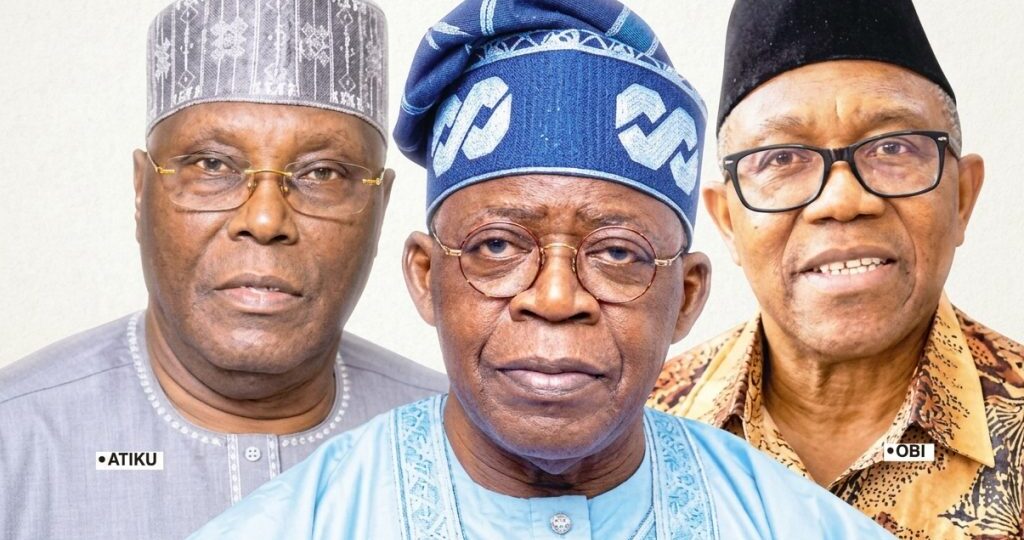
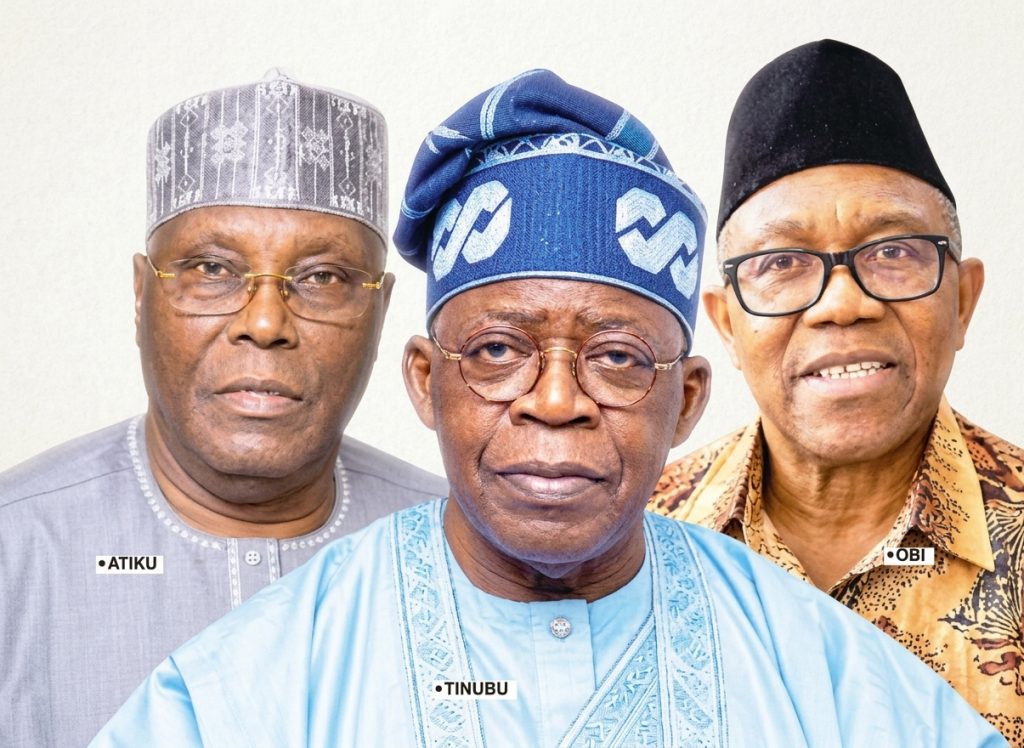
•Candidates’ performance in two regions has shaped presidential election since 1999
By Luminous Jannamike
Behind the battle for the presidency lies a contest over voter numbers, party machinery and political alliances. Tinubu has a head start as incumbent, but Atiku, Obi and other challengers know that no region is anybody’s political inheritance.
The road to Aso Rock in 2027 runs through two regions where elections can be won, lost or thrown wide open: the North-West and South-West. Their combined electoral strength gives them enormous influence over the calculations of President Bola Tinubu and the opposition figures seeking to unseat him.
The Independent National Electoral Commission’s 2026 voter register puts the North-West at 25,083,411 registered voters and the South-West at 19,614,274. Together, they account for 44,697,685 registered voters, representing more than 43 per cent of Nigeria’s 103,428,715 registered voters ahead of the 2027 general elections.
Those figures make the two zones central to the presidential contest. But the real battle is more complicated than regional arithmetic. Candidates must convert registered voters into ballots, hold their traditional strongholds, penetrate rival territories and build a coalition broad enough to survive the country’s political and geographical divisions.
For Tinubu, the stakes are particularly high. His South-West political base helped launch his presidential ambition, while his 2023 victory also depended on support beyond the region. Former Vice-President Atiku Abubakar and Peter Obi must find ways to disrupt that balance if they hope to deny him a second term.
The numbers that can make or break a candidate
The North-West’s 25.08 million registered voters make it Nigeria’s largest geopolitical voting bloc. The South-West follows with 19.61 million, ahead of the North-Central, which has 16.97 million.
The political significance is unmistakable. Kano, Kaduna and Katsina are among the country’s most populous electoral states, while Lagos leads the national register with 7,488,633 voters. A candidate who makes substantial gains across these states can dramatically improve his national tally.
Yet neither zone is a political inheritance. The North-West contains competing party structures, influential local leaders and voters whose choices are shaped by security, economic conditions, personalities and the performance of elected officials. Kano’s political history, in particular, shows how a powerful state-level movement can disrupt calculations made in Abuja.
The South-West presents a different challenge. Tinubu’s longstanding political network gives him an advantage, but it does not guarantee uniform support across the region. Lagos demonstrated this in 2023 when Obi defeated Tinubu there by 9,848 votes, polling 582,454 against the president’s 572,606.
That result remains a reminder that even a candidate’s home territory can become a battleground. Party loyalty, local grievances, urban voting patterns and the credibility of candidates can all upset expectations.
The numbers also require caution. INEC’s register measures people registered to vote, not the number who will eventually cast ballots. Turnout, voter accreditation, election-day logistics and the distribution of votes among candidates will determine how much of that numerical advantage translates into electoral power.
What elections since 1999 reveal
Nigeria’s presidential elections have repeatedly shown that regional strength matters most when it forms part of a wider national coalition.
Olusegun Obasanjo’s victories in 1999 and 2003 rested on support extending beyond his South-West origins. Umaru Musa Yar’Adua’s 2007 victory reflected the strength of the Peoples Democratic Party’s national machinery, while Goodluck Jonathan’s 2011 success drew on substantial support in the South and parts of the North.
The 2015 election changed the political landscape. Muhammadu Buhari’s victory demonstrated that an opposition alliance could defeat an incumbent when it combined a formidable northern base with support in other parts of the country. The merger that produced the All Progressives Congress brought together political interests that had previously competed against one another.
Buhari’s re-election in 2019 again showed the importance of maintaining a broad electoral coalition, even as the contest exposed persistent regional divisions.
Tinubu’s 2023 victory followed another complex pattern. He won the presidency with 8,794,726 votes, ahead of Atiku’s 6,984,520 and Obi’s 6,101,533. The result was not the product of one region alone. It reflected a combination of Tinubu’s South-West support, votes from the North and the fragmentation of opposition support across several candidates.
The lesson for 2027 is not that a candidate must reproduce one previous election formula. It is that regional dominance, without alliances and sufficient support elsewhere, can leave a candidate short of victory.
The 2023 result that changed the game
The last election exposed the risks of treating Nigeria’s regions as predictable voting blocs. Tinubu secured 2,542,979 votes in the South-West and 2,652,235 in the North-West, according to zonal breakdown. The figures showed that his northern performance was at least as important as his home-region strength.
But the North-West did not vote as a single political unit. Atiku won Kaduna with 554,360 votes against Tinubu’s 399,293, while Rabiu Kwankwaso carried Kano for the New Nigeria Peoples Party. The split deprived the opposition of a unified northern vote while also limiting Tinubu’s ability to sweep the region.
In the South-West, Obi’s narrow victory in Lagos demonstrated that Tinubu’s political base could be challenged. Obi’s strength in the South-East, meanwhile, did not translate into enough votes across the country to secure the presidency. Atiku’s support in parts of the North also proved insufficient.
The distribution of votes made the difference. Had opposition support been concentrated behind a single candidate, the contest could have looked very different. Instead, three major contenders divided the electorate, while Tinubu assembled enough votes across several regions to finish first.
Simon Kolawole, veteran journalist and political analyst, captured the strategic calculation in his assessment of the 2023 presidential election result.
“Tinubu did well in ‘two out of three’ – the South-West and the core North,” he surmised.
Kolawole also noted that a winning candidate might need sizeable support from the North-Central or South-South, or both, in addition to strength in the South-West and core North. His point is central to the next contest: Commanding two major blocs may create a strong platform, but it does not remove the need to win elsewhere.
The constitutional hurdle also remains. Under Section 134 of the Constitution, a presidential candidate must secure the highest number of votes cast and at least one-quarter of the votes in no fewer than two-thirds of the states and the Federal Capital Territory. Regional strength must therefore translate into both a national plurality and geographically distributed support.
The road to Aso Rock runs through alliances
Tinubu enters the race with the advantages of incumbency, an established party structure and a political network built over decades.
But those advantages will be tested by the electorate’s assessment of his administration, particularly over the economy, living costs, jobs and insecurity.
The North-West could become a referendum on the government’s handling of insecurity and economic hardship. In the South-West, the president will need to defend his political base against discontent and opposition efforts to make inroads in urban centres and states where local dynamics favour challengers.
Atiku faces the challenge of converting northern support into a broader national coalition, while Obi must demonstrate that his strong following in parts of the South and among younger voters can expand into regions where he was less competitive in 2023. Both will also have to confront the consequences of opposition fragmentation, party defections and competing presidential ambitions.
The choice of running mates, the strength of state party organisations and agreements with influential political figures could prove decisive. So could turnout: A candidate with a smaller but highly mobilised support base may outperform a rival whose larger pool of registered supporters stays away from polling units.
The North-West and South-West will undoubtedly shape the arithmetic of 2027. But neither region can deliver the presidency by itself, and neither should be treated as a guaranteed bloc for any candidate.
The contest will be decided by who can turn voter numbers into actual ballots, withstand local political surprises and build alliances beyond familiar strongholds. For Tinubu, the challenge is to defend the coalition that brought him to power. For his challengers, it is to break that coalition without splitting their own support.
Discover more from NAIRAVOICE.COM.NG
Subscribe to get the latest posts sent to your email.