
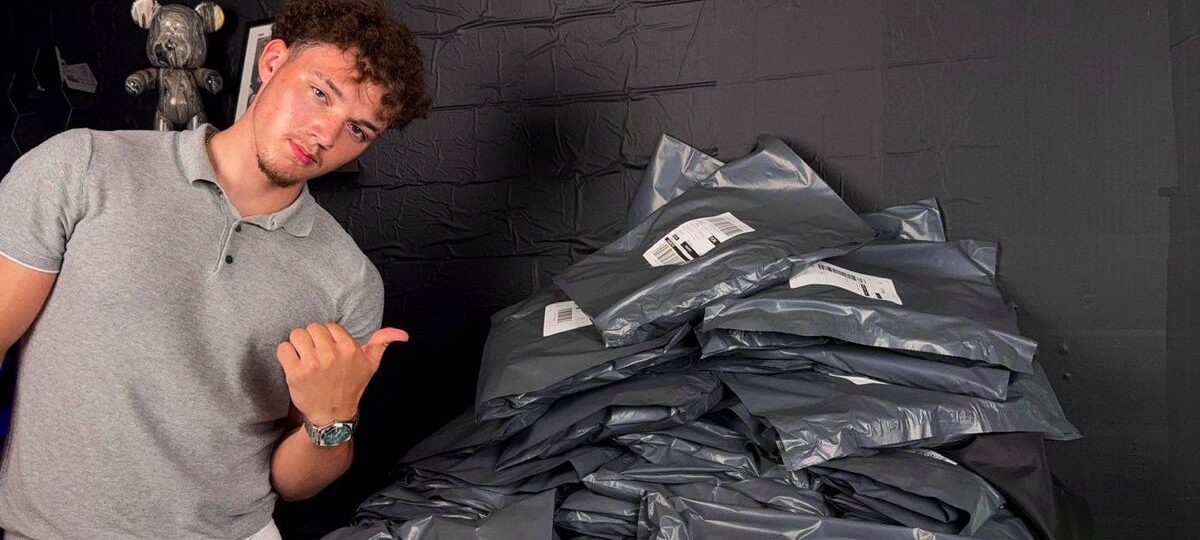
This as-told-to essay is based on a conversation with Morgan Purnell, a 20-year-old entrepreneur who runs a vintage-clothing resale business and is based in Surrey, UK.
It’s been edited for length and clarity.
My dream when I was a kid was to play professional rugby.
But when I tore 2 ligaments in my right knee when I was 17, it knocked me out of rugby for about a year and a half.
My entire identity was stripped overnight.
At that time, I saw a Google ad for Vintage Wholesale Supply, where you can buy vintage items in bulk.
I had about £400 ($537) saved from working a part-time job in a sports center, and bought 50 kilos of Ralph Lauren trousers for around £200 ($268).
Within that first month, I had sold around 70 pairs of Ralph Lauren chinos on Depop and Vinted and used TikTok to promote my page.
I bought each pair for about £4 ($5.37) each and sold them for between £20 and £30 each ($27 and $40).
That was the start of my journey in July 2024, and what drove my spark.
I thought I might as well keep reinvesting.
At the very beginning, I would work nonstop — seven days a week, probably 12 hours a day, just because that was all I could think about.
I was at boarding school, so I had some of the stock in my bedroom at school.
I had some of it in my car and some at home, too.
In my first year of reselling, I started documenting my journey on TikTok.
For instance, I launched a series about turning £400 ($533) into £10,000 ($13,340).
Day 2 of scaling my reselling business from £10k to £20k per month. 🚀 Follow us as we look to hire, outsource and scale our output to reach a new goal in our journey 🎯 #reselling #vinted #itsmorganpurnell #entrepreneur #reseller I took on two boys I knew from my local area to help with the business, and I paid them for tasks such as ironing and photographing the stock.
About three or four months in, in September 2024, Vinted saw a huge uptick.
Everyone sort of jumped in, flooded it, and things started selling really well.
So I transitioned to mainly selling there.
The original plan was to study business management and marketing at the University of Bath.
I felt like it was what my parents wanted me to do because it was the safer option.
However, I had proven to them that my business would generate enough to allow me to live and earn at least what a graduate would.
I decided I was going to do a year out, and if I could make it work, I would keep doing it.
In 2025, we made £142,235 ($191,241) in revenue, including from partnerships, such as social media content for wholesalers.
Vinted sales made up £85,873 ($115,442) of this.
I was able to build up a following on social media and start to use that to sell some reseller bundles, which involve supplying bulk to other resellers.
I now source from suppliers in Karachi, Pakistan.
That’s been a real blessing because I can put out a story if I’m in trouble and shift stock fairly quickly.
Income fluctuates a lot with reselling.
In the six months to December 2025, monthly sales ranged from a low of £3,709 ($4,984) in March to a high of £20,403 ($27,418) in December.
Thanks to AI, I have better inventory management systems.
I use Aistetic, which turns product photos into marketplace-ready listings.
I also use ChatGPT to organize my data and sold items in one place, which makes it much easier to manage inventory across three to four sites.
I now use a mix of Vinted, Depop, and eBay.
They complement each other well because eBay is a platform where you generally sell at a slower pace, but it has a more mature demographic with more disposable income.
So, you tend to get better prices on eBay.
Vinted is great for selling quickly, though at lower prices.
I feel like you could list a bottle of water on Vinted and probably sell it if you set the price right.
I kind of compare Depop to Instagram and Vinted to TikTok.
At the moment, it’s just me working on the reselling businesses.
I spend five or six hours a day on reselling alone, but never work on Sundays.
I never work on Sundays, I go to church and spend time with my family.
The benefit of being an entrepreneur will always come down to freedom — the freedom of choice, the freedom to go to work when you want, the freedom to leave work and go to the gym when you want, and not having that pressure.
Discover more from NAIRAVOICE.COM.NG
Subscribe to get the latest posts sent to your email.