ABUJA, NIGERIA – President Bola Tinubu has recalled how he worked as a taxi driver and took up other jobs in the United States to finance his university education, saying the experience shaped his commitment to expanding access to education in Nigeria.
Tinubu said he postponed the start of his studies for several months after arriving in the US to save enough money to fund his education.
The President disclosed this in a post on his X handle on Wednesday while outlining his administration’s interventions and reforms in the education sector.

He said his experience of struggling to pay tuition, accommodation and other living expenses had given him an understanding of the financial difficulties many Nigerian students face while pursuing higher education.
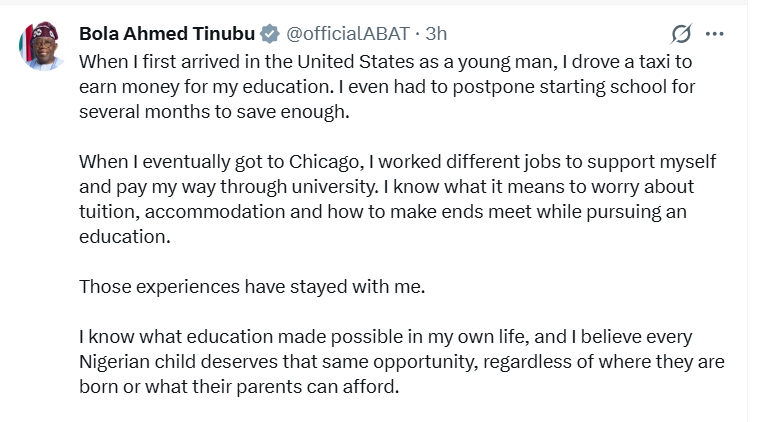
“When I first arrived in the United States as a young man, I drove a taxi to earn money for my education. I even had to postpone starting school for several months to save enough.
“When I eventually got to Chicago, I worked different jobs to support myself and pay my way through university. I know what it means to worry about tuition, accommodation and how to make ends meet while pursuing an education.
“Those experiences have stayed with me. I know what education made possible in my own life, and I believe every Nigerian child deserves that same opportunity, regardless of where they are born or what their parents can afford,” he said.
Tinubu said education remained a major priority of his administration, highlighting the Nigerian Education Loan Fund (NELFUND), technical and vocational education reforms, university funding and investments in medical training as some of the interventions being pursued by the government.
NELFUND Disburses Over N372bn in Student Loans
The President disclosed that NELFUND had provided more than N372 billion in student loans to support institutional fees and students’ upkeep.
NELFUND was established under the Student Loans (Access to Higher Education) Act, 2024, which Tinubu signed into law in April 2024. The scheme provides interest-free financial assistance to eligible Nigerian students in public tertiary institutions.
The facility covers institutional charges and upkeep allowances, with approved tuition and other institutional fees paid directly to beneficiaries’ schools, while maintenance allowances are transferred to students’ bank accounts.
The law removed the previous family income threshold and guarantor requirement, allowing eligible students to apply without their parents meeting a specified income level or providing guarantors.
Under the repayment arrangement, beneficiaries are expected to begin repaying their loans two years after completing the National Youth Service Corps programme. Repayment is linked to employment or income, with employed beneficiaries required to have 10 per cent of their monthly salaries deducted at source.
Tinubu said the intervention was intended to reduce financial barriers to higher education and provide students with opportunities to complete their studies.
Government Reports Progress in Technical Education
On technical and vocational education, the President said the government’s programme had attracted more than 2.8 million applications, while 38 technical colleges had been rehabilitated.
He added that students in federal and selected state technical colleges now benefit from free tuition, boarding, textbooks and uniforms.
The intervention is part of the government’s efforts to expand access to technical and vocational training and equip young Nigerians with practical skills.
Tinubu’s announcement also highlighted the need to strengthen technical education as a pathway for young people to acquire competencies relevant to employment and national development.
ASUU Agreement Targets University Stability
The President also disclosed that his administration had reached a new agreement with the Academic Staff Union of Universities (ASUU), providing for a 40 per cent increase in academic staff remuneration and measures aimed at improving stability in the nation’s universities.
He said the agreement was intended to support uninterrupted academic activities and ensure that students complete their programmes within the expected period.
“A four-year course must take four years. Our young people deserve to complete their education on time and get on with their lives. Promise made, promise kept,” he said.
The statement comes amid longstanding concerns about disruptions to university education and the effect of industrial disputes on students’ academic progress.
N110bn Investment in Medical Schools
Tinubu further disclosed that his administration was investing N110 billion in the rehabilitation of 24 medical schools to strengthen medical education and expand the country’s capacity to train healthcare professionals.
He said annual nursing enrolment had increased from 28,000 to 115,000, while medical and dental enrolment had risen from 5,000 to 12,000.
The President said the expansion was necessary to increase the number of trained healthcare professionals available to serve the country.
“Nigeria needs more doctors, nurses and other healthcare professionals, and we must build the capacity to train them here at home,” he added.
The proposed rehabilitation of medical schools and reported increase in enrolment form part of the administration’s stated efforts to strengthen healthcare training institutions and improve access to professional education.
Over One Million Out-of-School Children Returned to Learning
The President also said more than one million children who were previously out of school had returned to learning through interventions by his administration.
He added that the government was investing in teacher development and expanding educational opportunities for girls.
Tinubu further announced that a new national curriculum was being implemented to restore Nigerian History to classrooms.
He said the inclusion of the subject was important to helping children understand the country’s past, develop a sense of national identity and prepare for future responsibilities.
“Our children must know where we have come from, understand the country they belong to, and be prepared to take responsibility for its future,” he said.
The President commended the Minister of Education, Dr Tunji Alausa, the Minister of State for Education, Professor Suwaiba Sa’id Ahmad, and other members of the education team for their contributions to the reforms.
Tinubu Unveils Interactive Education Reform Platform
As part of efforts to improve public access to information about the education sector, Tinubu announced the introduction of an interactive A–Z platform for the Nigeria Education Sector Renewal Initiative.
He said the platform brings together information on government reforms, programmes, achievements and opportunities across the education system.
The President urged Nigerians to visit edu4pbat.ng to explore the initiative and provide feedback on challenges affecting education in their communities.
He encouraged parents to identify opportunities available to their children, students to explore programmes they could benefit from, and teachers to access information about available support.
Tinubu also called on members of the public to report areas where education interventions were not working as expected, saying feedback would help the government identify and address challenges.
“If you are a parent, find out what opportunities are available for your children. If you are a student, explore the programmes you can benefit from. If you are a teacher, see what support is available.
“And if something is not working as it should in your community, I want to hear about it. Your feedback will help us identify problems and address them,” he said.
The President concluded by stressing that a child’s circumstances at birth should not determine the limits of their ambitions, adding that every Nigerian child deserved a fair opportunity to fulfil their potential.
His remarks placed access to education at the centre of the administration’s stated development priorities, while highlighting student financing, technical training, university stability, medical education and school enrolment as key areas of intervention.
Discover more from NAIRAVOICE.COM.NG
Subscribe to get the latest posts sent to your email.