

A while ago, I was chatting with a friend, venting about some of the stresses of being a working mother, the feeling of spinning plates with something always dropping. “What I want is a wife,” my friend said.
I remember laughing out loud, because it so perfectly captured our frustrations.
We both have dutiful, egalitarian husbands who go above and beyond to do their share of the housework and childcare.
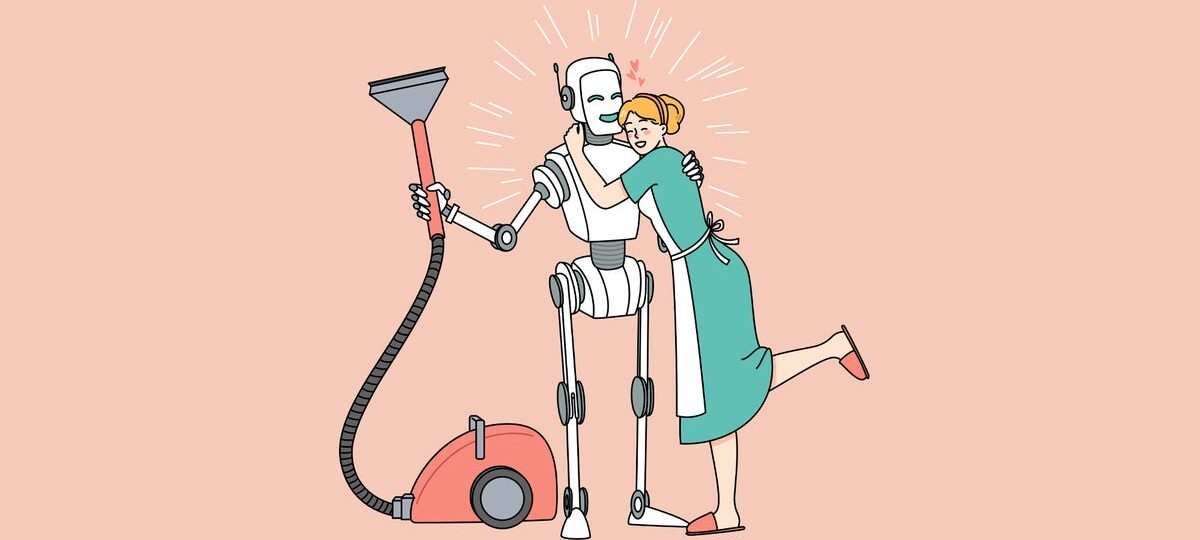
Sonia Baschez, a marketing entrepreneur and podcaster, went viral earlier this week for saying what she wanted from AI agents is “a wife,” not “a husband” — by her definition, something that anticipates your needs versus just doing tasks you assign it.
Silicon Valley keeps building me a husband when what I really want is a wife lolI don’t want an agent that only does one-off, random tasks that are nice but not life-changing: booking flights, making dinner reservations, or buying ticketsI want an AI wife who knows what’s on… Let’s indulge in some broad, sweeping, gendered stereotypes for a moment.
Consider the “mental load” — the concept in heterosexual couples with kids that the mother is often mentally carrying a running tab of chores and considerations, even when the dad helps out.
The classic example is a dad offering that if he is given a grocery list, he can go to the store, but that requires that the mom needs to make the list by knowing what’s currently in the fridge and what the meal plan for the week is.
Some people enthuse that AI agents like Muse or Instinct are like having your own executive assistant.
But the truth is, I don’t really need an executive assistant at my job.
I’m not a globe-trotting executive who needs to book lots of flights, nor am I a coder building an app, which seems to be what a lot of the product demos for tools like OpenAI’s Dots are.
Instead, what I’ve found AI agents for (I’ve tested Muse the most) to be most helpful for is personal and family tasks, especially related to the various paperwork, scheduling, and messages that come from my kids’ school and activities.
Basically, I agree with Baschez’s idea.
I want something I don’t have to give a list of detailed instructions to, I want it to just do it.
Although Muse has been great for time-saving on certain discrete tasks like filling out a school form and sending it in, for a lot of the tasks I’ve given it, I still have to do a lot of work on my end to give it step-by-step instructions.
Basically, the same thing that happens when I ask my husband to do something and then realize ugh, it’s just easier if I do it myself.
I talked to Baschez about her idea. “I think in general, women understand that if I’m going to have an AI assistant, I want it to do enough for me that I actually feel like I’m getting part of my life back,” Baschez told me. “A lot of women who have their own businesses like me are saying, ‘This would be great so I can focus more on business where I’m not doing that dumb administrative stuff, but then also I can focus on my family and not have to do the emotional labor and the mental load.'” Baschez told that a lot of the reactions she had been hearing from women were similar to mine, and that even most men understood the concept (although at least one person didn’t get the joke and thought she genuinely believed wives were just “chore mules”).
She’s well aware that the metaphor of AI being a “wife” instead of a “husband” is playing into gendered stereotypes that are certainly not true of all partnerships.
But it’s useful shorthand that people can understand — something that helps normies imagine what use an AI agent could be to them.
Plus, there is a funny way that AI reveals some 90s-sitcom-level stereotypical gendered behavior.
I saw a tweet today about a dad who said his wife asked him to read a book to the baby, and he considered instead training an AI model on his own voice to read audiobooks to it instead (unclear if he actually followed through).
Another funny tweet about Amazon cutting off AI agents had the Rodney Dangerfield-esque punchline: “I already have a human agent who buys way too much shit on Amazon called my wife.” Right now I’m testing out Muse, Instinct, and Dot — giving them some similar tasks to see which performs better, and to get a feel for which is easiest for me to use.
But my initial tests have revealed a nasty side effect: now I have too many “wives,” and they’re nagging me all day.
Husbands: you finally have my sympathy.
Discover more from NAIRAVOICE.COM.NG
Subscribe to get the latest posts sent to your email.