

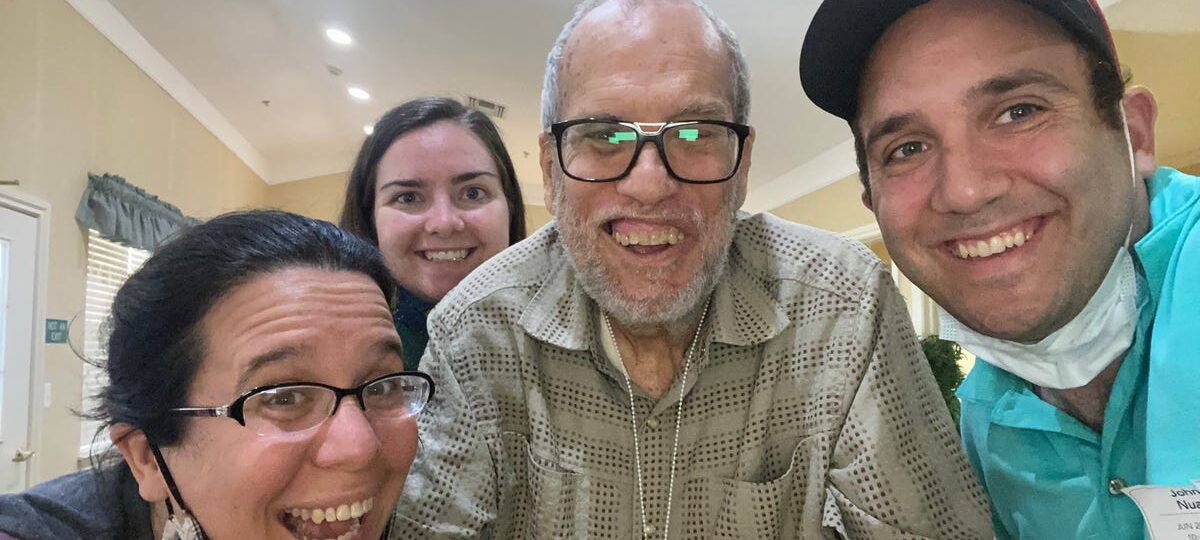
This interview is based on a conversation with John Nuar, 34, who lives in Canton, Michigan.
Nuar built a home to live in with his father with dementia, where he lived from 2017 to 2019 before moving in with his brother.
He lived for three years in memory care before he died in 2024.
This interview has been edited for length and clarity.
I work in supply chain management for an automobile company in Michigan.
I have two siblings, and since my 20s, have been a caregiver for my father.
My dad started having early memory lapses around 2015 when he was in his late 60s.
It got to the point that in 2017, we wanted him to live with my wife and me because he needed more support.
He needed to be on the first floor due to hip issues preventing him from doing stairs.
My dad was on board with moving in with us.
We had to frame it in a way that didn’t take away his independence, making the things that are hard for him easier.
My wife and I went under contract for our current place in January 2017, and the builders told us it would take six to seven months to finish.
We sold our other house at the end of August to give ourselves a month to move.
When the time came, the house was nowhere near done, so my wife, our two dogs, and I lived with my sister and her kids while my dad bounced between his two siblings, which wasn’t great because he kept getting lost.
Are you paying for your own or your loved one’s long-term care?
Do you have thoughts to share about long-term care in the US?
To share your story with a reporter, please fill out this quick form.
We noticed in a few instances that, while we were tracking his phone, he was on the other side of Detroit.
I would call him and ask what he was doing, and he wouldn’t really know and said he would come back home.
We eventually moved into the home we built in late October.
We’d make him breakfast in the morning, and he would eat dinner with us at night, and he would be on his own during the day.
We stayed on top of his medications, refilling his pillboxes and monitoring everything.
In March of 2019, he hit our garage door and didn’t tell us about it.
I was on a business trip, and my wife confronted him about it.
We decided that it wasn’t safe for him to drive anymore, so my wife took the keys away from him.
We tried using public transportation with him, but it’s pretty sparse in our town.
We would drop him off at church and have the bus pick him up, but he’d forget the bus was coming, and we’d have to get him an Uber.
Looking back, I would not have bought the house we live in now.
We used technology as much as we could to augment things because we were both at work all day.
We’d have cameras in the house where we could see what he was doing.
He had an automatic door handle so that if he locked himself out, we could unlock the door for him remotely.
There were three times he ended up wandering, and the last time he had wandered 15 miles.
He ended up at a friend from church’s house, and they called me to come pick him up.
This was our wakeup call that it’s not going to work out with him living with us, not being at home 24/7.
We started investigating our options.
In Michigan, there’s a voucher program, but he was a few hundred dollars over the limit to qualify.
We also tried the PACE (Program of All-Inclusive Care for the Elderly) program through Medicare and Medicaid, but it didn’t work out.
I wish I had understood better how different states treated Medicaid, which could have influenced where we moved.
We didn’t really talk about what would happen with his end-of-life care earlier in his life, so we weren’t confident in what he wanted.
I wish I had done this before we got into a more serious crisis.
I was trying to have conversations with him that were simple enough to understand, with advanced dementia.
It was either private pay for everything or put him in a nursing home, and we didn’t have the funds to privately fund everything.
He didn’t have a ton of money left, either.
The nursing homes that would take him were rated very poorly, and the higher-rated ones didn’t have Medicaid beds available, meaning we would have to pay $10,000 a month until a Medicaid bed opened.
We hit a tipping point, and luckily, my aunt and uncle, who live in Virginia, agreed to take him in because they live in a walkable area.
After two months, they got him a caregiver, then another as he became more confused.
They’re both in the medical field, but they were deferring all the medical and financial decisions to me, though they walked me through a lot of decisions.
My sister and I tried to go out at least one weekend a month to give my aunt and uncle a reprieve.
But in early 2021, they said he was past the point where home care was a good idea anymore.
We ended up putting him in a private pay-only memory care facility back in Michigan, and we found one with heavy incentives to get people in since this was during the height of the pandemic.
My wife and I picked up the difference between what his Social Security and $300 monthly pension covered and what the place cost.
The facility he was at was pretty good overall.
He was falling all the time in his first year before becoming wheelchair bound.
There was a lot of stress, and we would get so much anxiety whenever the facility called.
Our daughter was born six months into his being there, after which there was a constant tension of asking ourselves, “Should we put him into a state facility?
Is he actually getting any value out of memory care?” He lived there for just under three years before he died.
In total, my wife and I paid about $120,000 out of pocket.
This was about $1,500 at first, but rose to $3,500.
When he first started in memory care, it was $4,200 a month, but it rose to $6,600 in the end.
This was partly due to rising costs and partly because his care level increased.
We rented his wheelchair for $175 a month, and his Medicare supplement was $326 a month.
Our income grew significantly during his care, so we were not drawing down our savings and didn’t have to make any major adjustments to raising our kids.
We had a lot of help with childcare from family.
I often had anxiety around not saving this money for the future, making calculations like if I saved $3,000 now, that would be worth $80,000 in 30 years.
1 thing that I preach to people is maxing out an HSA for long-term care expenses.
We want our kids not to go through the same things we went through with my dad.
My wife and I both have advanced healthcare directives and wills fully filled out, so it’s written down what we want if something were to happen.
I’m also preparing for the scenario of if I can’t work after 50 because of some sort of disability.
My wife and I have been more frugal.
There was also an emotional cost to all of this; having to look at dollars and then make a care decision was, and still is, very hard.
Discover more from NAIRAVOICE.COM.NG
Subscribe to get the latest posts sent to your email.