
Hours before the 2018 World Cup kicked off in Russia, delegates representing more than 200 FIFA member states filed into a massive conference center rising above the left bank of the Moscow River.
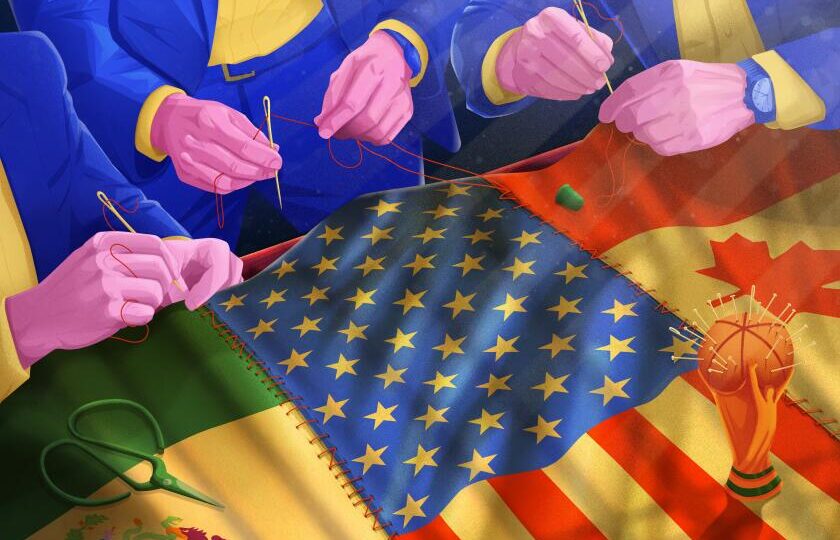
There they would be voting to pick a host for the 2026 tournament and the ballot held just two candidates: Morocco, bidding for the World Cup for the fifth time, and a joint bid from the U.S., Mexico and Canada, marking the first time three countries offered to share host duties.
Months earlier it had appeared to be an election in name only. This World Cup, with 48 teams, would be the most complex sporting event in history and the North American bid was unique in both size and scope. The three countries had all the resources, infrastructure and logistical know-how to put on the tournament, having already combining to host six men’s and women’s World Cups.
That dwarfed the offerings of Morocco, which had no existing stadiums that conformed to tournament specifications and would need to spend upwards of $15 billion to prepare for a World Cup.

The U.S., Mexico and Canada would go on to win the bid, but as the presidents of those three countries’ soccer federations, co-chairs of the so-called United Bid, took their seats in the first row of the main hall that Wednesday, the outcome was very much in doubt.
“Even the night before, we never believed we had this locked up,” said Carlos Cordeiro, then the newly-minted president of the U.S. Soccer Federation and a co-chair of the United Bid committee.
“You always have doubt in those moments,” remembered Decio de Maria, then president of the Mexican federation. “It’s like the flip of a coin.”
That doubt was well-earned. Cordeiro, De Maria and Steve Reed, then president of the Canadian Soccer Association, had spent much of the last three months living together in an extended-stay hotel in London, their base for a desperate last-ditch effort to wrestle the 2026 World Cup away from Morocco.
From there the three presidents traveled around the world in less than 80 days, meeting with representatives of every FIFA federation that had a vote — and some that didn’t. They coaxed, cajoled, begged and beseeched for support to bring the tournament to North America.
“Nobody knew if we were behind, tied or ahead,” said De Maria, who had helped bring the 1986 World Cup to Mexico as well. “But what I learned about the process is that you have to visit everybody, talk to them and make a good presentation.
Read more:Column: United Bid Committee tries new approach to rescue 2026 World Cup bid
“At the end, they understood that our bid was a good one.”
But it didn’t start that way.
On April 10, 2017, when the United Bid was officially announced, it was done from the 102nd floor of New York’s One World Observatory, the tallest building on the continent. The lack of subtly was the point and the document supporting the United Bid would run to more than 70,000 pages.
Sunil Gulati, then president of U.S. Soccer, was first to the podium, flanked by De Maria and Victor Montagliani, then president of the Canadian federation. The three countries’ combined wealth and resources made the United Bid arguably the strongest in World Cup history.
And for months no other country even considered a challenge, making the United Bid’s selection appear to be more a coronation than a vote. But then in August of 2017, less than 10 months before FIFA would vote on awarding the rights to the tournament, Morocco entered the race.
Within weeks the boldness of the United Bid became its weakness. The proposal was announced by the U.S. Soccer president, in the U.S., where a majority of games, including the final, would be played. And Gulati was the bid committee’s sole chairman.

To outsiders the bid looked less like a united one and more like one led by the U.S. If once that had been a strength, it soon became a weakness because just eight months into President Trump’s first year in office, anti-American sentiment was growing over his administration’s derogatory comments about some African and Latin American countries and a proposed travel ban on citizens of majority Muslim countries.
“There was always perhaps a little bit of hesitation about the U.S.; if it was a U.S. bid and they were the ones at the forefront,” said Reed, who succeeded Montagliani as the head of Canadian soccer a month after the United Bid was announced. “So we kind of positioned it differently. ‘No, it’s these three nations and we are all equal and we’re co-hosting’.”
“In the politics of football,” Reed added “you just never know.”
Gulati knew. Because he had been burned by those politics before.
Eight years earlier the U.S. was confident it had done enough to win the right to host the 2022 World Cup, only to lose to Qatar in a process marred by allegations of bribery and fraud. For Gulati, who had put so much into that bid, it was a crushing setback.
“There were two divergent thoughts,” he remembered recently of that moment. “One is, I never want to do this again, I never want to be near these people again.
“And two was, let’s start right away.”
It took him a while to get to that second place. But by 2015, FIFA president Sepp Blatter had been forced to resign, felled by a corruption scandal, and Gianni Infantino, his successor, had changed the way the organization approved World Cup bids, going to a transparent public ballot in which every country would vote electronically.
Read more:World Cup: 2026 World Cup is awarded to North America
Convinced the process would be fair this time, Gulati and U.S. Soccer prepared to bid again. But so did Mexico and Canada. Worried they would divide votes that would cost North America the tournament, officials in the three countries began negotiations over sharing the event.
The result was the United Bid, officially launched 1,250 feet above the streets of lower Manhattan. But just 10 months later, the campaign suffered what appeared to be a fatal blow — yet one which may ultimately have saved it from ruin.
In the wake of the U.S. national team’s failure to qualify for the 2018 World Cup, coach Bruce Arena and his staff resigned. Seven weeks later Gulati also fell on his sword, announcing that he would not seek a fourth term as U.S. Soccer president. That cleared the way for Cordeiro, Gulati’s vice-president, to win the presidency at U.S. Soccer’s general meeting in February 2018.
A Harvard graduate and former Goldman-Sachs investment banker, Cordeiro was well-suited to head a World Cup bid. He was born in Bombay (now Mumbai) to a Colombian mother and Luso-Indian father, then moved to Miami Beach, one of those most diverse cities in America, when he was 15.
But he took over U.S. Soccer — and, by extension, the United Bid — at a delicate time, with the vote to award the 2026 tournament just four months away. He had a lot of catching up to do, so in his first international trip as president, he traveled to the UEFA Congress in Slovakia.
The visit was intended to shore up the United Bid with some of the 55 European federation presidents in attendance. But after just a few conversations, Cordeiro came to realize the bid may not have had the level of support he assumed it did.

Worried the World Cup was slipping through their fingers the bid committee reorganized in a way that made it, well, more united. Less than 24 hours after Cordeiro had landed in Slovakia, he, Reed and De Maria were named co-chairs of the committee. The reorganization served two purposes: it made the bid appear more a joint project and less something that was led by the U.S., and it also gave the three federation presidents equal standing and power to speak on behalf of the bid.
That second part was vital because the committee believed the best way to make up its perceived deficit to Morocco was to meet in person with representatives of each of the FIFA federations that would be voting in Moscow.
With just 12 weeks left before the vote, that would have been impossible for one person. But with three separate delegations – each with representatives from the U.S., Canada and Mexico – traveling to locations in Europe, Asia, Oceania and South America — the sprint to the end, while still challenging, was suddenly manageable.
“We didn’t want to just talk about a united bid, but truly show that was the case,” said Cordeiro, who hatched the plan.
The three presidents and their staffs — divided into three teams, Team Red (Canada), Team Green (Mexico) and Team Blue (the U.S.) — checked into the Fraser Suites, an extended-stay apartment hotel in London. Meetings were scheduled with various federation representatives and most nights the three co-chairs and their traveling parties would call in to find out where they were going next.

The strategy, said one member of the U.S. team, was to make it personal by meeting with federation heads on their turf, face-to-face, and allowing them to ask questions, dig into the details, and even challenge the United Bid representatives.
The itineraries frequently sent each of the three co-chairs to five or more countries each week because the United Bid couldn’t afford to skip any of them. Under FIFA rules, the vote of each member federation counts equally, giving Fiji and the Faroe Islands as much power as France and Finland.
Cordeiro remembered being in Hong Kong and getting a message that he had to be in Saudi Arabia the next day. A direct flight would take 11 hours but he was routed through Dubai instead, making the trip a tortuously long one. Another Cordeiro trip started with a flight from London to Latvia, then on to Belarus and Lithuania on the same day. Before the week was out, he would also visit Slovenia, Poland, Turkey and Ukraine.
Along the way the bid representatives found themselves singing karaoke in Kuala Lampur, attending the King’s Cup final in Saudi Arabia and sitting for a traditional dinner in a heated winter garden in the city square in Latvia.
That left little time for family.
Near the end of the ordeal Reed invited his wife to visit him in London for the first time in a month, only to be dispatched, with De Maria, to southern Africa at the last minute. His plane took off just as one carrying his wife landed.
Read more:U.S. and Canadian referees will have a record-sized presence at World Cup
“We had a really good presentation with all the federations down there and we ended up getting almost all of the African vote,” Reed remembered triumphantly.
Well, not really; the continent went 41-11 for Morocco but Reed and De Maria did pick up South Africa, Zimbabwe, Botswana, Lesotho and Namibia, making the overall count a landslide, with the United Bid receiving more than twice as many votes as Morocco. When Infantino, the FIFA president, read the results to the gathered delegates in the Moscow convention center, Cordeiro pumped both fists, began to clap, then embraced Reed before turning to hug De Maria.
Both the Canadian and Mexican federations have gone through four presidents since 2018; in the U.S., Cindy Parlow Cone, a former World Cup champion, became U.S. Soccer’s first female head in 2019, less than a year after Cordeiro tugged the World Cup bid across the finish line.
Cordeiro, meanwhile, has gone on to become a senior advisor to Infantino while Gulati is a senior advisor to the New York-New Jersey host committee, which is responsible for July’s World Cup final. For Reed and De Maria, their fame was far more fleeting and their vital work seemingly forgotten.
Not that they care all that much.

De Maria 70, an economist who now advises one of Mexico’s largest pharmacy chains, plans to attend the World Cup opener at Azteca Stadium. He is one of the few people in Mexico, he said, who will have attended games from all three World Cups the country has hosted, with 2026 following 1970 and 1986.
“I’m proud I have the privilege of being in charge, of doing that job,” he said by phone from Mexico City. “But the thing that I’m proud of the most is that we will have three World Cups. For most of the children of this country, it’s going to be their first time.”
Reed, who brought the tournament to Canada for the first time, said he had to buy tickets to the opening game in Toronto.
“We weren’t doing it for the accolades. We weren’t in it to get the freebies and stuff,” Reed, 70, a retired CPA, remembered by phone from a cabin in British Columbia’s remote Northern Gulf Islands. “It was just, you know, a labor of love, wanting to make sure that we had the opportunity to bring something to Canada.”
“It was crazy and very, very tiring,” he added. “There were times when we were at each other’s throats. But we’re truly very close friends now.”
This story originally appeared in Los Angeles Times.
Discover more from NAIRAVOICE.COM.NG
Subscribe to get the latest posts sent to your email.