
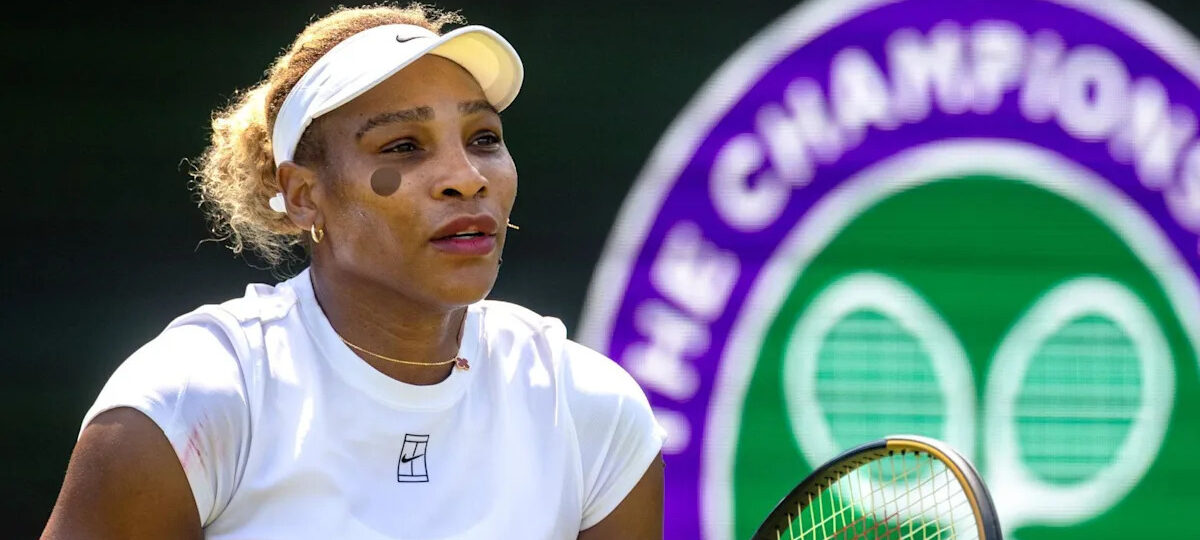

Serena Williams says the “gruelling” nature of the anti-doping testing process almost stopped her from making a shock comeback to the sport which she once dominated.
The 44-year-old American superstar returned in the Queen’s doubles earlier this month before deciding to make a singles comeback at Wimbledon.
The first sign the 23-time Grand Slam singles champion was seriously planning to play again after a four-year absence came when she rejoined the sport’s anti-doping testing pool in December.
But mother-of-two Williams, speaking in a packed Wimbledon news conference on Sunday, says the protocols almost put her off.
“It’s gruelling. That was a big reason why I didn’t want to come back either, because it’s just so hard,” said Williams, who plays Australian world number 53 Maya Joint in the first round on Tuesday.
“My life is busy, I run a [venture capital] company, I travel the world. I have children. It’s like I could be in so many different cities so many different times.”
What are the rules? And why are players ‘stressed’ about them?
Every active player is subject to out-of-competition testing.
But those in the testing pool – which is largely comprised of the top 100 singles, doubles and wheelchair players as well as returning athletes – must let the testers know where they will be for one hour of every single day.
A player who misses three out of-competition tests in a 12-month period after being contacted by a tester is likely to be sanctioned.
Williams claimed there are “new rules” in place, but the ITIA says the protocols around whereabouts have not changed since she “evolved away” from tennis September 2024.
“It’s unprofessional. I hate it. I think it’s necessary, but I think a lot of the stuff, if I want to go places outside of my window, I should be able to go without having it count as a missed test,” said Williams.
American player Jenson Brooksby was banned for 18 months for missing three tests, although his suspension was later reduced to 13 months by the International Tennis Integrity Agency (ITIA).
The ITIA says no-notice testing is a “fundamental pillar of an effective anti-doping programme”.
A lot of players have voiced their concerns about the process, highlighted the stress which they say the system causes them.
Two-time US Open finalist Jessica Pegula said last year she knows a lot of players who “don’t sleep” because they fear missing a test, while recent French Open champion Alexander Zverev described how he was called back to his home in Monte Carlo by testers while he was driving his daughter to Nice airport.
Now Williams is also complaining her personal freedom is being taken away by the process.
She she does not mind because she loves tennis but “it is just getting [back] into that routine of reporting every day”.
Williams added: “I guess now for 24 hours where I’m going to be is just different – at least for me. I don’t know if that works for everyone else.”
The ITIA says the rules are not designed to “trip players up”.
In a statement provided to BBC Sport, it added: “We understand the system can seem challenging, but it is there to protect players.
“If players are unsure or have questions, we would welcome a conversation with them directly or through their agents.”
Last week, 2023 Wimbledon champion Marketa Vondrousova was handed a four-year ban for refusing to take a doping test.
While the ITIA said it had no choice other than to recommend she received that punishment as per the rules, Vondrousova received an outpouring of support from fellow players who thought it was too severe.
French Open semi-finalist Marta Kostyuk was among those to criticise the length of the ban.
The debate around Vondrousova’s ban – and now Williams’ comments – underlined how there is often friction between the players and the body which is trying to ensure they compete in a clean sport.
“There are always two sides of every story – what the player says and what the ITIA say – but I just try to follow the rules,” Kostyuk told BBC Sport.

Discover more from NAIRAVOICE.COM.NG
Subscribe to get the latest posts sent to your email.