
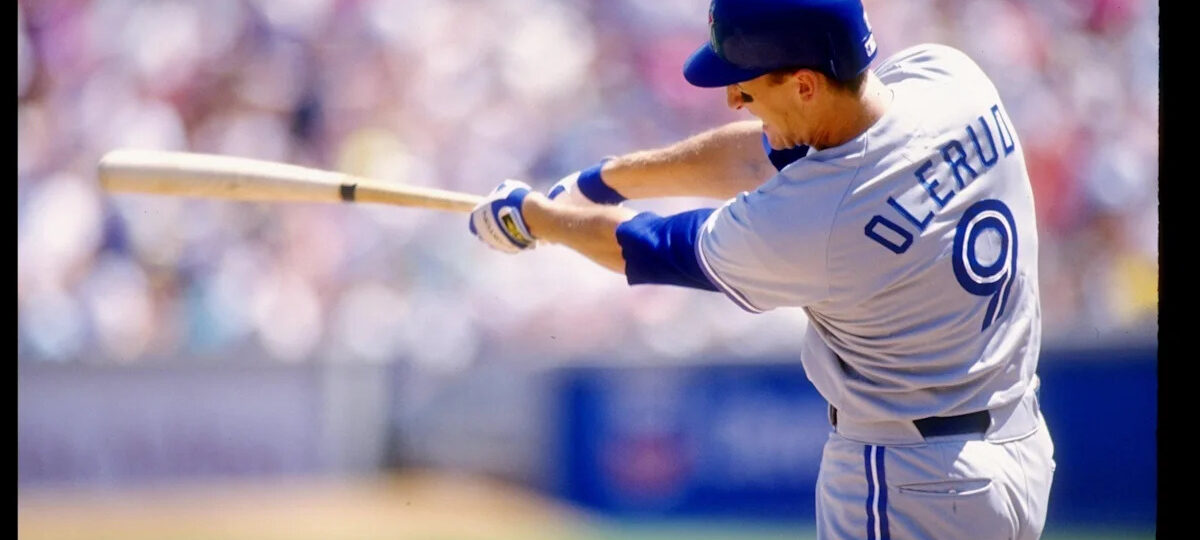

Today marks John Olerud’s 58th birthday.
John Olerud, born in Seattle, Washington, followed his father’s path—his father also named John—who played catcher for Washington State University and reached Triple-A in professional baseball. Olerud Jr. was picked by the Blue Jays in the third round of the 1989 draft out of Washington State, where he stood out as both a pitcher and a fielder, amassing a 26-4 record on the mound. Unusually, he started his pro career directly in the majors, only appearing in minor league games in 2005 while recovering form after joining the Boston Red Sox.
Olerud gained recognition for wearing his batting helmet while playing first base—a precaution after a health scare in early 1989, when he collapsed following a workout due to spinal column bleeding. A month later, he had surgery to remove a brain hemorrhage, leading him to wear the helmet in the field for extra protection.
After signing with the Blue Jays in late August, Olerud joined the major league roster as a September call-up, appearing in several games as a defensive replacement. In 1990, he made the team out of spring training, platooning at designated hitter while Fred McGriff played first base. Facing mostly right-handed pitchers, Olerud hit .265/.364/.430 in 111 games and finished fourth in Rookie of the Year voting. That offseason, the Jays traded McGriff and Tony Fernandez for Roberto Alomar and Joe Carter, clearing the way for Olerud to become the starting first baseman.
In 1991, Olerud began the season in a platoon with Pat Tabler and later Ed Sprague. He posted a solid .256/.353/.438 line with 17 home runs. Bill James oncecompared him to a young Rusty Staub, though Olerud would go on to surpass that comparison. He played infive games during the ALCS loss to theTwins, collecting three hits in 19 at-bats.
In 1992, as the Blue Jays won their first World Series, Olerud became a full-time player, starting against both right- and left-handed pitchers. He played through a broken nose suffered during batting practice, yet improved at the plate, hitting .284/.375/.450. Olerud shined in the ALCS win over Oakland, batting .348 with a home run, and hit .308 in the World Series victory over Atlanta—though he appeared in only four of six games as Cito Gaston shifted Carter to first base when the designated hitter was unavailable.
Olerud’s breakout year was 1993, when he hit .363/.473/.599 with 24 home runs, 54 doubles, 200 hits, 114 walks, 109 runs, and 107 RBIs. He was batting over .400 as late as August 2. He led the league in batting average, on-base percentage, OPS (1.072), runs created (161), doubles, and intentional walks (33). That year, he was an All-Star, won the Hutch Award for competitive spirit, and finished third in MVP voting behind Frank Thomas and teammate Paul Molitor—though many believed Olerud deserved the honor. He also had a 26-game hitting streak and became just the 20th player in MLB history to record both 200 hits and 100 walks in a season. It remains one of the greatest single seasons by a Blue Jay.
Olerud remained productive in the postseason, hitting .348 with four walks in the ALCS win over the White Sox. Although he batted just .235 in the World Series win against Philadelphia, he contributed a home run and four walks. By age 24, Olerud already owned two World Series rings—a remarkable start to his career.
The next few seasons were disrupted by the lockout and strike, and the Blue Jays struggled to recreate their earlier success. Although Olerud didn’t replicate his 1993 numbers, he consistently posted an on-base percentage above .390 each year. He might have thrived as a leadoff hitter, but speed was considered essential for that spot at the time. In 1996, his final year with Toronto, Olerud hit .274/.383/.472 with 18 home runs in 125 games, as Cito Gaston increasingly favored Joe Carter at first base and Carlos Delgado emerged as a key player.
With Carter, Delgado, and Olerud all competing for playing time over two seasons, roster changes became inevitable. Delgado was young, inexpensive, and had a bright future, while Carter remained Cito Gaston’s favorite. Olerud was seen as not aggressive enough at the plate, and his stellar 1993 season had set expectations he couldn’t quite match. Despite being the youngest and arguably the best hitter and fielder of the trio, Olerud was the one the Jays decided to move.
If trading Olerud was a mistake, sending him to the Mets for pitcher Robert Person was an even bigger blunder by Gord Ash. Person went 8-13 with a 6.18 ERA in two-plus seasons with the Jays. Meanwhile, Olerud remained a terrific player for several more seasons, while Joe Carter did not. It was simply a bad trade, but Ash was a poor GM for the team.
Olerud enjoyed three great seasons with the Mets, then four and a half strong years with the Mariners. He later played half a season with the Yankees and wrapped up his career with the Red Sox in 2005. Over 17 seasons, he compiled a .295/.398/.465 batting line, 255 home runs, 1,230 RBI, and 1,275 walks (77th all-time).
Baseball Reference lists Olerud at 6’5″ and 220 pounds—bigger than I remember. He had a picture-perfect left-handed swing and an excellent eye at the plate. He was strong defensively, winning three Gold Gloves as a Mariner. He probably deserved at least one Gold Glove as a Jay, but that’s how things go.
Matt noted that John hit better after leaving the Jays, even considering his one big season. This may have been because Cito insisted he become a pull hitter, even though Olerud’s real strength was hitting from foul line to foul line. Cito’s hitting philosophy worked for some players, but not for everyone.
John Olerud is married, lives in Fall City, Washington, and has a daughter. We saw him at the celebration for the World Series-winning teams in July. He looked like he could still play.
Happy birthday, John.
Today is Eric Hinske’s 49th birthday.
Eric Hinske was born in Menasha, Wisconsin. The Cubs selected him in the17th round of the 1998 draft from the University of Arkansas.
In March 2001, Hinske was traded to the A’s for Miguel Cairo. Later that year, he and Justin Miller were sent to the Jays for Billy Koch—a trade that clearly worked out in Toronto’s favor.
Eric’s rookie year in 2002 was outstanding. He racked up 99 runs, 84 RBI, 24 home runs, 77 walks, and 13 steals (caught just once)—almost all career highs and most setting team rookie records, except steals. He hit .279/.365/.481 with a 119 OPS+ and posted a 4.7 WAR per Fangraphs. His defense at third base was the main drawback, with limited range and 20 errors for a .946 fielding percentage, though Fangraphs gave him a 2.8 UZR/150. He made an early impression with a two-run single against Pedro Martinez in his first major game, and it seemed the Jays had found their third baseman for years to come.
After that season, JP Ricciardi signed Hinske to a five-year, $14.75 million deal, buying out his arbitration years—a move that seemed wise at the time. In 2003, Hinske hit just .243/.329/.437 (OPS+ 97) with 12 homers, but he tallied 45 doubles (fifth in the AL) in 124 games and stole 12 bases in 14 tries. His defense remained an issue, leading the league with 22 errors and a .930 fielding percentage. A broken bone in his hand cost him a month, which was blamed for his dip in offense—at least initially.
Hinske’s 2004 season was rough. He hit just .246/.312/.375 in 155 games (OPS+ 76), though he did have a 16-game hitting streak. The only highlight was his improved defense: just eight errors and a .978 fielding average, which led the AL. After the season, the Jays brought in Corey Koskie and Shea Hillenbrand for third base duties, moving Hinske over to first.
In 2005, Hinske improved at the plate, hitting .262/.333/.430 with 15 home runs, but made seven errors at first base. An OPS+ of 100 wasn’t enough for a first baseman or DH, so after the season, Ricciardi acquired Lyle Overbay for first and Troy Glaus for third.
At the start of 2006, Hinske platooned in right field with Alex Rios, but Rios soon won the job outright thanks to his strong play. When Rios went on the DL with a staph infection in June, Hinske filled in. Later, after Shea Hillenbrand’s departure, a spot at DH opened up for Hinske.
Hinske was enjoying his best season since his rookie year, hitting .264/.353/.513 with 12 homers in 78 games, when, on August 17, the Jays traded him to the Red Sox for cash.
Hinske developed a reputation as a good luck charm. In 2007, he earned a World Series ring with the Red Sox. The following year, he was on the losing side with the Rays, making the final out of the World Series on a strikeout—his second postseason at-bat, the first being a home run. In 2009, he won another ring with the Yankees, though he only had one plate appearance, drawing a walk. In 2010, his Braves lost in the NLDS to the Giants, but Hinske still managed two home runs in seven playoff at-bats. He remained with Atlanta through 2012, then played for the Diamondbacks in 2013.
After retiring, Hinske became a scout for the Yankees, then joined the Cubs as first base coach before becoming their hitting coach. He earned his third World Series ring with Chicago. This year, he’s serving as the assistant hitting coach for the Mets.
Happy birthday, Eric.
Today is Rick Bosetti’s 73rd birthday.
Bosetti played for the Blue Jays from 1978, the team’s second season, through 1981.
In 1978, as the Jays’ center fielder, he hit .259/.299/.347 with five home runs in 136 games. The following year, he played all 162 games, batting .260/.286/.362 with eight home runs, 13 steals, and 12 times caught stealing.
In 1980, after Toronto brought in Barry Bonnell for center field, Bosetti’s playing time dropped. He appeared in 53 games, hitting .213/.277/.324. In June 1981, he was traded to the A’s for cash. As a Blue Jay, he hit .252/.289/.348 over 376 games in four seasons.
Rick played for the Phillies and Cardinals before joining the Jays, and later appeared in 15 games over two seasons with the A’s after his time in Toronto.
Happy birthday, Rick.
It’s also Bobby Kielty’s 50th birthday.
The Jays acquired Kielty in exchange for Shannon Stewart midway through the 2003 season. He played 62 games in the outfield, hitting .233/.342/.376. After the season, Toronto traded him to the A’s for Ted Lilly.
Kielty played seven seasons in the majors, hitting .254/.348/.408 with 53 home runs in 599 games. He spent time with the Twins before joining the Jays, and later played for the A’s and Red Sox.
Happy birthday, Bobby.
Discover more from NAIRAVOICE.COM.NG
Subscribe to get the latest posts sent to your email.