
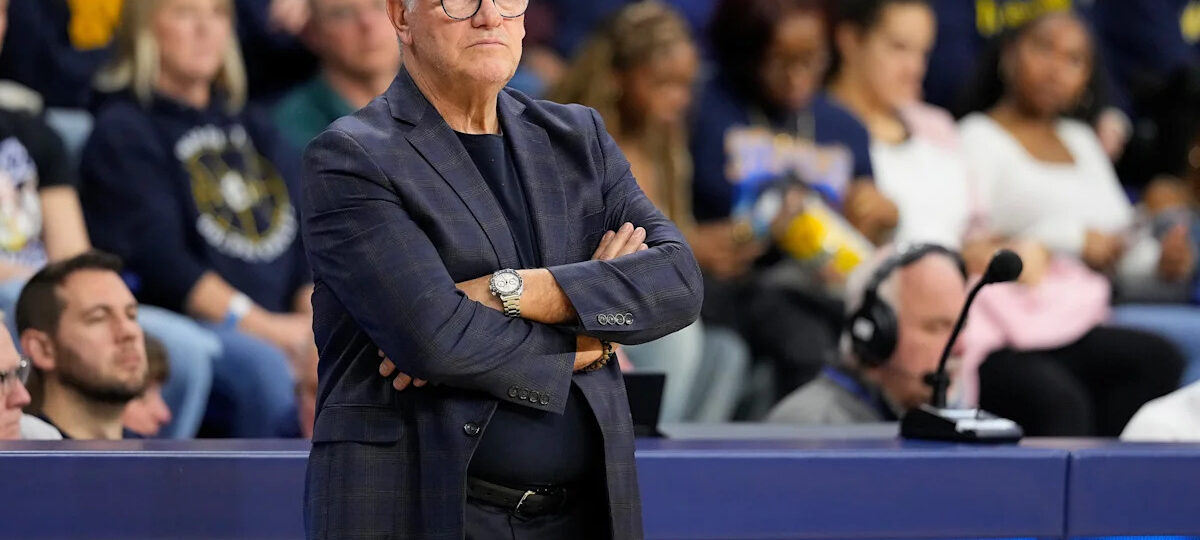
Legendary UConn head women’s basketball coach Geno Auriemma remembers when Caitlin Clark was a relative unknown in the basketball world. Iowa knew her, of course. Diehard women’s basketball fans were very much aware of the stat sheet-stuffing guard. And basketball junkies in general could wax poetic about her potential.
But she wasn’t a household name during the 2020-21 season, when Paige Bueckers, also a freshman at the time, made history by sweeping all the National Player of the Year awards for which she was eligible while starring for Auriemma’s Huskies.
Since then, however, Clark’s popularity has soared, and so has that of women’s hoops, with Auriemma partly attributing Clark’s meteoric rise to her patented logo 3s and her rivalry with Angel Reese.
Auriemma expounded on those factors and a whole lot more during his early July appearance on Richard Deitsch’s “Sports Media Podcast” after he was asked about the state of the never-ending conversation surrounding Clark, the NCAA’s all-time leading scorer and now a three-time All-Star for the WNBA’s Indiana Fever.
The 12-time national championship-winning head coach said Clark involuntarily became “a cause” and the fouls against her aren’t “a referendum on America.”

Two years ago, Auriemma said on “The Dan Patrick Show” amid the infancy of Clark’s roller-coaster rookie season with the Fever that “the delusional fan base” following Clark disrespected WNBA players by saying that she was going to immediately tear up the league.
“The kid was set up for failure right from the beginning,” Auriemma said at the time, via CBS Sports.
Auriemma, 72, told Deitsch this month that he expected Clark to face scrutiny coming out of Iowa. He talked about how he warned UConn top picks, such as Diana Taurasi and Breanna Stewart, of the negative side of the hype that comes with that position. But, according to Auriemma, due to the bandwagon incessantly circling Clark when she reached the W in 2024, the flak she received, and its fallout, transformed Clark involuntarily into “a cause.”
“She became the reason why white players get beat up in the WNBA, and she became the reason why Black players don’t get the endorsement and don’t get the adulation that white players get,” Auriemma said, illustrating the narratives that sprouted.
“And so instead of it becoming Caitlin Clark gets fouled hard … no s***, every first-round draft pick gets fouled hard. Not every foul is a good foul. Not every foul is a bad foul, but there are fouls that are flagrant. But that’s all they are. They are not a referendum on America, which is what the whole goddamn thing has become.”
“She became the reason why white players get beat up in the WNBA, and she became the reason why Black players don’t get the endorsement and don’t get the adulation that white players get,” Auriemma said, illustrating the narratives that sprouted.
“And so instead of it becoming Caitlin Clark gets fouled hard … no s***, every first-round draft pick gets fouled hard. Not every foul is a good foul. Not every foul is a bad foul, but there are fouls that are flagrant. But that’s all they are. They are not a referendum on America, which is what the whole goddamn thing has become.”
Auriemma then pointed out that this kind of dialogue isn’t tethered to Bueckers, another No. 1 overall pick who instantly ascended to All-Star status in the league with the Dallas Wings.
“Or if it is happening, I don’t hear about it. So it’s that whole s*** storm of, ‘This is Jesus coming down to save the WNBA,'” Auriemma said in reference to Clark.
He quickly clarified: “[Caitlin] never stood up and said, ‘I’m Jesus, and I’m coming.’ This was not something that was created by her. It was created about her by all the people that in America are delusional [thinking] one player, who’s not Wemby (San Antonio Spurs center Victor Wembanyama), is going to come in and transform the league.
“Now, maybe there was a transformation in terms of how much attention is being paid. Yes. How much the league is valued? Yes. But it’s not like when Tiger [Woods] came into the PGA Tour. He changed the PGA Tour forever. Why? Well, there was so much money that came to the PGA Tour, but in addition, he won every tournament. So that’s the big difference.”
While Clark has earned All-Star recognition each of her first three seasons in the W, she’s experienced shooting slumps and a collection of injuries, most notably last season when she suited up for just 13 game due to a handful of soft-tissue setbacks.
She’s currently averaging 21.2 points and 8.2 assists per game, ranking fourth and second among all players in the league this season in those respective stat categories. Plus, she’s shooting 36.7% from 3-point land over her past eight outings, and she’s made three or more triples five times in that span.
Even so, the 24-year-old Clark has yet to be on the court for a playoff win. And within All-Star voting this year, albeit a process that’s been called into question, she ranked just 11th among guards in player voting, despite clocking out second in fan voting and third in media voting.
Auriemma hopes the toxic, agenda-setting discourse whirling around Clark — which she has repeatedly and continuously condemned — dissipates “faster than anybody can imagine.”
“Now having said that, I do think there are some personal animosities in that league where people are going to take a shot at her unfairly,” he said. “No question about that. And anybody can deny it all they want. Because if I’m wrong, then there will be a lot more people coming to her defense, and they’re not. And neither am I because I don’t coach in the league, and I don’t play in the league.
“But yes, it shouldn’t be a national referendum. And yes, there are players in that league that would love to kick her ass every minute of every day.”
Earlier in his discussion with Deitsch, Auriemma joined the critics voicing their dissatisfaction with the way the WNBA is officiated. Refs have been at the center of controversy in the league for years now, and tensions flared up when Phoenix Mercury forward Alyssa Thomas pushed on Clark’s throat while standing up during a June 24 game in Indianapolis’ Gainbridge Fieldhouse. A foul wasn’t called in the moment, and the play wasn’t reviewed amid the Fever’s loss, much to Indiana’s dismay. Eventually, Thomas was issued a flagrant 2 for her “reckless” contact with Clark and suspended one game.
“People think that showing off how physical your game is is the sign of a badge of honor,” Auriemma said in his recent interview with Deitsch. “Like, ‘Yeah, look how tough our game is. Look how physical it is.’ It’s bulls***. They can’t play like that. They can’t play with that. If LeBron [James] goes to the basket, and you punch him, he can still get a 3-point play. If a woman’s basketball player who’s not at the rim, not over the rim, and you hit them, they’re not getting a 3-point play. They’re not getting no play.”
He later added: “There’s a reason why the officiating is such a hot topic right now is because there’s a lot going on that, to me, isn’t called. Not just in that particular incident between Alyssa Thomas and Caitlin Clark. It’s not about that.
“That’s just a microcosm of the way that league is officiated.”
Discover more from NAIRAVOICE.COM.NG
Subscribe to get the latest posts sent to your email.