
 Getty Images
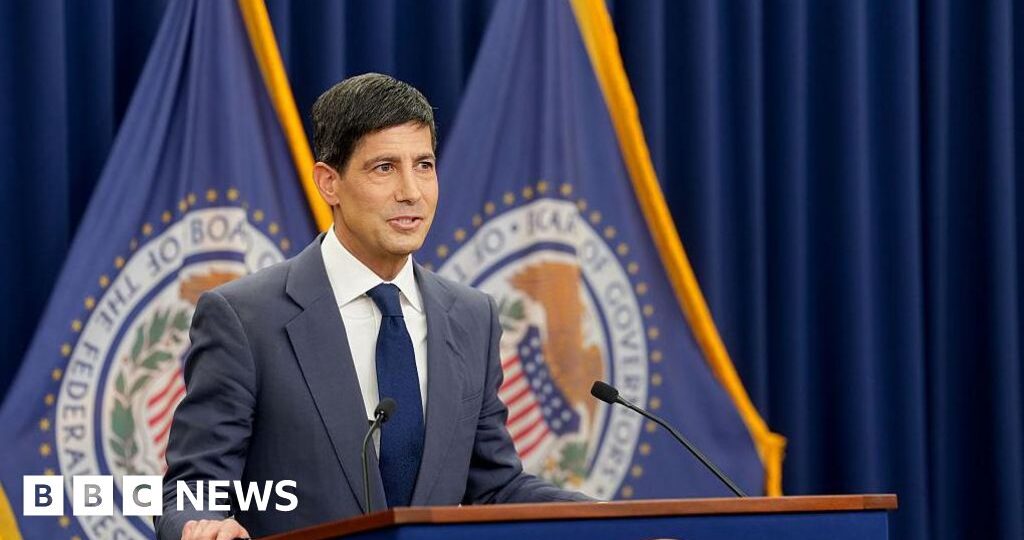
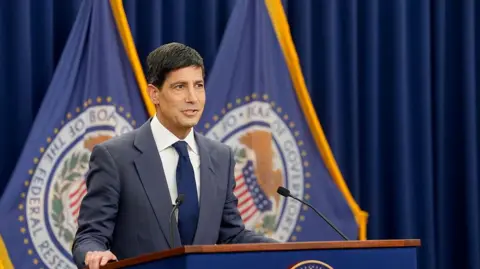
The Federal Reserve held US interest rates between 3.5% and 3.75% after Kevin Warsh’s first meeting in charge of the central bank.
Fed governors were split on whether to keep rates steady or increase them in a bid to tame inflation, which has been pushed up by the US-Israel war in Iran.
US President Donald Trump pushed Warsh’s predecessor, Jerome Powell, to cut interest rates, and made clear he expected Warsh to fulfill his demand for cuts.
But, with inflation running at an above-target 3.8%, and uncertainty surrounding Trump’s deal to end the war with Iran, the Fed’s rate-setting committee unanimously decided to kept rates steady.
In a statement backed by its 12 members, the Federal Open Market Committee (FOMC) said: “Economic activity is expanding at a solid pace despite elevated uncertainty that owes, in part, to the conflict in the Middle East. Productivity growth and capital investment are strong.
“Job gains have kept pace with the workforce, and the unemployment rate has changed little.”
The Fed’s statement on Wednesday represented a marked change in the central bank’s communication style, one of Warsh’s key promises for his tenure.
He was a sharp critic of how the Fed has communicated its decisions in the past, arguing it should say less while getting on with the job.
Its most recent statement, released in April, was almost 350 words, while Wednesday’s update was just 132. “The Committee will deliver price stability,” it concluded.
The Fed’s update also removed a statement hinting that it was leaning towards lowering interest rates in the future.
And nine of the 18 central bankers who participated in the FOMC’s rate-setting process predicted an interest rate hike this year, while just one said they expected a cut. The remaining eight predicted rates will stay the same, according to the closely watched “dot-plot” grid of central bankers’ expectations released alongside the decision.
Warsh did not offer a projection of his own for the “dot-plot”, which he opposes, but said he encouraged his colleagues to go ahead with it.
Samuel Tombs, chief US economist at Pantheon Macroeconomics, said the “big news” from Wednesday was the “dot-plot” pointing to potential interest rate hikes before the end of the year.
Asked about the Fed’s decision, Trump said “it’s alright… whatever”.
He said “it could happen… it’s hard to believe”, when asked about potential interest rate hikes. “It just keeps the country down, it is so unusual,” he added.
But he heaped praise on Warsh, who he nominated to replace Powell, saying “we have a very good guy over there now, so I’m guided by what he wanted”.
In a press conference after the decision, Warsh said the change in Fed leadership was “a natural and timely opportunity to reaffirm its mission, to review current practices”.
He said forward-looking guidance from the Fed was unhelpful to discussions about interest rate and other monetary policy decisions. And Warsh said his new, slimmed-down statement, “just gives you the facts as best we can judge it”.
Warsh also indicated he will move quickly to reshape the central bank and how it sets policy. He launched task forces to examine five areas of how the Fed works: how it communicates, the size of its balance sheet, its use of economic data, the link between productivity and jobs and its framework for managing inflation.
Inflation, the rate at which prices are increasing year over year, hit 3.8% in April. Trump’s decision to launch strikes on Iran, which resulted in it retaliating by shutting the key Strait of Hormuz shipping lane, has been largely blamed for the increase.
It led to a spike in energy costs, which the US Bureau of Labor Statistics (BLS) has said is a key driver of the price rises.
But, asked about the rising cost of living, Trump in June said, “I love the inflation”.
“I love it. The numbers were great. You know what I really love? I love the inflation,” Trump said at the White House.
When inflation is high, central banks can raise interest rates to restrict the supply of money in the economy and bring further price rises under control. Interest rate cuts, which Trump called for, are believed to spur on the economy by lowering borrowing costs and encouraging spending.
Discover more from NAIRAVOICE.COM.NG
Subscribe to get the latest posts sent to your email.