
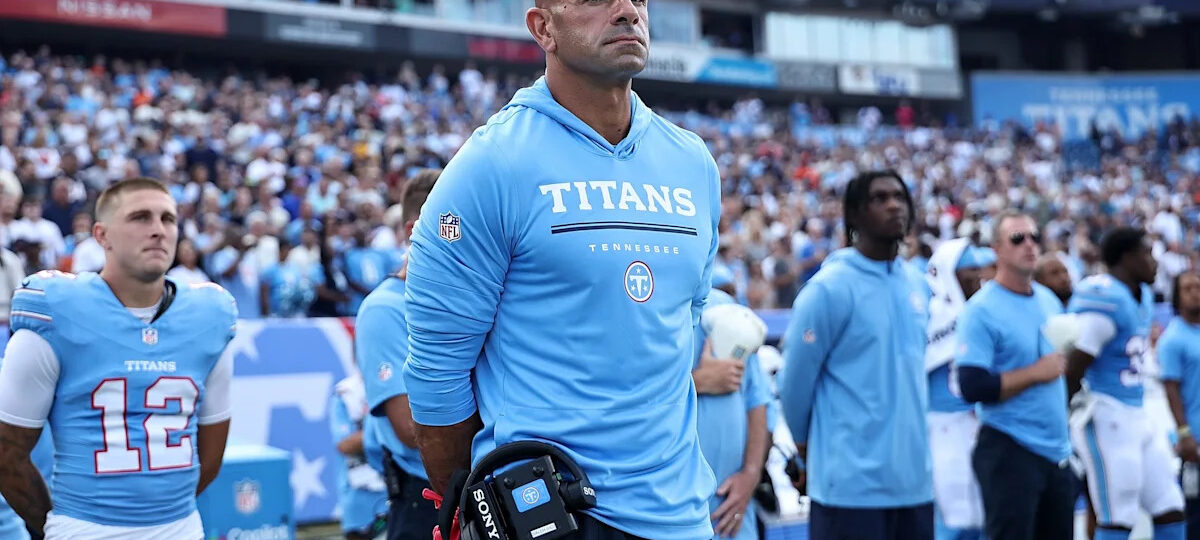
The Philadelphia Eagles will play their first road game of the season Sunday when they visit a Tennessee Titans team attempting to establish a new identity. Tennessee lost its opener to the New York Jets, 23-10, and finished with only 195 yards of offense. Quarterback Cam Ward struggled to create explosive plays in his first regular-season game under offensive coordinator Brian Daboll, while a rebuilt defense surrendered 367 yards.
The Titans are seven-point home underdogs, but their defensive front, return game, and mobile quarterback give Philadelphia several legitimate concerns.
Here is what Eagles fans should know about Tennessee entering Week 2.
Tennessee was held to 10 points while losing its home opener to the Jets.
The Titans gained 68 rushing yards and 127 net passing yards. They converted four of 12 third downs and committed one turnover.
Tennessee’s defense allowed 215 passing yards and 152 rushing yards. The Jets converted only two of 12 third downs but still controlled enough of the game to leave Nashville with a 13-point victory.
Saleh is in his first season as Tennessee’s head coach after previously leading the Jets and serving as San Francisco’s defensive coordinator.
His defenses are traditionally built around a disruptive four-man front, fast linebackers, and zone coverage. Tennessee hired former Jacksonville head coach Gus Bradley as defensive coordinator, giving Saleh another experienced voice with a similar foundational philosophy.
Brian Daboll was hired to coordinate the offense and oversee Ward’s development.
Ward completed 19 of 32 passes for 140 yards and one touchdown in Week 1. He was sacked three times and rushed four times for 21 yards. The production was modest, but Ward’s talent remains evident. He can make throws from different platforms, attack tight windows, and create after the original play breaks down.
Vic Fangio identified Ward’s arm strength and mobility as two of his defining traits. That combination gives Philadelphia a second consecutive test against an athletic quarterback after Jayden Daniels repeatedly escaped pressure in Week 1.
The Eagles must pressure Ward without creating open scrambling lanes.
Daboll wants to develop a balanced offense that uses Ward’s mobility, play-action, and quick passing concepts. The opener never developed that rhythm. The Titans averaged 3.4 yards per rushing attempt and did not create enough manageable third downs. Ward frequently operated in obvious passing situations, allowing the Jets to attack Tennessee’s protection.
Establishing the running game would make Daboll’s entire call sheet available. Philadelphia allowed Washington to possess the ball for 33 minutes, 20 seconds and must avoid allowing Tennessee to build a similar advantage.
Calvin Ridley remains Tennessee’s most accomplished receiver, though he wasn’t targeted in Week 1 despite running routes on most of Ward’s dropbacks. That disconnect should make getting him involved an obvious priority. First-round rookie Carnell Tate gives Tennessee another polished route runner with size and ball skills. The Titans selected Tate with the fourth overall pick to grow alongside Ward.
Tight end Gunnar Helm is a reliable short-area target who can help Ward when Philadelphia’s pass rush forces him to deliver the ball quickly.
Tennessee also has young talent in the backfield. Regardless of how the carries are distributed, the Titans need greater efficiency after managing only 68 rushing yards against New York.
The Titans’ protection allowed three sacks in Week 1 and struggled to create consistent displacement in the running game.
Philadelphia will not have Jonathan Greenard, but Jalyx Hunt, Nolan Smith Jr., Arnold Ebiketie and A.J. Epenesa should still have opportunities to affect Ward.
Jalen Carter and Jordan Davis can make the matchup uncomfortable from the interior. Carter and Cooper DeJean received no final injury designations, while Davis is coming off a seven-tackle performance.
The challenge is maintaining rush discipline. Pressure will mean little if the Eagles allow Ward to escape the pocket and attack open space.
Simmons remains the player Philadelphia must identify before every snap.
The three-time Pro Bowl defensive tackle can align over either guard, attack the center, or move outside in passing situations. His strength, first-step quickness, and ability to split double teams create problems against any offensive line.
His matchup becomes more significant with Landon Dickerson on injured reserve. Philadelphia could turn to Fred Johnson, Drew Kendall or Willie Lampkin at left guard.
Simmons will be tasked with performing after stating that Tennessee must contain Hurts and “make him be a quarterback.” The comment drew attention because Hurts threw for 380 yards and three touchdowns while adding a rushing score during Philadelphia’s 35-10 victory over Tennessee in 2022.
Franklin-Myers signed a three-year, $63 million contract to form an imposing interior combination with Simmons.
His Tennessee debut was quiet. Franklin-Myers recorded three tackles and one pressure against the Jets, but his power and versatility could trouble Philadelphia’s reshuffled line.
The Eagles cannot direct all their protection help toward Simmons and assume the remainder of Tennessee’s front will remain quiet.
Tennessee added Jermaine Johnson II to strengthen its pass rush. Johnson recorded one pressure in Week 1 but has the explosiveness to challenge tackles around the corner.
Rookie Femi Oladejo also showed promising flashes during training camp and the opener. His motor and developing power could earn him additional snaps against Philadelphia.
The Titans recorded nine total pressures in Week 1. They will need considerably more disruption to prevent Hurts from attacking their secondary.
Hill recorded 16 tackles in his NFL debut, the most by a linebacker in a first-game league record.
The rookie’s speed, range, and physicality make him a central figure against Saquon Barkley and Hurts. Tennessee must account for Barkley between the tackles while preventing Hurts from turning broken plays into first downs.
Cedric Gray has cleared concussion protocol, giving the Titans another young linebacker who can contribute beside Hill.
The secondary remains one of Tennessee’s greatest questions after extensive offseason changes.
Saleh and Bradley will attempt to protect the group with zone coverage, disciplined eyes, and pressure from the front. That approach becomes difficult if Simmons and the edge rushers cannot make Hurts uncomfortable.
DeVonta Smith, Dontayvion Wicks, Dallas Goedert and Makai Lemon give Philadelphia several favorable matchups. Hollywood Brown could also receive his first offensive snaps after practicing fully on Friday.
Dike earned first-team All-Pro honors as a rookie and can change field position on punts or kickoffs.
Eagles special-teams coordinator Michael Clay specifically identified Dike as a major concern. Philadelphia’s coverage players reached Washington’s returners in Week 1 but allowed additional yardage by stopping their feet at contact.
The Eagles cannot repeat those tackling mistakes against one of the NFL’s most dangerous return specialists.
The defensive front is the Titans’ clearest strength.
Simmons is an elite interior defender, Franklin-Myers has produced across multiple schemes, and Johnson gives Tennessee another talented edge rusher. That group will attack an Eagles line playing without Dickerson.
If Tennessee can disrupt Hurts without blitzing, it can devote additional defenders to Barkley, Smith, Goedert and Philadelphia’s other receiving threats.
The offense did not produce enough or generate enough explosive plays in Week 1.
Tennessee ranked 31st in total offense, 30th in rushing and 29th in net passing after its opener. Ward averaged 4.4 yards per attempt, while the Titans produced 10 points. The small sample needs perspective, but Philadelphia has a chance to force Ward into another inefficient game by winning early downs and making Tennessee operate in obvious passing situations.
The Titans enter the game relatively healthy. Gray cleared concussion protocol, strengthening the linebacker rotation.
Philadelphia ruled out Greenard because of a pectoral injury. Safety Andrew Mukuba is questionable with a knee injury.
Carter, DeJean, Hollywood Brown and Elijah Moore received no game-status designation and are available.
Philadelphia and Tennessee last met on Dec. 4, 2022, when the Eagles earned a 35-10 victory at Lincoln Financial Field.
Hurts completed 29 of 39 passes for 380 yards and three touchdowns. He also rushed for a score. A.J. Brown caught eight passes for 119 yards and two touchdowns against his former team.
The Eagles lead the all-time series 8-5, but Tennessee won three of the previous four meetings before Philadelphia’s dominant 2022 performance.
Tennessee is rebuilding around Ward, Saleh and a collection of young players, but the Titans possess enough defensive talent to make Philadelphia work. The Eagles must protect their reshuffled interior, contain Ward without sacrificing rush-lane discipline, and prevent Dike from shifting field position.
If Philadelphia stays ahead of the chains and forces Tennessee to sustain long scoring drives, its overall talent should produce an efficient 2-0 start. The clearest path to an upset begins with Simmons disrupting the pocket and Ward creating explosive plays after escaping it.
This article originally appeared on Eagles Wire: Eagles vs. Titans preview: Get to know Philadelphia’s Week 2 opponent
Discover more from NAIRAVOICE.COM.NG
Subscribe to get the latest posts sent to your email.