 Image source, Reuters
Mercedes’ Kimi Antonelli became Formula 1’s youngest world champion by finishing third at the Mexico City Grand Prix.
Red Bull’s Max Verstappen won the race, with Ferrari’s Lewis Hamilton finishing second.
Hamilton was unhappy with his team-mate Charles Leclerc and said Ferrari “have to have some serious talks behind closed doors” after fighting between their two drivers cost them victory in Mexico.
BBC F1 correspondent Andrew Benson answers your latest questions.
McLaren has its ‘papaya’ rules, is it now time for Ferrari to introduce its ‘Maranello’ rules? – John
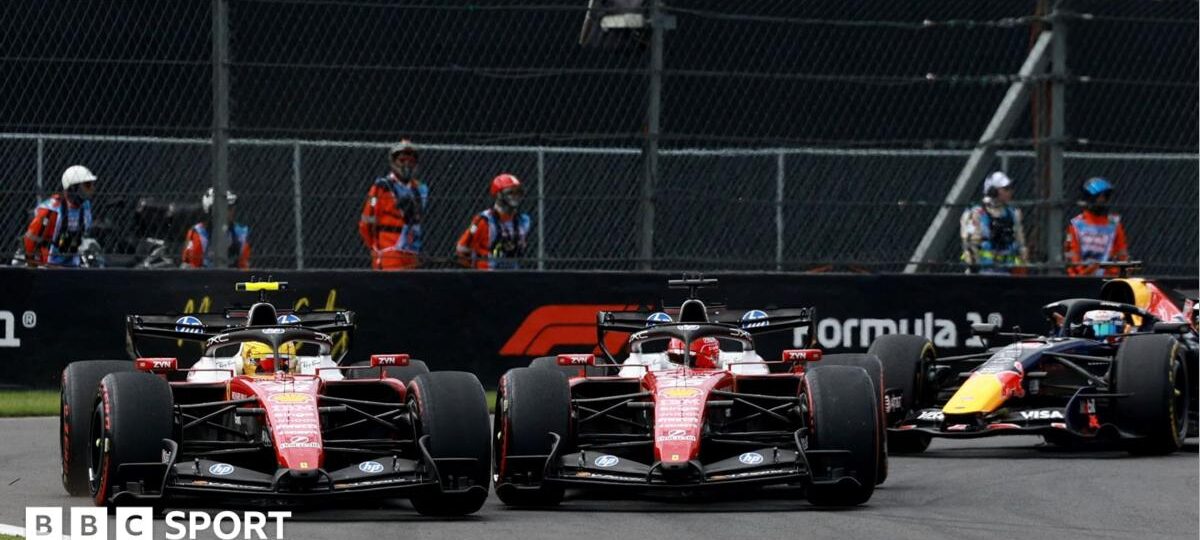
The battle between Lewis Hamilton and Charles Leclerc on the opening lap in Mexico, and the fall-out from it, provided a perfect illustration of the problems that can arise when a team has two top drivers of equal status.
Hamilton’s point after the race was that Ferrari would have won the race – probably got a one-two – if the pair had worked together on that first lap.
“When your team-mate works against you and then you lose positions like that, it’s definitely tough,” he said.
Team boss Frederic Vasseur aldo bemoaned the loss of a potential one-two, admitting he was “frustrated”.
Leclerc argued that it takes two to tango. “I could be also unhappy with how much he pushed me off track out of Turn One,” he said, “but it is racing. When you are fighting for a win it is the way it should be.”
Leclerc added: “At the end we both did a mistake going into Turn Four. It’s not like we had contact whatsoever. We both went straight and that gave the opportunity for Max to overtake. So I don’t think it should be that much of a talking point.”
Clearly there is a problem here. It’s not the first time the Ferrari drivers’ competing priorities have caused issues this year, and Vasseur has yet to find a way to manage it effectively, and get the drivers to buy into what he decides.
In this case, the two drivers are expressing two completely different, but valid, points of view.
Hamilton is thinking of the team result – which conveniently also meant a win for him – Leclerc primarily about the fact that they are allowed to race for the win.
The problem is that the team’s result was compromised and a win thrown away.
Had Verstappen not passed Hamilton as a consequence of the incident, Leclerc could have given the place back by Turn 11 as was required by the rules.
But once Verstappen was between them, continuing in the lead was Leclerc’s only realistic option.
This is a really difficult situation for Vasseur to handle.
The team wants to win the race as first priority, but the same applies to each individual driver. Sometimes those two competing priorities clash.
And if Ferrari ever get themselves a car that can compete for the title, it will only get harder, because the stakes for both drivers are then much higher.
McLaren have done better at handling this, and Lando Norris and Oscar Piastri have been more acquiescent, but even their approach has led them into problems, as happened a number of times last year. And sometimes the drivers ignore it, as with the crash between the two drivers in the sprint in Singapore.
Vasseur’s problem is that if he had asked the drivers not to race on the first lap on Sunday, he would have been essentially asking Leclerc to hand Hamilton a win. And how do you keep an ambitious driver happy in that situation?
One also has to ask whether, if the situations were reversed, Hamilton would accept the same request.
Hamilton revealed after the race that Ferrari “don’t have rules of engagement, and whether or not that would change anything from Charles’ side, I don’t know”.
McLaren have rules of engagement. One is not to crash into each other. That’s not what happened here. Another is that the team result comes first. But it’s very hard to come up with specific rules that would deal with a live racing situation such as this.
One could argue all day about the rights and wrongs and who could have done what to engineer a better outcome.
As Hamilton said: “We’ve just got to figure out. But something needs to change for sure.”
Given that Yamaha have withdrawn from MotoGP in Qatar (and, I understand, much of the media aren’t going), why is F1 still so intent on going? The US mid-terms are potentially a trigger point. The risk seems too high. – Richard
This weekend’s Qatar MotoGP has been a subject of controversy in motorcycle racing in the context of the war in the Middle East.
First, the vast majority of riders wrote a letter to the sport’s bosses saying they would prefer not to race there, and at the weekend Yamaha pulled out of the race, citing a company-wide travel policy.
The race is still going ahead. MotoGP, like F1, is owned by US group Liberty Media.
Similar concerns also exist within F1 on a widespread basis about the end-of-season races in Qatar and Abu Dhabi going ahead.
Privately, many people within the sport have significant misgivings about going to the Middle East, but those opinions are by and large not being voiced publicly.
One person who has done so is Williams driver Carlos Sainz, who said at the US Grand Prix: “(The sport’s bosses) seem very convinced that it’s going to go ahead.
“On my personal side, and not speaking as the GPDA, it’s very difficult to be convinced right now because there are still things happening in the Middle East, and also there is obviously an election that is going to happen in the US and things that are going to happen on the political side of the world that could affect the next month, month and a half, very suddenly.
“So, I think it’s relatively premature to be so convinced.”
It’s hard to argue with the factual basis for those remarks. Nevertheless, Sainz and Williams were subsequently spoken to by F1, after which Williams put out a statement “clarifying” his remarks.
F1’s argument is that it has no reason to cancel the races.
The governments in question are said to be insisting there are no significant risks and that there have been no attacks on civilian infrastructure for nearly six months.
The UK government is not advising people not to travel to those countries.
And F1 not only has lucrative race contracts in place, but Qatar and Abu Dhabi are both heavily embedded in the sport. For example, Qatar is a co-owner of the Audi F1 team; Abu Dhabi is a co-owner of McLaren.
And the concern is, if these races are cancelled, not only would F1 lose the money, but when could it go back to the Middle East? The two wars in question – between the US/Israel and Iran and between the Houthi separatists in Yemen and Saudi Arabia – could continue for years.
However, many people in F1, including a number at a very high level, believe holding the races in Qatar and Abu Dhabi at the end of the season is the wrong thing to do in the circumstances.
Many senior figures privately consider the “worst-case scenario”, as one put it the other day.
Imagine the situation stays quiet, and then the missiles start flying again once the sport is out in the Middle East.
If that means personnel are trapped there and can’t get out, never mind people getting hurt or even killed, the PR consequences for F1 would be enormous.
F1 is not deaf to these concerns. But it is caught between a rock and a hard place.
Essentially, it’s waiting to see whether the situation escalates in the context of last week’s Israeli election result, or the US mid-term elections, which are being held on Tuesday.
That’s why Imola is being prepared as a back-up to replace Abu Dhabi if the two races cannot go ahead.
For practical reasons a decision cannot be delayed much longer. Morally, a number of people in F1 are arguing privately that it should already have been made.
But the complexities of the situation mean the sport remains in limbo, and the races are going ahead as a default position.
How a boy from Bologna became a world champion
Given Estaban Ocon’s withdrawal from Mexico and an apparent breakdown in the relationship with Haas, what does this mean for the rest of his season? Will Haas drop him for Ryo Hirakawa? – Josh
Esteban Ocon was dropped by Haas for the rest of the Mexico City Grand Prix weekend after what appears to have been some kind of confrontation between the Frenchman and team boss Ayao Komatsu on Friday after practice.
That followed a dispute between Ocon and race engineer Laura Mueller about tyre choices during second practice.
Haas have not said anything about the dispute or what led them to drop Ocon.
Ocon put out a statement admitting that there had been “a difference in viewpoints (that) led to a discussion with the parties involved” but saying he “categorically rejected any reports or allegations suggesting that any form of physical violence was used to resolve any differences of any nature”.
As of now, there is no further information.
On Saturday, a source said that, at that point, the move was only for that weekend.
But it’s possible Ocon has driven his last race for Haas, given whatever happened was obviously serious enough for Komatsu to take such significant action and the Frenchman is due to leave the team at the end of the season anyway.
If that’s the case – and it will become clear in the coming days – then Haas have two obvious options.
One is to continue with Hirakawa, who did a creditable job in Mexico. The other is to bring in Rafael Camara, who has already been signed for next year.
Why are cars allowed to change tyres if a red flag is called? This sometimes ruins a tense end to the race. – Ken
Debate about this rule has continued periodically since the 2011 Monaco Grand Prix, when it appeared to end prospects of a grandstand finish between Sebastian Vettel, Fernando Alonso and Jenson Button.
They were running one-two-three with Vettel on the oldest tyres, which may well have not made it to the end, Alonso on newer ones and Button on newer again when there was a crash and a red flag and the tyre jeopardy was removed.
Every time there is a red flag when drivers are on tyres of different life or compound competing for a win, people bring up the way this rule erases any potential for that battle to play out.
But the rule is in place for safety reasons, for example in case anyone has run over debris and damaged their tyres.
There does not seem to be an attitude to address or change it.
Antonelli title win ‘beginning of something special’
Get in touch
Send us your question for F1 correspondent Andrew Benson
Related topics
Antonelli – the boy ‘born in a garage’ who became world champion
How Antonelli ‘blew everyone away’ to make F1 history
A world champion but ‘one of us’ – a city’s pride in Antonelli
Antonelli heads list of F1’s youngest champions
How much do you know about F1 champion Antonelli?
Kimi Antonelli Becomes Youngest F1 World Champion
Discover more from NAIRAVOICE.COM.NG
Subscribe to get the latest posts sent to your email.