

 AFP via Getty Images
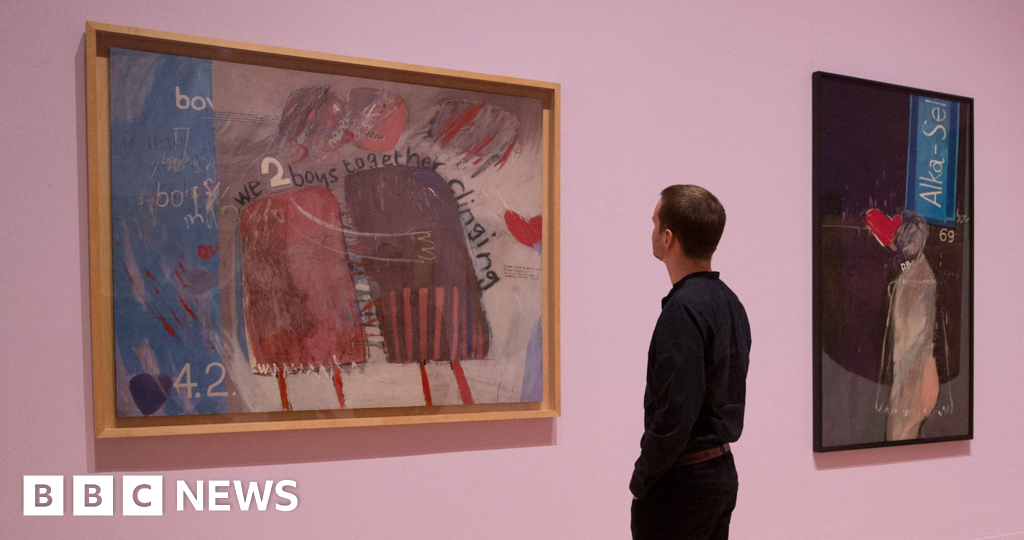
One of David Hockney’s early paintings depicts a couple wrapped in an embrace.
Painted in 1961, this picture may sound like it captures a relatively traditional romantic scene.
But at the time, it was a radical piece of work. That is because the couple in the painting are both men, and in 1961 it was still illegal to be gay in the UK.
Hockney, who has died aged 88, painted We Two Boys Together Clinging as a second-year student at the Royal College of Art.
Homosexuality was only partially decriminalised some six years later, in 1967, when the law changed to allow sex between two men “in private”, so long as they were both over the age of 21.
The 1961 painting, inspired by a Walt Whitman poem of the same name, was an early statement of intent by an artist who would go on to become a defining figure of British – and LGBT+ – culture.
Over the next decade, Hockney continued to break social taboos by celebrating same-sex relationships in his art – often by depicting the quiet, everyday moments of gay domestic life.
There is an underground quality to some of Hockney’s early work. His pictures are reminiscent of graffiti: spiky, expressive and defiant, rendered in bold lines and block colours.
“He was really pioneering as somebody who was unashamedly proud of his queerness before the legalisation of homosexuality in ’67,” says Dominic James Bilton, the co-leader of the Queer British Art Network.
In these early paintings, Hockney “showed and made work on same-sex relationships and desire and sexuality” at a time when “not a lot of people were doing that”.
Hockney’s style changed radically a few years later, after he travelled to California for the first time in 1964. There he painted his famous swimming pool pictures.
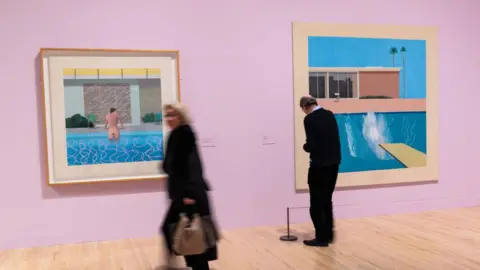
In one 1966 painting, Peter Getting Out of Nick’s Pool, a nude man climbs from the water of a swimming pool, his back to the viewer, head turned as though in conversation with someone just out of frame.
The 1963 painting Domestic Scene, Los Angeles shows one man in a shower while another man washes his back.
“Those works are so queer, so sensual and sexy and playful and joyous,” Bilton says, adding they also show the “domesticity” and “dull aspects of gay relationships”.
Hockney was “normalising same-sex relationships… that we take for granted”, Bilton suggests, adding the artist showed that gay people “are just normal people… doing normal stuff, looking at our partners and thinking: ‘oh, you’re beautiful'”.
 Getty Images
Perhaps best known among Hockney’s pool paintings is A Bigger Splash, which depicts the moment just after a diver has disappeared below the surface of a swimming pool.
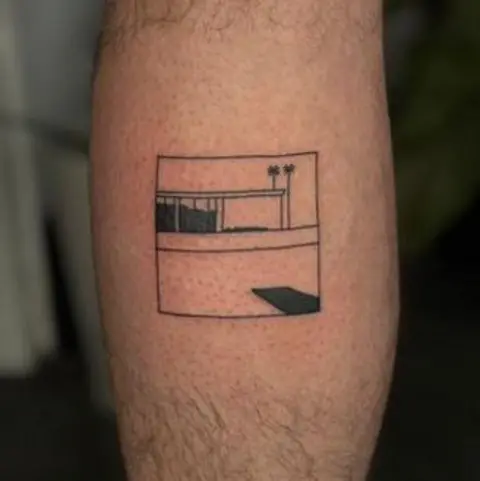
Life-long fan Joe Thomas has the painting tattooed on his leg. “I can still remember the feeling of awe and deep peace the first time I saw it,” he tells the BBC. “It suggests making that leap and going for it; something I try to live by.”
Thomas’s other favourite is Peter Getting Out of Nick’s Pool, which he describes as a “snapshot of a peaceful, beautiful and gay paradise in the mid-60s”. “There’s stillness and love,” he says.
“So much of Hockney’s painting, to me, feels so naturally gay… it’s not radically queer or a bombastic explosion of his sexuality, it just so happens to be about being gay and fancying other men. I find a freedom in that.”
 Handout
For 26-year-old curator and art commentator James Marshall, it is important the history of Hockney’s early work is not forgotten.
“For a lot of people growing up now, especially a lot of the gay youth – including myself – you can look at his paintings and assume they’re lovely, pretty pictures.
“But they’re also a strong act of protest at a time when showing queer lives as normalised or domesticated was very much avoided,” he says.
In the 1960s, depictions of gay men in popular culture were defined by “parody”, Marshall explains. In the media, “queer figures were often isolated, very alone… narrowed down to very basic stereotypes”.
But Hockney’s California series “told an alternative story of queerness” in which gay life was “domesticated” and “peaceful”.
To fully appreciate the work, Marshall says, “people need to understand the context of that time”.
 Handout
It is easy to underestimate the political power of Hockney’s paintings today, according to writer and critic Michael Valinsky.
He tells the BBC it is now difficult to appreciate the effect Hockney’s work had on museum-goers in the 1960s, 70s and 80s.
“It’s hard for me to think about the shock factor at the time,” he says.
According to Valinsky, Hockney’s paintings offered society new, visual ways to engage with ideas about homosexuality. “That helps the cause, right? Don’t name it, just look at it,” he said.
To author and art critic Will Gompertz, David Hockney’s work was “always radical”, from his earliest paintings to his final works.
“Even his later work… it was really joyful at a time when there’s so much cynicism, so that just to celebrate life is deemed to be facile.
“Ultimately, he completely challenged that notion, and said: ‘No, I want to celebrate what’s beautiful, and bring that to people’s attention’,” Gompertz says.
But Hockney’s joyful work always “comes with a bite”, he adds, whether the artist was depicting gay love at a time when homosexuality was still illegal, or exploring “how we’ve lost our connection with nature”.
In his later work, Hockney interrogated man’s relationship with technology and “reinvented the landscape [painting] for the 21st Century”.
In Gompertz’s assessment, “every iteration of what [Hockney’s] done has been equally as bold” as those early works.
“I think the boy you meet at 16 or 17 when he went to art school, to the man who died [on Friday], he doesn’t change a lot. He’s the same thoughtful, bold, curious, colourful character,” Gompertz said.
Discover more from NAIRAVOICE.COM.NG
Subscribe to get the latest posts sent to your email.