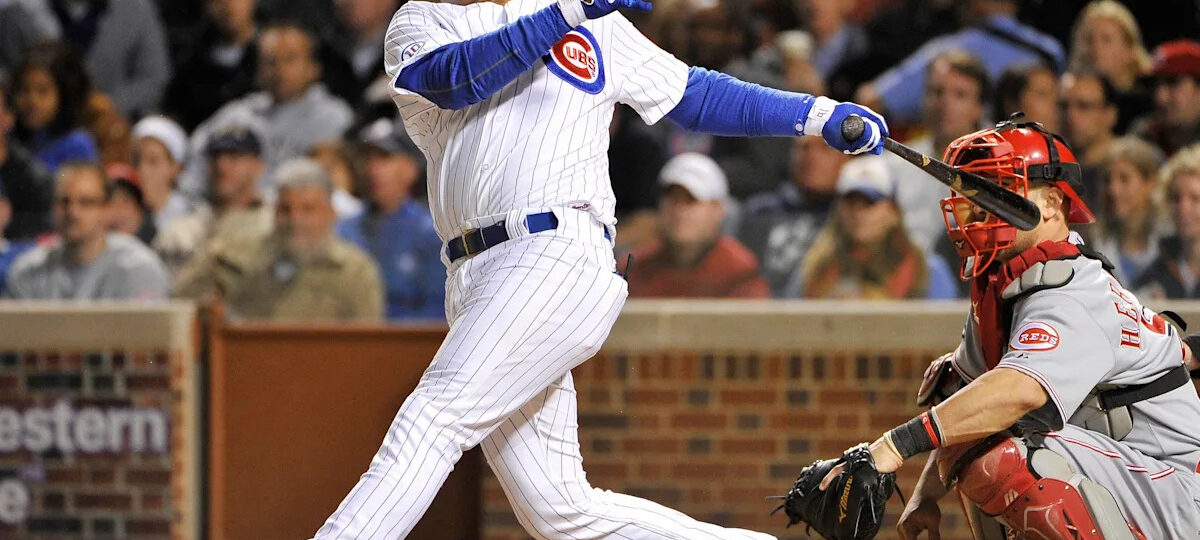
 Aramis Ramirez of the Chicago Cubs follows through on a two-RBI double scoring teammates Starlin Castro and Reed Johnson during the sixth inning against the Cincinnati Reds
It’s another week here at BCB After Dark: the coolest club for night owls, early risers, new parents and Cubs fans abroad. Thanks for stopping by. We always like to see a friendly face. There’s no cover charge tonight. We still have a few good tables available. The hostess will seat you now. Bring your own beverage.
BCB After Dark is the place for you to talk baseball, music, movies, or anything else you need to get off your chest, as long as it is within the rules of the site. The late-nighters are encouraged to get the party started, but everyone else is invited to join in as you wake up the next morning and into the afternoon.
Last week I asked you which Cubs player was most deserving an All-Star nod. The vote had a pretty clear winner as Ben Brown received 45 percent of the vote. Nico Hoerner was in second place with 21 percent. Pete Crow-Armstrong got 16 percent of the vote and I suspect he’d get a lot more votes had I conducted the poll today.
Here’s the part where we listen to jazz and talk movies. You’re free to skip that if you want. You won’t hurt my feelings.
Tonight we’re finishing up our tribute to the late, great Sonny Rollins, who passed away last month at the age of 95. Here is Rollins in 1975 playing the Duke Ellington tune “In a Sentimental Mood” along with pianist McCoy Tyner. There’s also an introduction from Chick Corea.
This is mostly pure Rollins and just his saxophone feeling the mood.
Helvetica (2007), directed by Gary Hustwit, is a documentary about the font that I’m currently using to write this essay, although what font you’re actually reading this in probably something else. The film does a great job at showing us how something that is so ubiquitous in our lives that we don’t even generally notice it has the capability to change the way we perceive things. It does less well trying to explain the context of Helvetica and the esoteric debates that graphic designers are so passionate about.
Helvetica was a new sans serif typeface created in 1957 by Swiss graphic designers searching for a new font in line with the ideas of postwar modernism. Originally called Neue Haas Grotesk, the name was changed to “Helvetica,” a play on the Latin name “Helvetia” for Switzerland, to make it more marketable around the world. Helvetica was simple, clean and bold, which marked it as different than the fonts commonly used in design at the time. It made a statement.
Helvetica was quickly adopted by advertisers. The way the designers interviewed in the film explain it, the fancy typefaces used before Helvetica were harder to read and could blend into the background. They also came across as more of a polite request to the viewer. Helvetica, in contrast, was bold and bright. Rather than a request, Helvetica was more definitive and came across as a command. Helvetica was authoritative. Because it was quickly adopted by governments and big corporations for its legibility, it became associated with status and power.
Hustwit interviews a lot of graphic designers and it seems like all of them have something to say about Helvetica. Some of them love it for its clean, powerful modernism. They love it because it is a blank slate that can serve so many different purposes. But as one designer points out, there’s a difference between being “legible” and having something to say, and according to some, Helvetica’s simplicity doesn’t say much. Others criticize it for being “fascist,” calling it a symbol of authority and a killer of creativity, which is why governments and corporations love it so much. Still more point out that anything that becomes as commonplace as Helvetica is will become boring and conformist over time.
Hustwit intercuts these interviews with designers with a steady stream of signs, logos and advertising that use Helvetica. He really makes you notice something that may have passed over hundreds of times before.
Where Helvetica falls down, just a bit, is where it throws us into a passionate argument without really giving us the context to fully understand it. If you’ve ever come across a group of graphic designers angrily arguing about font choices on social media, you know the feeling. It’s kind of fun to watch them get all worked up, but you don’t quite understand why they’re so angry. One of the designers admits he spends most of his day thinking about fonts and typography, but he doesn’t really explain why to those of us who don’t. Which makes it harder to understand his passion for Helvetica.
Still, it’s an interesting watch, especially in the way is both shows and tells how Helvetica took over the world. It’s also illuminating in the way it shows that a mere font, something that most of us don’t even notice, can manipulate how we think and how we behave.
Here’s the trailer for Helvetica. There’s no dialogue, but this will give you a good sense of how the font is everywhere.
Welcome back to everyone who skips the music and movies.
We’re one quarter of the way through the 21st century, so there have been a lot of “best of the quarter-century” articles over the past year or so. On top of that, the recent emergence of Pete Crow-Armstrong had me thinking if the trade that brought him to Chicago ranks among the best trades in Cubs history.
So tonight, I’m asking “Which Cubs trade was the best one this century?” I have a few candidates. I guess I should have put “other” in there, but I can’t imagine any of you seriously voting for one that I didn’t list. You can mention other favorites in the comments.
The ones that I think are the candidates for best Cubs trade of the century (so far) are:
July 23, 2003: Aramis Ramírez and Kenny Lofton from the Pirates for José Hernández, Bobby Hill and Matt Bruback.
Lofton was a key member of the 2003 team down the stretch, replacing the injured Corey Patterson. He left at the end of the season as a fre agent. Ramírez, of course, became the Cubs’ starting third baseman for nine season, was a two-time All-Star with the Cubs and is now in the Chicago Cubs Hall of Fame.
Hernández played 58 games for the Pirates before they released him. Hill was the big prize prospect in this trade, but he never really established himself, playing just a year and a half in the majors before going down to the minors for good.
November 23, 2003: Derrek Lee from the Marlins for Hee-Seop Choi and Mike Nannini
Lee broke Cubs fans hearts in the 2003 National League Championship Series, but he quickly became a fan favorite after his acquisition. He played seven seasons as the Cubs’ starting first baseman, made two All-Star teams and finished third in MVP voting in 2005 when he won the batting title with a .335 average along with 50 doubles and 46 home runs. Most years that’s easily good enough for the MVP, but Albert Pujols and Andruw Jones both had career years that year as well.
Choi spent one year in Miami before getting traded to the Dodgers, primarily for Paul Lo Duca. He only spent a year and a half in LA but played eight years in Korea before retiring. He never lived up to his potential, but you have to wonder how much the concussion that cost him the second half of the 2003 season player a role in that.
January 6, 2012: Anthony Rizzo and Zach Cates from the Padres for Andrew Cashner and Kyung Min-Na.
I don’t think I need to tell any of you about Rizzo. He was the Cubs’ starting first baseman for eight full seasons and parts of two more. He made three All-Star Games, won four Gold Gloves and recorded the final put out of the 2016 World Series.
Cashner played five years for the Padres and in two of them, he was a pretty good starting pitcher. His first year in San Diego he pitched out of the bullpen and in the last two he struggled with injuries.
Neither Cates nor Kyung Min-Na played in the majors.
July 31, 2012: Kyle Hendricks and Christian Villanueva from the Rangers for Ryan Dempster.
Both Hendricks and Villanueva were minor leaguers when the Cubs acquired them. Hendricks was considered a low-ceiling “pitchability” guy who someone managed to get more out of less stuff than any other pitcher through terrific control and a nasty changeup. He pitched 11 seasons in Chicago, won an ERA title in 2013 and finished third in Cy Young Award balloting that year. He started Game 7 of the 2016 World Series and allowed just two runs, one earned over nine innings in that curse-breaking series.
Villanueva never made the majors with the Cubs, but he did play a season and change in the majors with San Diego before a long career in Japan and Mexico that is still ongoing.
Dempster only started 12 games in Texas and had a 5.09 ERA. The Rangers made the Wild Card that year, but lost the one-game playoff to Baltimore. Dempster played one more year in Boston (where he got a World Series ring) before retiring.
Arrieta was a former top-five prospect in the Orioles system who flopped in the major leagues before getting dealt to the Cubs. He pitched on the North Side for five years before leaving in free agency. In that time, he won a Cy Young Award and threw two no-hitters. He won two games in the 2016 World Series.
Strop was a key member of the Cubs bullpen for seven years. He was mostly a setup man, but he did save 29 games in Chicago.
Feldman pitched a half-season in Baltimore. Clevenger bounced back and forth between Baltimore and Triple-A Norfolk for three seasons.
July 30, 2021: Pete Crow-Armstrong from the Mets for Javier Báez and Trevor Williams.
Crow-Armstrong had been the Mets 2020 first-round pick but only played six games before he missed the rest of 2021 with a shoulder injury. He quickly established himself as the Cubs’ top prospect. He made his major-league debut late in 2023. He won a Gold Glove and made the All-Star team in 2025. This year he leads the Cubs in both fWAR and bWAR
Báez had a very good half season with the Mets, but the rest of the team fell apart and they finished the 2021 season below .500. He then left for Detroit as a free agent where he’s struggled.
Williams pitched a year and a half with the Mets, totaling 12 starts and 28 relief appearances. He had a quite good 3.17 ERA for the Mets in that year and a half. The Mets did make the Wild Card Series in 2022, but Williams did not pitch in it.
So now it’s time to vote. What was the best trade for the Cubs in the 21st Century?
Thanks for stopping by. We’ve enjoyed having you. Please tell your friends about us. Get home safely. Check for any personal items you may have forgotten. Recycle any cans and bottles. Tip your waitstaff. And join us again tomorrow evening for more BCB After Dark.
Discover more from NAIRAVOICE.COM.NG
Subscribe to get the latest posts sent to your email.