
Chris Haworth tried to make it as a tennis player and couldn’t. He gave the pro tour about a year and a half, traveled, lost more than he won, and went home to Oklahoma City to coach.
Then a client he was teaching got into pickleball and kept after him to try it. He finally did, in 2022. “I kind of got hooked that first time,” Haworth said, “and then it slowly grew and grew and grew.”
A few years later he had climbed to Professional Pickleball Association’s No. 1 in men’s singles.
He’s also the most prominent openly gay man in a sport still deciding who its faces are. His husband, Jackie, travels to tournaments and knows half the tour.
“It feels really cool to experience it almost in a totally different way, to be able to be myself,” he said. “Being able to represent the LGBT community is really important to me.”
What Haworth wants is for it to be ordinary, and he means that as the whole point. On tour, he said, it barely registers.
“I’m just another player, and when Jackie’s with me, he’s just another spouse that comes along,” he said. “It’s nothing out of the ordinary, and it’s not something that needs to be overly talked about.”
None of that would carry much weight if he didn’t win, but he does win. A lot.

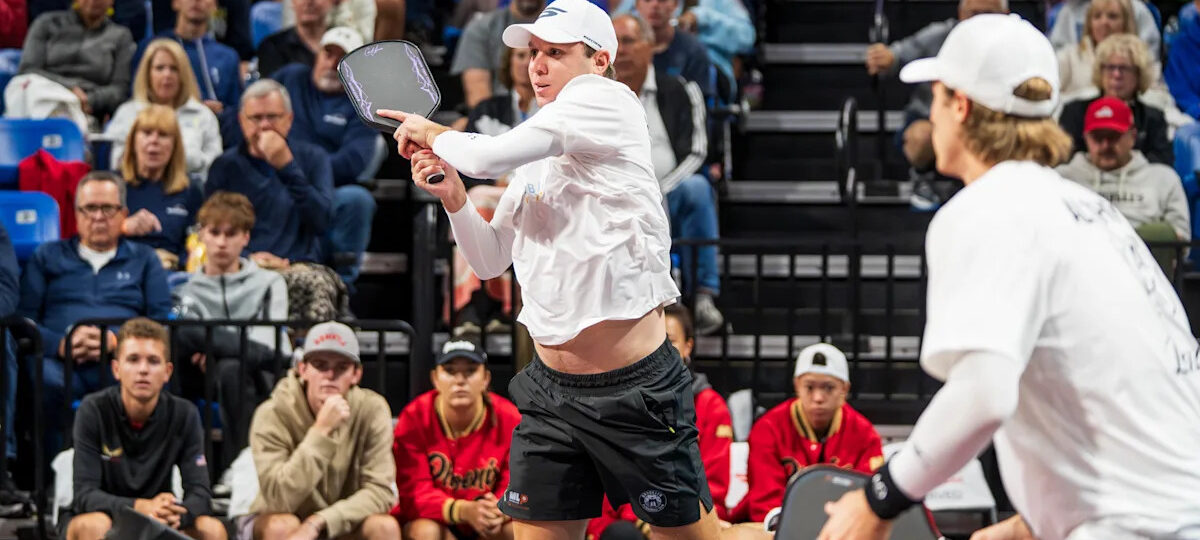
Haworth credits the old game for most of what makes him win now. He grew up a nationally ranked junior and played four years at Oklahoma State, and it shows in how he plays. He attacks from the baseline, and he hits topspin in a sport where a lot of converts still punch at the ball like they’re back on a hard court. His size helps too. Tall enough to reach, not so tall he loses control. Reaching No. 1 didn’t surprise him.
“Everyone plays and expects to become number one. It doesn’t happen for everyone, so actually accomplishing it was pretty cool,” he said.
The win that told him he belonged came against Ben Johns, the one name in pickleball that most casual fans know. Haworth has beaten him a handful of times since, and he still sounds a little awed by it.
“To be able to beat someone that’s done everything in the sport, this total legend,” he said. “Years from now he’ll still be looked at as the first great player in pickleball.”
Fans know Johns, but beyond him, there aren’t any marquee names. That’s the puzzle professional pickleball is still working on and Haworth is one of the pieces that fits in the solution.
Millions of Americans play pickleball, more every year. It’s been the country’s fastest-growing sport for five years running, and last year it pulled even with tennis in how many people play. The money has followed. This spring a $225 million investment folded the two main circuits, the PPA Tour and Major League Pickleball, into a single company. The crowd is there. The stars are still being made.
“You go to a random club down the street, and they can only name a few pros,” he said.
The way he describes the fix, it comes down to getting those millions of players to care about the people at the top.
“The biggest thing pickleball is finding right now is connecting the millions of people that play,” he said.
Building stories around players, making them human, gives fans someone to follow.
Serena Williams ended her retirement with a doubles win alongside Victoria Mboko at London’s Queen’s Club HSBC Championships.
 1 / 13
Serena Williams ended her retirement with a doubles win alongside Victoria Mboko at London’s Queen’s Club HSBC Championships.
 2 / 13
 3 / 13
 4 / 13
 5 / 13
 6 / 13
 7 / 13
 8 / 13
 9 / 13
 10 / 13
 11 / 13
 12 / 13
 13 / 13
Pickleball still skews older, full of players who found it later in life, but Haworth thinks its future runs through the other end of the age range. He sees kids who grow up with a paddle the way he grew up with a racket.
Haworth spent a week at a junior camp in Kansas City, kids in from all over the country, and it took him right back to his own junior tennis days. Some of the pros now are 14 and 15 years old.
“That’s the next evolution of where pickleball needs to go,” he said. “Getting kids involved.”
Haworth thinks about the gay kid in that group too, the one he didn’t get to be. He was never out as a junior tennis player and he never had a player to watch who made being out look unremarkable, the way he tries to now.
“It doesn’t have to be this life-altering event that becomes front page news,” he said.
Just someone living a normal life, with his partner in the stands.
“Even if I can make a difference to one or two of them, that would mean the world to me,” he said. “I’m trying to make sure I wear this the right way.”
Discover more from NAIRAVOICE.COM.NG
Subscribe to get the latest posts sent to your email.