
Major League Baseball owners have a big problem on their hands. They need to explain how the game is broken, and they don’t have a shred of evidence.
The recent postseason proved to be a blessed unveiling of common sense. For those fearing a lockout that could dismantle or even eliminate the 2027 season, the mighty Los Angeles Dodgers were sent home looking humbled and vulnerable. The other three semifinalists were veritable cheapskates at the marketplace, ranking 19th (Milwaukee Brewers), 28th (Tampa Bay Rays) and dead-last 30th (Cleveland Guardians) in payroll.
Please, someone explain how this means disaster. Let’s have the most hawkish owners, the ones planning to steer the negotiations of doomsday, come out of hiding for televised news conferences. “The owners” want this or that – sorry, that’s far too vague. We need to see you in person, because baseball is absolutely thriving heading into winter.
For my money, one of baseball’s great things is the absence of a salary cap. The game operates on pure capitalism: Run your business correctly, with foresight, and reap the rewards. Bungle your way through the landscape, cutting corners at every turn, and pay the price. In fact, prepare to lose money at times. Just get better.
And I really need to know how this system has hurt the game. The game’s popularity was built on Yankees bombast, dating to Babe Ruth’s time, larger-than-life clubs who spent big money but, more importantly, played the game at an ethereal level. – right through Derek Jeter’s time. But it didn’t have to be that way. One of the game’s most memorable dynasties, the Oakland A’s of 1972-74, were built on scotch tape and shoestrings. While owner Charlie Finley spent approximately no money (until the free-agent system drove him nuts), the team drafted and traded superbly, resulting in one of the most pristine baseball showcases – pitching, defense, power, speed, fundamental smarts – the sport has ever seen.
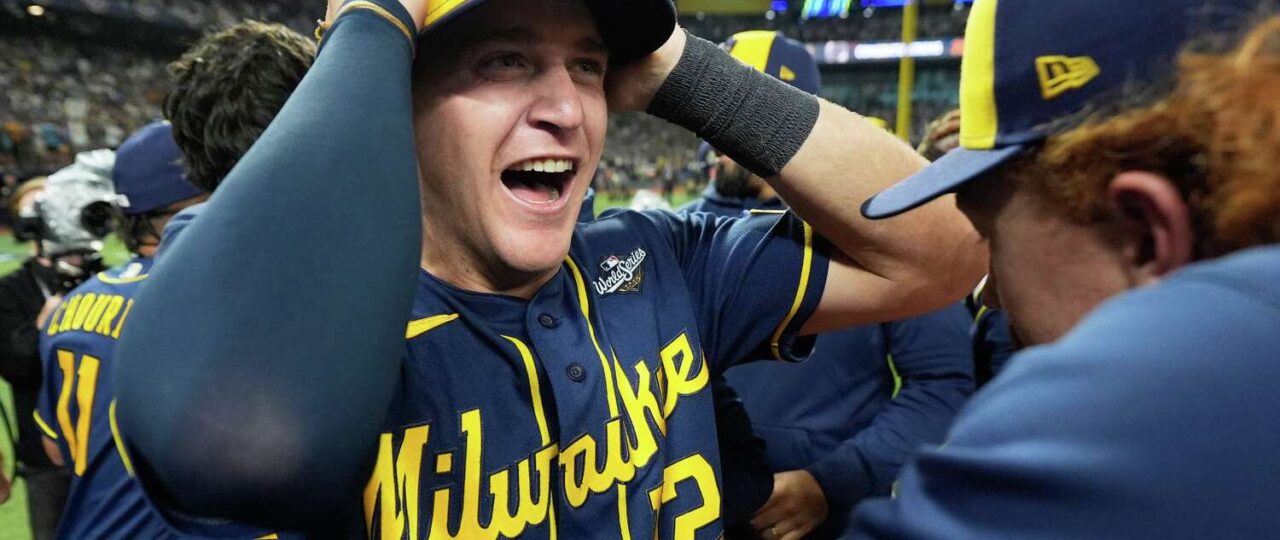
Remarkably, the Milwaukee Brewers’ world championship brought a lot of that into focus. Their only real star, from a national perspective, was Jacob Misiorowski and his 103 mph fastball. And you didn’t need a parade of high-profile showmanship to realize how distant they’ve become from the San Francisco Giants and other teams frozen by sustained weakness.
The Brewers’ rotation was so deep, they had no use for ex-Giant Kyle Harrison, who had been unhittable for lengthy stretches earlier in the season but hit a rough patch. The bullpen wasn’t a day-to-day mystery, rather a precise order of relievers at the top of their games. Whatever you like from a catcher – calling pitches, reading the ABS system, throwing out runners, blocking pitches in the dirt, delivering clutch hits, taking charge like an angry drill sergeant – William Contreras delivered, winning the Series’ MVP award.
It just went on like that. The Giants are among the teams overly enamored with the launch-angle swing, which at times makes about as much sense as pouring ketchup over the bat handle. The Brewers knew how to work a two-strike count, get hits to the opposite field, put topspin on the ball for the appropriate sharp grounder. They bunted, they stole bases, they played defense, and if you wanted to see all of that in a single player, they gave you Brice Turang, the best second baseman in the game. Whatever you call it – “small ball” is pretty weak – it got Milwaukee past esteemed Dodgers starters Tarik Skubal, Yoshinobu Yamamoto, Blake Snell and Tyler Glasnow, all of whom were given a lead, in the NLCS.
They Brewers could be quite spectacular at times, especially 22-year-old outfielder Jackson Chourio, who provided two of the postseason’s precious gems. Game 2 of the Division Series found Milwaukee facing San Diego’s flame-throwing Mason Miller, fresh off one of the most dominant seasons ever seen from a relief pitcher, but Chourio answered a 101 mph fastball with a two-run, walk-off single. Then he dominated the Brewers’ Game 3 win in the World Series with four hits, two runs scored, an RBI and a stolen base.

The way analytics work in baseball, productive offense is all about drifting away from traditional contact and into the explosiveness of raw power. Which is nice, until the wasted at-bats pile up. The Brewers hit just three home runs in the Series, and you might have trouble remembering the names (Frelick, Hamilton and Pratt), because they were playing the game correctly, adjusting to every nuance that presented itself.
They also had something we see in the great teams throughout sports: belief. Much as the Valkyries reached the heights in the WNBA, the Brewers were about sacrifice, a dismissive wave to stardom, a work ethic all about making the next person look good.
Not that they couldn’t get a little snarky. Some of the Brewers took mild potshots at the Dodgers – a team they shockingly outplayed in the regular season and then swept in October. And when manager Pat Murphy and outfielder Jake Bauers shared a celebratory moment Wednesday night, Murphy told his potential free agent, “You’re gonna be rich. Just remember when you’re on that horse-t Yankee team and you’re all playing for yourselves, remember this is the way we used to do it.”
It was so useful to see Jason Stark of The Athletic, run down a few things to make the owners think twice about a lockout. Things called facts. All proving that, in the end, salary caps sound good mostly in theory:
• Over the last 10 seasons, four baseball franchises won first-ever championships – to the NFL’s none.
• No league can match MLB’s streak of 24 consecutive seasons (2001-24) without a team winning back-to-back titles.
• For all the money spent by the Yankees and Mets, they have won just one of the last 25 World Series.
• If you check the last 24 Super Bowls, you’ll find quarterbacks Patrick Mahomes, Tom Brady, Peyton Manning and/or Ben Roethlisberger representing the AFC in 21 of them.
Do baseball’s owners even acknowledge these realities? Are they too busy throwing up their hands, declaring “it’s over,” when the Dodgers sign the so-so Kyle Tucker, who recently admitted he doesn’t even like the game?
Even the Dodgers aren’t buying this all-conquering nonsense. Yes, they won two in a row, but if you talk to seasoned L.A. fans, they’ll tell you that postseasons are mostly about failure. Teams like to feel good about winning 100 games, but the Dodgers did that six times over the past 10 seasons and couldn’t finish the job. They reached the postseason 13 times from 1995-2019, but no rings.
Your 3-Dot proprietor can be kind of a crazy optimist sometimes, but advancing age should be about feeling comfortable, enjoying the nice things in life, rather than “You want a great team? Give me the 1914 Boston Braves.”
Baseball in the spring and summer is a very nice thing. Some of my fellow elders depend on it, bound to their homes by disability, family crises or even blindness. The game is their lifeblood. To have it snatched away for months, or even an entire season, marks an unconscionable sin. So put me down for baseball, perhaps even right on time.
Still, complete idiots loom, online as well as in the boardroom. David Samson, formerly a top executive with the Montreal Expos and Miami Marlins, recently declared on his podcast that “We don’t need baseball on the radio any more. The only reason we have it is so people can feel better about what baseball means to them.”
Well, we certainly can’t have that, can we? I’d like to suggest that Samson, and any owner who is willing to give up a season over nothing, get shoved onto a barge and set adrift. We don’t need them any more.
Bruce Jenkins writes the 3-Dot Lounge for the San Francisco Chronicle. Email: jenksurf@gmail.com Twitter: @Bruce_Jenkins1
Subscribe
There’s more to San Francisco with the Chronicle. Subscribe today for just 25¢.
This article originally published at Brewers deliver the message that baseball is healthy. MLB owners should pay heed.
Discover more from NAIRAVOICE.COM.NG
Subscribe to get the latest posts sent to your email.