Trips to the store used to offer a break from the digital screens that dominate modern life.
Retailers are now trying to bring more advertising into stores by selling brands access to screens in aisles, endcaps, and checkouts, where customers make their final decisions.
Walmart, Walgreens, Amazon, and grocery chains are betting that the screens can help shoppers find relevant products while opening a new source of high-margin revenue. “We do see a meaningful opportunity there to have more engaging screens throughout the store,” Walmart’s head of advertising, Ryan Mayward, said this week at a conference hosted by Goldman Sachs.
Walmart has a large and growing online ad business, and it already has a lot of screens in its stores, mostly located in perimeter areas like the deli, bakery, or electronics sections.
The next step is to bring some of that online ad information to an in-store shopping experience.
Now, Mayward said the retail giant is testing options in higher-traffic areas, like aisle endcaps.
These displays would include up-to-date information about inventory and pricing that could entice shoppers to venture down an aisle for a sponsored product. “We’re really excited about using the store and introducing new advertising services,” Mayward added.
Although Walmart is the largest retailer to adopt the tech, it’s far from the first.
Walgreens also made news this month when it said it is taking another swing at digital display ads in its stores after its ill-fated experiment replacing cooler doors with TV screens.
The drugstore chain said it is partnering with in-store advertising firm Looma to outfit about 1,200 locations with screens, starting in October, to serve ads near specific merchandise.
Looma provides similar services to retailers such as Kroger, HEB, and BJ’s Wholesale Club, and says it projects that most major chains will have 100 to 200 screens per location within the next seven years.
Brands under the Albertson’s banner have also seen more screens pop up in their stores after the company launched a test last year of jumbo displays at the entrance and in the produce section.
And while the initial use case for in-store digital ads is to highlight merchandise in-store, retailers are already looking at ways to sell ads for other products and services as well.
Mayward said these “non-endemic” ad placements are starting to appear on its recently acquired Vizio TV platform and in the Walmart app, from businesses such as fast-food restaurants, insurance agencies, and local car dealerships.
Those aren’t showing up in the store context at this point.
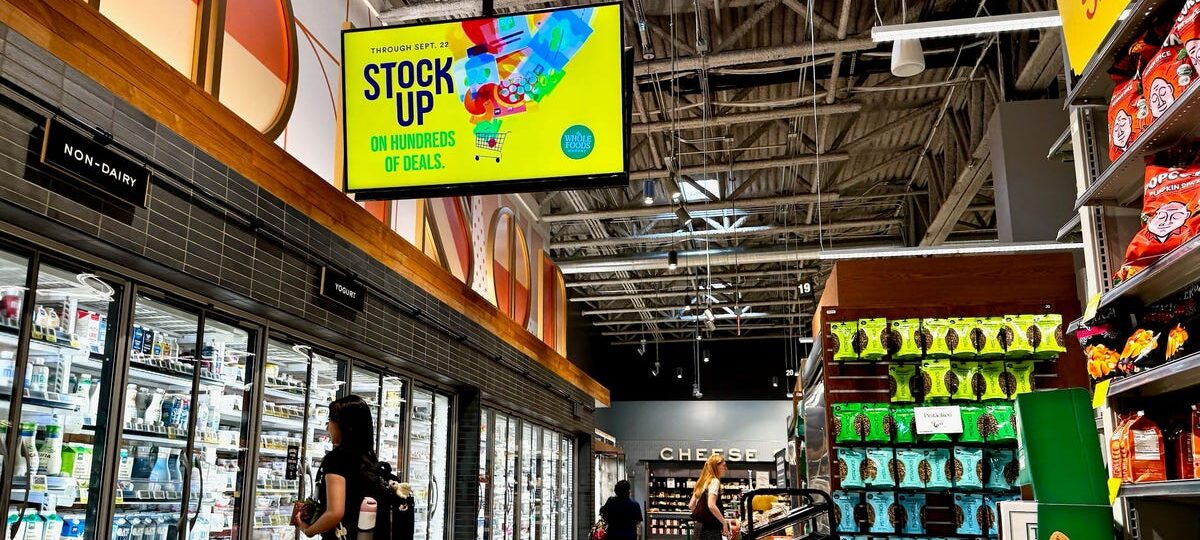
A spec sheet from Amazon also outlines some of its rules for running digital ads on screens in Whole Foods Markets.
Ads are mostly limited to promoting products those stores actually have in stock, but front entrance displays may feature outside brands.
The Amazon rules also say ads should be “designed to inspire and inform” shoppers and may not be noisy or distracting.
A survey earlier this year from retail media network Grocery TV found that shopper acceptance of ad screens depends on the in-store context.
Shoppers are generally comfortable seeing ads in their mobile apps, at the front entrance, or over the deli counter, the survey found.
They’re far less receptive to digital promotions on cooler doors or on store shelves.
Retailers stand to make big bucks if they can get this concept to work with customers.
The Grocery TV survey found that shoppers were 2.5 times more likely to consider a product when it was presented in a relevant context for their situation, and nearly two-thirds of shoppers reported buying something after seeing it on an in-store screen.
That not only boosts sales for the store, but it also helps drive growth for the higher-margin ads businesses that have been key to retailers’ overall profitability.
Mayward said the Walmart Connect business is seeing profit margins of more than 70%, as compared to roughly 5% in the core retail operation. “Ads growth can also happen outside of the dynamics of our e-commerce business,” he said. “I think that’s an important insight for understanding the long-term growth potential of Walmart Connect.”
Discover more from NAIRAVOICE.COM.NG
Subscribe to get the latest posts sent to your email.