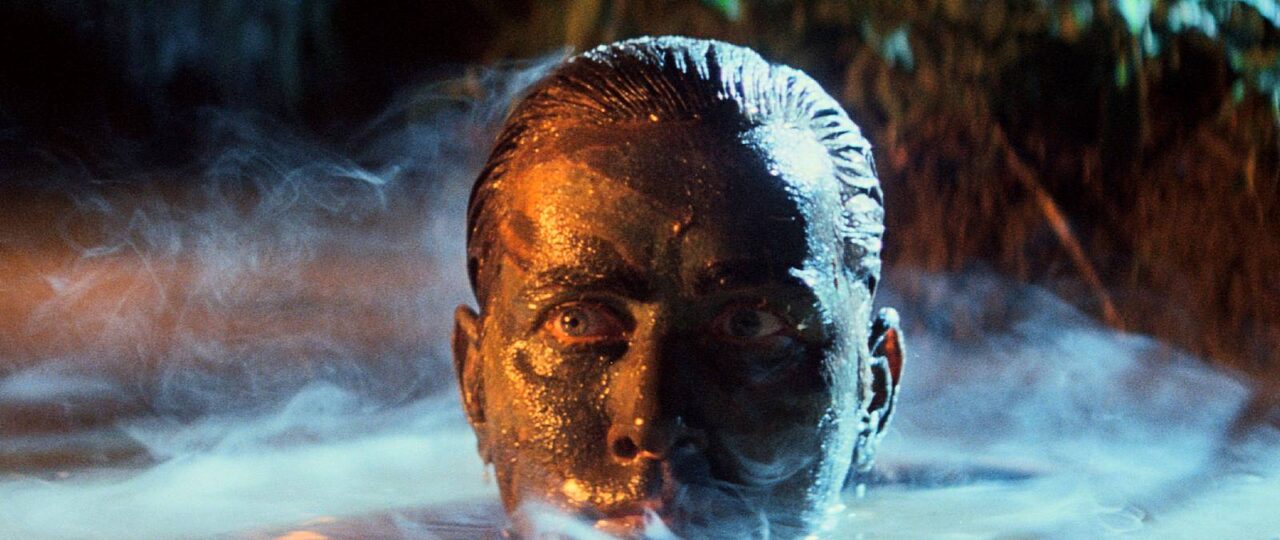
The most impactful final lines in war movie history are still the iconic ending from Apocalypse Now. War movies have given audiences some of cinema’s most memorable dialogue, from declarations of military brotherhood to chilling observations about the cost of victory. Whether depicting the chaos of the battlefield or the psychological damage inflicted on those who survive it, the genre has never been short of powerful words. However, the best war movies understand that sometimes the most devastating statement is also the simplest.
A perfectly delivered line can communicate more about the human consequences of conflict than an entire battle sequence, particularly when it arrives at precisely the right moment. Few filmmakers have demonstrated that understanding quite as effectively as Francis Ford Coppola. His 1979 Vietnam War epic remains one of the most ambitious, disturbing, and visually extraordinary films ever made.
Starring Martin Sheen as Captain Benjamin Willard and Marlon Brando as the increasingly unhinged Colonel Walter Kurtz, Apocalypse Now depicts an increasingly nightmarish journey into the Cambodian jungle. Its reputation rests on extraordinary filmmaking, unforgettable performances, and an uncompromising examination of America’s involvement in Vietnam.
Yet, after nearly three hours of psychological torment, spectacular violence, and moral uncertainty, Coppola delivers an ending that requires remarkably little explanation. Its iconic final words remain as haunting today as they were when audiences first heard them.
Apocalypse Now Is A Harrowing Look At The Reality Of War
<<img src="https://static0.srcdn.com/wordpress/wp-content/uploads/2026/07/apocalypse-now.jpg?q=49&fit=crop&w=825&dpr=2" />
</figure>
Apocalypse Now approaches the Vietnam War from a perspective considerably different from conventional military dramas. Rather than concentrating on battlefield strategy, heroic soldiers, or the familiar distinction between victory and defeat, Coppola examines the psychological consequences of a conflict that has seemingly destroyed every conventional understanding of morality.
Apocalypse Now follows Captain Willard, an emotionally detached Army officer assigned to travel upriver and assassinate Colonel Kurtz. His superiors consider him dangerously unstable, but Willard gradually discovers that the colonel’s descent into madness is considerably more complicated than his assignment initially suggests.
The journey itself becomes an increasingly disturbing examination of American military involvement. At the mouth of the river, Lieutenant Colonel Bill Kilgore (Robert Duvall) demonstrates the absurdity of a military culture that can simultaneously celebrate violence and treat warfare like an elaborate recreational activity.
Further upriver, the situation becomes increasingly desperate. Soldiers struggle to distinguish between civilians and enemies, military authority becomes increasingly meaningless, and the psychological effects of prolonged exposure to violence become impossible to ignore. The Do Lung Bridge sequence is particularly revealing, depicting American soldiers defending a position without any apparent understanding of their mission or even who is commanding them.
Coppola’s approach owes considerably to Joseph Conrad’s 1899 novella Heart of Darkness, transplanting its exploration of colonialism, imperialism, and psychological deterioration into the Vietnam War. It refuses to present military intervention as an uncomplicated struggle between good and evil. Instead, it examines how supposedly civilized institutions can produce extraordinary brutality.
Apocalypse Now’s Final Quote Defines The War Movie Genre
<<img src="https://static0.srcdn.com/wordpress/wp-content/uploads/2020/10/Kurtz-in-Apocalypse-Now.jpg?q=70&fit=crop&w=825&dpr=1" />
</figure>
There are plenty of extraordinary moments throughout Apocalypse Now, but its most enduring statement arrives during the final confrontation between Willard and Kurtz. After finally reaching the colonel’s compound, Willard discovers the horrifying consequences of Kurtz’s absolute authority. Surrounded by mutilated bodies, severed heads, and devoted followers, the officer encounters a man who has abandoned every conventional moral boundary.
Kurtz’s conversations with Willard reveal a man who has become increasingly consumed by his understanding of human brutality. Kurtz believes that true military effectiveness requires an almost unimaginable capacity for cruelty, and his observations challenge Willard’s understanding of the mission. Eventually, Willard kills Kurtz during a ceremonial slaughter, an extraordinary sequence intercut with the ritual sacrifice of a water buffalo. As Kurtz lies dying, he delivers the film’s final words: “The horror, the horror.”
The line originates in Conrad’s Heart of Darkness, where Kurtz utters the same words shortly before dying. It encapsulates everything Willard has witnessed during his journey, from the casual destruction of Vietnamese communities to the complete disintegration of military discipline and Kurtz’s transformation into a tyrannical figure.
Importantly, the words suggest an understanding of the terrible things human beings are capable of doing, particularly when institutions and ideologies give them permission to abandon their moral responsibilities. Kurtz has spent much of the film attempting to rationalize his brutality, but his final statement suggests that he ultimately recognizes something profoundly disturbing about the world he has created.
Willard has completed his assignment, but there is no conventional sense of victory, justice, or moral resolution. Killing Kurtz does not undo the atrocities that brought him there, nor does it offer any meaningful explanation for the wider conflict. The final words leave audiences confronting the same uncomfortable questions that have haunted Willard throughout his journey.
Apocalypse Now Gave Us Several All Time Great War Movie Quotes
<<img src="https://static0.srcdn.com/wordpress/wp-content/uploads/2023/02/willard_on_kurtz-s_compound_in_apocalypse_now.jpg?q=49&fit=crop&w=825&dpr=2" />
</figure>
Apocalypse Now is practically overflowing with memorable quotations. Screenwriter John Milius, Coppola, and journalist Michael Herr, who contributed to the screenplay and narration, helped create a collection of lines that have become inseparable from popular understandings of the Vietnam War.
Perhaps the most recognizable comes from Robert Duvall’s Lieutenant Colonel Kilgore: “I love the smell of napalm in the morning.” Delivered after an American air assault, the remark perfectly captures the character’s extraordinary detachment from the destruction surrounding him. It is simultaneously darkly funny, horrifying, and an indictment of the military culture that allows such an attitude to flourish.
Another unforgettable exchange comes during Kilgore’s attempt to secure a beach for his soldiers to surf. When questioned about the enemy’s presence, he responds with the equally iconic declaration: “Charlie don’t surf!” The line is ridiculous in the context of an ongoing military operation, which is precisely why it works. Kilgore’s priorities are so completely disconnected from the reality of combat that surfing conditions appear to matter more than the lives being lost around him.
Martin Sheen also delivers one of the film’s most memorable observations with “Never get out of the boat.” Initially presented as advice associated with Willard’s increasingly dangerous journey, the statement becomes an ominous reminder that the river represents a boundary between the relative familiarity of military life and the psychological nightmare waiting further upriver.
Then there is Willard’s description of his assignment: “Terminate with extreme prejudice.” The chilling bureaucratic language disguises the reality of what he has been ordered to do. It is an especially revealing example of how Apocalypse Now uses dialogue to expose the contradictions of military authority.
Even the opening narration provides an unforgettable introduction to Apocalypse Now‘s psychological landscape. Willard’s declaration, “Saigon. Shit. I’m still only in Saigon,” immediately establishes his exhaustion and disconnection from ordinary life. Despite being physically removed from the battlefield, he cannot escape the war psychologically.
These quotations have endured because they reveal something distinctive about the film’s characters, its understanding of military culture, or the absurdity of the conflict itself. However, none quite matches the devastating simplicity of Apocalypse Now‘s final statement.
Apocalypse Now
Discover more from NAIRAVOICE.COM.NG
Subscribe to get the latest posts sent to your email.