

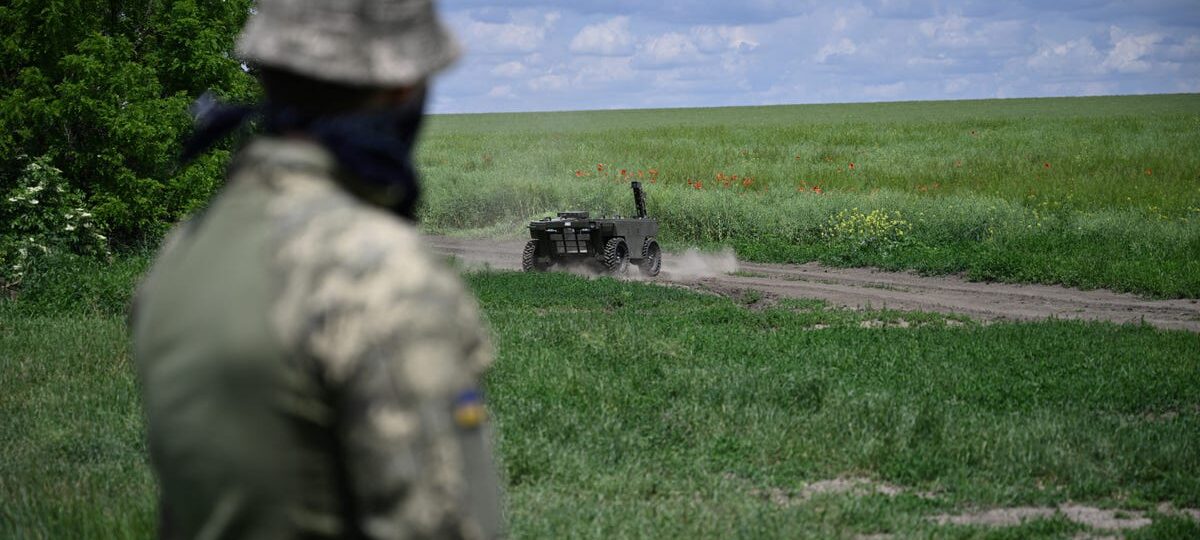
The commander of a British Army battalion tasked with experimenting with new technologies said that his unit has tested out dozens of ground robots.
He concluded that they can be useful, but only for certain missions.
And they come with a long list of challenges.
As Western militaries rush to absorb lessons from the war in Ukraine and integrate more uncrewed systems into their respective forces, soldiers are finding that some systems might look good on paper but aren’t effective in all combat scenarios.
Ground robots, in particular, can face weight, navigation, cost, and power constraints that raise questions about when and how they should be used.
In Ukraine’s case, the systems have seen use in logistics operations, replacing soldiers in highly dangerous areas of the battlefield, but soldiers have also said they’re not a catch-all solution.
At a recent US Army-led exercise at Fort Irwin in California, a handful of American allies and partners gathered with US forces to experiment with new systems in a simulated conflict against a near-peer adversary.
The British Army’s experimentation unit, the 2nd Battalion, The Yorkshire Regiment, was present for the event alongside the unit that will take over their experimentation role, the 1st Battalion Irish Guards.
John Black, commander of the 2nd Battalion of the Yorkshire Regiment, told Business Insider that he and his unit have seen and tested a wide range of uncrewed ground vehicles, or UGVs. “Any use case you can think of, we’ve tried it,” he said, adding that they’re not just driving it around to see how it works; rather, they are focused on “trying to employ it in a tactical scenario.” Through that experimentation, Black and his troops have encountered problems that can make UGVs difficult to use.
For instance, many of the medium- to large-sized UGVs they tested required trailers or flatbed trucks to transport.
Depending on how soldiers are moving and what they’re carrying, that creates a logistical burden.
And once they’ve moved it into position, troops still have to figure out how to get it into the fight. “Even if they’ve got quite long range and good speed, there’s still going to be a process where you’re moving them into the fight,” Black said.
UGVs can also create power and refueling challenges.
Depending on the system, specifically it’s size, range, and capabilities, troops in the field may need to carry extra batteries, generators, or fuel — or periodically bring the robot back to a charging point.
Remote control introduces another set of problems, from maintaining a reliable connection to keeping the robot on course.
The systems can also struggle with difficult terrain.
Often, their advertised range doesn’t translate cleanly to real-world conditions, such as uneven ground.
Obstacles “confound” most UGVs, Black said.
Whether UGVs can rely on autonomous features is a particularly thorny subject.
Autonomy has become a major area of interest across uncrewed capabilities, but Black said some manufacturers have moved away from offering autonomous UGVs. “We have seen, over the last few years, these vendors stop offering autonomous ones because it’s unworkable,” he said, explaining that such autonomous features can result in the system being more expensive and difficult to use.
Despite those limitations, Black said there are certain situations where he sees value, including breaches and mine removal.
Both missions are incredibly dangerous for soldiers.
For that reason, militaries have been using remote-controlled technologies for breaching fortified positions and removing mines for decades.
Certain UGVs coming online now could be the next evolution in that technology, but other methods could prove more practical.
Ground robots are seeing growing use in Ukraine, sometimes operating as a safer option than sending soldiers into “the kill zone” to deliver supplies and ammo.
Ukraine has also used them offensively, such as driving one equipped with a gun off a drone boat in a first-of-its-kind robotic amphibious assault.
However, their growing use in that fight hasn’t settled the debate on their overall usefulness.
Black indicated that they might be a niche tool, most effective only in those cases where keeping a soldier out of harm’s way matters most.
Discover more from NAIRAVOICE.COM.NG
Subscribe to get the latest posts sent to your email.