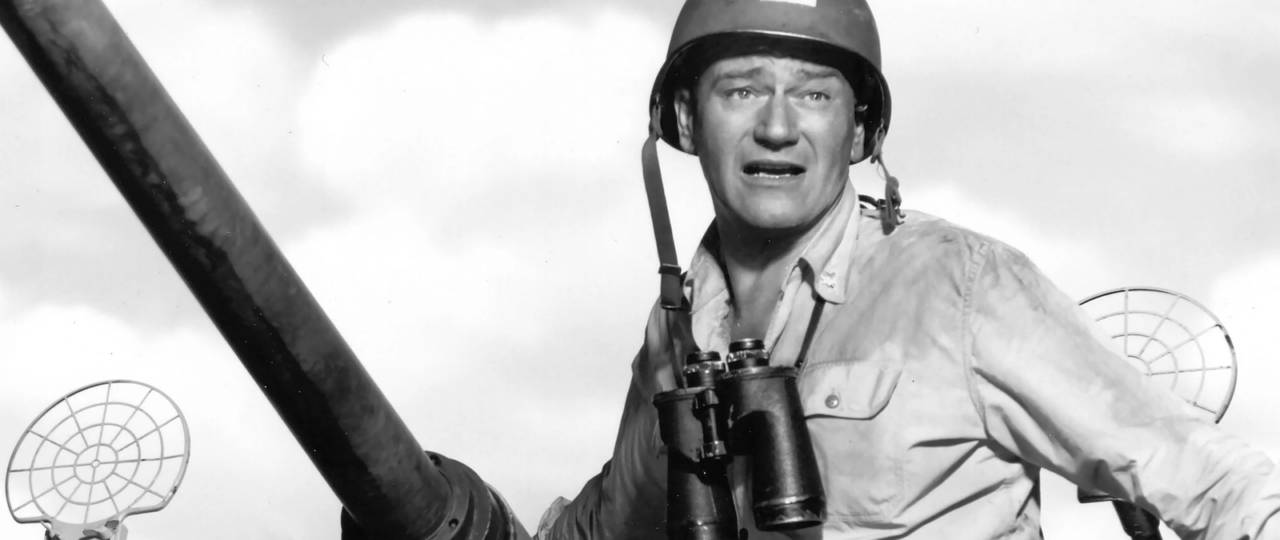
When it comes to the actors of the golden age of Hollywood studio films, John Wayne stands among the most memorable. The man’s star persona was rigid and largely unbending, with a projected strength that made him the biggest star in America for large chunks of the 1940s through the 1960s. As a tall, hard-edged natural leader, he fit best into Westerns and war movies, following the end of World War II with major roles in movies like Back to Bataan, They Were Expendable, and George Waggner‘s 1951 film Operation Pacific — one of his more unsung and genuinely exciting war films, now a streaming hit on Tubi. The best part of Operation Pacific is that it almost functions as a spy film for stretches, covering the nature of the “silent service” that operated in the Pacific Theater of the war, carrying out discrete operations from the depths of the ocean. As the Star Wars-esque title crawl notes, the attack on Pearl Harbor necessitated quiet work from unnoticed vessels.
Like many of the war movies to follow World War II, Operation Pacific is an explicitly patriotic and stirring portrait of heroism and sacrifice. While the noir films starring actors like Humphrey Bogart might have demonstrated the listlessness and potential for violence following veterans years later (see Key Largo), Wayne was committed to bringing those characters to life at their best — fighting an unambiguous enemy, hard towards their men but gentle when the situation demands it. Operation Pacific‘s opening sequence, with Wayne beatifically and silently holding an infant after assisting an escape in the Philippines, is the perfect example. While he is playing a fictional character, Lieutenant Commander Duke E. Gifford, he is maybe one of the clearest John Wayne archetypes in any film, complete with his usual nickname.
‘Operation Pacific’ Relies On John Wayne’s Fatherly Side
<<img src="https://static0.colliderimages.com/wordpress/wp-content/uploads/2026/11/screenshot-2026-11-04-224530.png?q=49&fit=crop&w=825&dpr=2" />
Image via Warner Bros.</figure>
Operation Pacific follows the actions and strategies of the USS Thunderfish, a submarine engaged in the “silent service” during the war. While its 1951 release year means it wasn’t exactly wartime propaganda, it’s also perfectly adoring of the Navy men at its center; modern viewers might struggle with moments like the gleeful loading of missiles aimed at Japanese aircraft carriers (complete with character actor legend Ward Bond‘s Commander Pop Berry yelling “jackpot!”), but it does speak to the freshness of the war in the audience’s minds. Something like 2006’s Letters From Iwo Jima can lend nuance to the war, but many of the movies released immediately following the war gave viewers what they wanted: a cozy and heroic mythology that came to define the Greatest Generation.
As Operation Pacific‘s Duke, John Wayne is strong, competent, and keen to look into the distance while making monosyllabic proclamations. That was one of the actor’s best moves, and it gave him a fatherly warmth that was hard to shake, even in his darkest roles, like John Ford‘s 1956 film The Searchers. He might have been something of a young rebel in his first official Ford collaboration with 1939’s Stagecoach (not counting some cameos in silent films a decade before), but soon enough, Ford had him playing the old man, literally in the case of 1949’s She Wore A Yellow Ribbon. These roles (along with his wonderful work in Howard Hawks’ Red River) were important for Wayne’s development as an actor, but Operation Pacific gives a clearer view of John Wayne’s movie star image. This is a movie where he is always right, in matters of warfare and romance, immediately rekindling a relationship with his Navy nurse ex-wife Mary (Patricia Neal).
‘Operation Pacific’ Shows John Wayne At His Movie Star Peak
 Image via Warner Bros.
- Image via Warner Bros.
- Image via Warner Bros.
- Image via Warner Bros.
- Image via Warner Bros.
 Image via Warner Bros.
 Image via Warner Bros.
 Image via Warner Bros.
 Image via Warner Bros.
 Image via Warner Bros.
- Image via Warner Bros.
- Image via Warner Bros.
- Image via Warner Bros.
- Image via Warner Bros.
- Image via Warner Bros.
 Image via Warner Bros.
 Image via Warner Bros.
 Image via Warner Bros.
 Image via Warner Bros.
 Image via Warner Bros.
John Wayne’s lack of service during the war evidently gave him a sense of shame that he spent the last several decades of his life atoning for. Marc Eliot‘s book American Titan: Searching for John Wayne claimed the actor prioritized war movies over actually serving, and his postwar hunt for Communists reeked of overcompensation. But both of these things ultimately did what the actor needed, making him the face of the strong man who won the war, and in Operation Pacific that’s necessary — he leads the USS Thunderfish through hell, surviving the crash dive death of Commander Pop and the endless artillery of Japanese fleets in the movie’s thrilling climax. He also wins back the affection of his ex-wife without much issue, in a storyline seemingly ripped directly from John Ford’s 1950 Western Rio Grande (where the estranged wife was played by the great Maureen O’Hara, in one of many collaborations).
In short, John Wayne is in sturdy movie star mode for Operation Pacific. In the way only he can, he grimaces and grins through the surprisingly thrilling submarine action (as well as some creaky sailor comedy). While it’s not exactly The Hunt For Red October (or Das Boot, or any other more contemporary submarine film), Operation Pacific mines the inherent danger of the confined, deep-sea vessel for suspense, with moments like a leak in the sub and methodical fixes for the Thunderfish‘s failing torpedo systems delivering tension. Whether or not the Thunderfish successfully averts the actions of the local Japanese fleet or Duke reclaims the love of his ex-wife, the movie’s more concerned with throwing viewers onto the high seas, delivering a stirring yarn of heroic action. And it delivers wonderfully.
Discover more from NAIRAVOICE.COM.NG
Subscribe to get the latest posts sent to your email.