
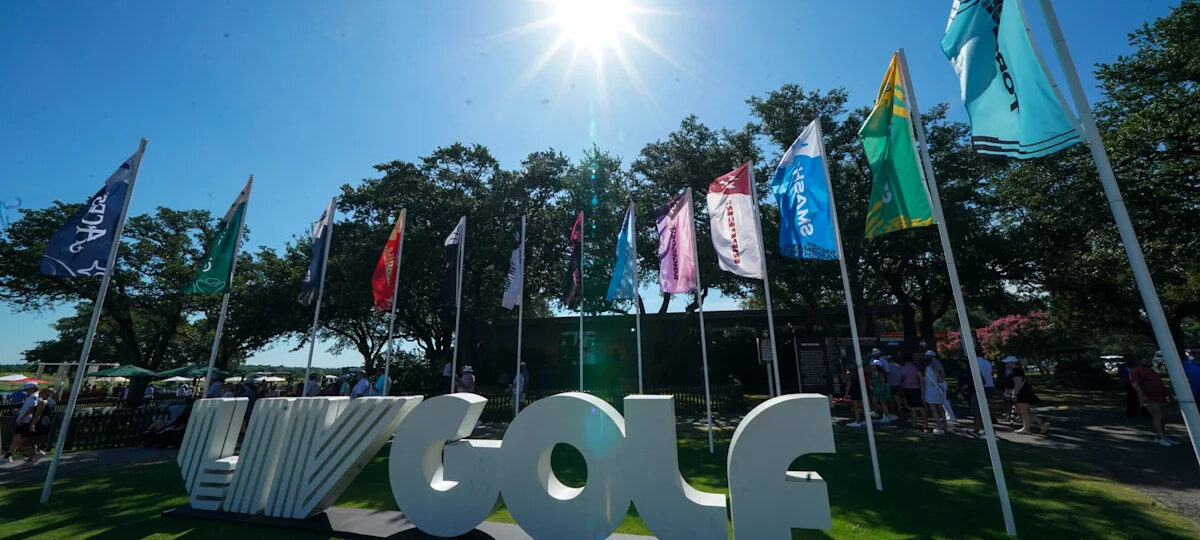

LIV Golf is not guaranteed to exist once the 2027 season gets underway. After years of enormous contracts, high-profile defections and attempts to disrupt professional golf, the league is now fighting to secure fresh investment and facing serious questions about what comes next.
The 2026 season has arguably been the most turbulent in LIV’s short history. Instability followed Brooks Koepka’s decision at the end of 2025 to pursue a return to the PGA Tour, while rumors intensified during The Masters that Saudi Arabia’s Public Investment Fund could walk away.
New Orleans has since been postponed, doubts have emerged over the Team Championship, and several players have reportedly indicated privately that they intend to leave after the season, regardless of whether new funding arrives.
LIV did not reach this position because of one decision. Several choices along the way arguably made survival much harder.
LIV Golf picked a fight with the PGA Tour immediately

The first came before LIV had even staged an event.
Signing Phil Mickelson and Dustin Johnson for the inaugural tournament at Centurion, followed shortly afterward by Bryson DeChambeau and Brooks Koepka, certainly got everybody’s attention. It also immediately put the PGA Tour on the defensive.
Suspensions followed, and professional golf descended into a bitter fight.
LIV might have bought itself more time by initially concentrating on younger players such as Eugenio Chacarra and David Puig, supplemented by established veterans, particularly from the DP World Tour. Instead, LIV went directly after some of the PGA Tour’s biggest names and made itself an immediate threat.
Greg Norman’s prominence as the operation’s public face did little to lower the temperature.
Then came the world ranking problem.
LIV failed to secure world ranking points until the eve of the 2026 season. Its 54-player fields, 54-hole tournaments, lack of a cut, and relatively closed structure all created problems.
Whatever players thought of the rankings themselves, their importance was impossible to ignore. A golfer leaving the PGA Tour or DP World Tour risked tumbling down the rankings unless he produced exceptional performances in the majors.
That made joining LIV a much bigger competitive gamble.
LIV’s relegation rules and team identities caused more problems
The relegation system created another credibility problem.
LIV promoted the idea that poor performance would have consequences, but those consequences were not always enforced. After the 2024 season, Bubba Watson and Branden Grace both retained their places despite being relegated.
Watson at least had captain status. Grace did not.
Grace went through the Promotions Event and failed to do enough to regain his position, yet Stinger GC still brought him back for 2025. Louis Oosthuizen subsequently told Golf Monthly that Grace was the only player the team considered.
LIV eventually tightened its relegation rules, but considerable damage had already been done.
Ironically, the league later discovered exactly how compelling genuine relegation could be. Anthony Kim lost his place, earned it back and then won in Adelaide within months. That was a sporting storyline created by consequences actually meaning something.
LIV also never completely solved its team problem.
Some identities worked naturally. Ripper GC represented Australia, Southern Guards received huge support in South Africa, and Majesticks developed an obvious connection with the United Kingdom.
Others remained much harder to define.
For many fans, supporting Crushers meant supporting Bryson DeChambeau. RangeGoats had a similar dependence on Bubba Watson. LIV built its long-term concept around franchises but never gave every franchise a sufficiently clear identity independent of its star player.
Given how heavily the league invested in team golf as its distinguishing feature, that was a major missed opportunity.
The White House talks may prove to be LIV’s biggest missed opportunity.
But the most consequential mistake may have come in February 2025.
Talks involving the PGA Tour and PIF at the White House appeared to bring professional golf closer to reunification than it had been since the framework agreement was announced in June 2023.
President Donald Trump was involved. Tiger Woods said a deal was close. For a moment, the possibility of players moving much more freely between the rival circuits appeared realistic.
But no full agreement followed.
One reported sticking point was PIF governor Yasir Al-Rumayyan’s determination to retain team golf as an important part of the arrangement.
That decision looks particularly costly now.
A deal with the PGA Tour may have meant LIV Golf could not continue in the same form. Teams may have changed. The schedule may have changed. The entire structure could have been forced into a compromise.
But LIV could have gained something it desperately needs now: stability.
Instead, it enters the closing stages of 2026 dealing with postponed events, uncertainty over its championship, reported player departures and the search for additional investment.
For years, LIV Golf’s willingness to spend heavily allowed it to force its way into professional golf’s biggest conversations.
Discover more from NAIRAVOICE.COM.NG
Subscribe to get the latest posts sent to your email.