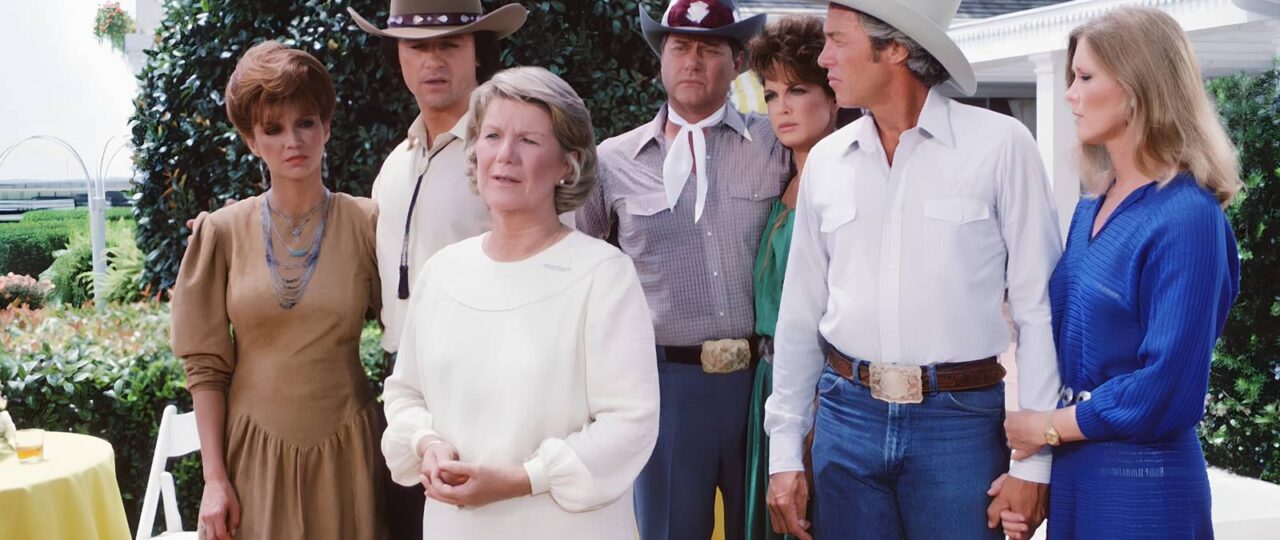
In the days before streaming, before TiVo, and even before the VCR, TV viewers had to set aside specific times to keep up with their favorite TV shows (yes, kids, it’s true). And in 1978, that meant the highest-rated drama, ABC’s Eight is Enough, had just shy of 18.5 million Americans sitting still in front of their television for a full hour, while the beloved half-hour sitcom Laverne & Shirley sat at the top with 22.7 million. Imagine, then, what it would take for a single episode of a TV series to have over 80 million Americans, and over 300 million worldwide, stop whatever they’re doing to watch. 46 years ago, Dallas took only two minutes to accomplish that very feat, a phenomenal response to a moment that changed television forever.
‘Dallas’ Was Already Changing the Rules of Television
Dallas premiered on CBS on April 2, 1978, a prime-time soap opera, the first of its kind since Peyton Place went off the air in 1969. In a different world, it would be the latter that paved the way for serialized storytelling, but ABC’s over-exposure of the series and the departure of Mia Farrow after its second season saw the idea scuttled, relegating the genre back to its traditional daytime airings. In the time between, self-contained episodic programs became the norm, with “case-of-the-week” and sitcoms dominating the scene. Dallas boldly bucked the norm, bringing back the serial aspect of the soap to prime time, and finding success with better production values than its daytime kin.
The series centered around the Ewing family of Texas, owners of the independent oil company Ewing Oil and Southfork, the family’s cattle ranch, and their bitter rivalry with the Barnes family. The series begins with the eloping of Bobby Ewing (Patrick Duffy) and Pamela Barnes (Victoria Principal), a move that only serves to reignite the age-old feud between the families, and the one between the moral, upstanding Bobby and his ruthless, scheming older brother J.R. (Larry Hagman). The mix of wealth, sex, affairs, power plays, and conflict that played out around the dysfunctional Ewings proved irresistible, and Dallas began its ascent to the top.
A large part of the series’ appeal came from the breakout popularity of Hagman’s J.R. There was nothing likable about the man: ruthless, mean, manipulative, and lacking any principles whatsoever. Yet in Hagman’s hands, J.R. was enthralling. You never knew what he would do from week to week, but you knew it would be morally questionable, and it would be great. But men like J.R. make enemies, enemies that would love to blast that wicked smirk off his face. And in the final two minutes of the third season, somebody did.
‘Dallas’ Sparked a Phenomenon That Revolutionized Television
 Image via CBS
- Image via CBS
- Image via CBS
- Image via CBS
- Image via CBS
 Image via CBS
 Image via CBS
 Image via CBS
 Image via CBS
 Image via CBS
- Image via CBS
- Image via CBS
- Image via CBS
- Image via CBS
- Image via CBS
 Image via CBS
 Image via CBS
 Image via CBS
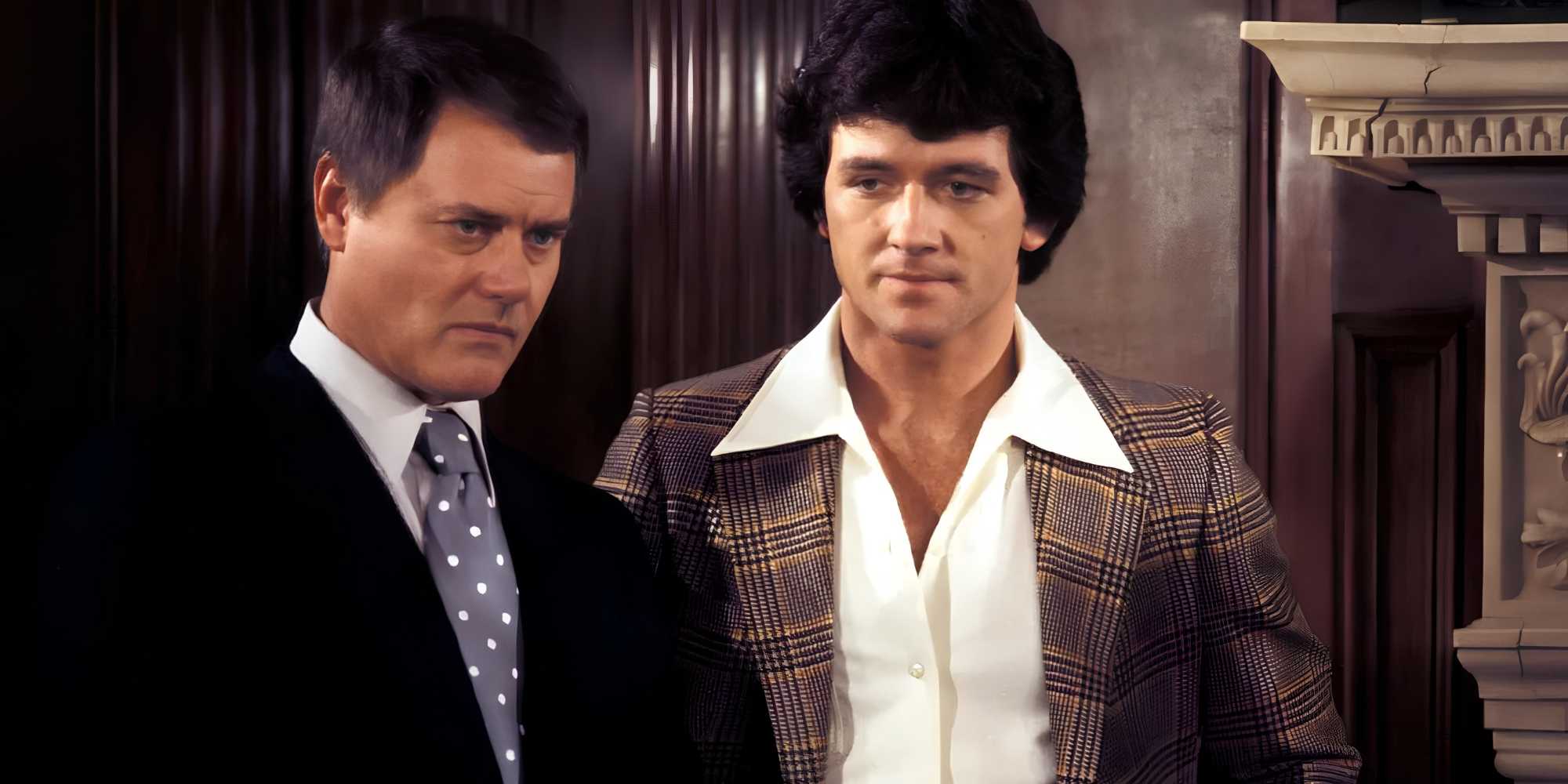 Image via CBS
 Image via CBS
As “A House Divided” begins, J.R.’s ruthlessness, his shady business dealings, and countless betrayals have pushed family and rivals alike to the edge. Cliff Barnes (Ken Kercheval) joins an ever-growing list of people — Sue Ellen (Linda Gray), Kristin Shepard (Mary Crosby), Alan Beam (Randolph Powell), and Vaughn Leland (Dennis Patrick) — with a motive to kill J.R. after he shuts down 23 profitable oil wells simply to deny Cliff his rightful share. And as the episode winds down, J.R., working late in his office, hears a noise and goes out to investigate, only to be shot twice in the gut by someone unseen, who is…
No one knows, and won’t know until the next season. In two minutes, Dallas set up the cliffhanger to end all cliffhangers, and “Who Shot J.R.?” dominated the landscape for the next eight months. Saturday Night Live did a “Who Shot J.R.?” sketch; t-shirts trumpeting “Who Shot J.R.?” or “I Shot J.R.” were everywhere; and Las Vegas took bets on whom the perpetrator was. The 1980 presidential election race weighed in, with Republicans wearing “Democrats Shot J.R.” buttons and Democrat Jimmy Carter quipping that his reelection campaign could be funded by discovering the identity of the shooter. Even the Queen Mother, upon meeting Hagman during a royal event in London, asked, “I don’t suppose you could tell me who shot J.R.?” (he couldn’t if he wanted to: the producers kept it a secret even from him until the last minute).
Four icons and four completely different ways of walking into trouble.
This is the one you would have been out there, why it fits, and what it would have cost you.
You have never explained yourself and you have never needed to,
because people work out fairly quickly that you are the most capable person in the room
without you ever having to mention it.
- Eastwood built the character out of everything he refused to do, stripping away the
backstory, the speeches and every bit of reassurance until only the competence was left. - You keep your own counsel, and while other people occasionally find that unnerving, you
have never felt any real need to fix it for them. - The Dollars films work because he genuinely is in it for himself right up until the
moment he is not, and he never explains that part either. - You would be gone before anybody got a chance to thank you.
You are the funniest person in most rooms and the most loyal
person in all of them, and you would be genuinely insulted if somebody suggested those two
things were in any tension.
- Doc has no real reason to be in this fight beyond the fact that his friend is in it,
which is the only reason he has ever needed for anything. - You lead with wit, and it does a very effective job of hiding how seriously you take the
handful of people you actually care about. - Val Kilmer’s performance is the most quoted in the entire genre because the jokes keep
getting sharper as the situation gets worse. - You would spend everything you had on this and still describe it as a good week.
You never wanted this job, and you took it anyway because the
alternative was standing there watching somebody less careful do it badly, which is the most
Western reason there has ever been.
- Earp is the reluctant authority figure, a man who came to town specifically to be left
alone and somehow ended up answerable for all of it. - You are protective by instinct, so when something goes wrong your first thought is who
is exposed rather than who is to blame. - These films understand that keeping order costs far more than breaking it, and that the
person holding the line almost never gets thanked. - You would do the whole thing again, and you would complain about it the entire time.
Nobody has ever successfully talked you out of something you had
already decided was right, and a long line of grown adults has found that out the hard way.
- Mattie is the most relentless character in the Western canon and she manages it through
argument, paperwork and flat refusal rather than a fast draw. - You have no patience for being managed, so you negotiate, you check the details and you
turn up exactly when you said you would. - True Grit is the rare Western where the moral centre is the youngest person on screen
and every adult around her has to catch up. - You would get what you came for, and the film is honest about what that takes out of
you.
That led to the unprecedented number of viewers who watched “Who Done It?” on November 21, 1980, to discover that J.R.’s sister-in-law and former mistress, Kristin Shepard, was the shooter. Those numbers, and the crazy media frenzy surrounding the storyline, established the season-ending cliffhanger as the de facto industry standard going forward: the good, the bad, and the ugly, including the infamous Dallas Season 9 cliffhanger that struck the entirety of the season from canon with the reveal it was all a dream, with Bobby Ewing alive after all.
“Who Shot J.R.?” became a defining moment in television history, being referenced and parodied ever since, the most notable being The Simpsons‘ “Who Shot Mr. Burns?” Season 6 cliffhanger. Yet the series’ influence extends even beyond that. It immediately spawned like-minded series like Dynasty and Falcon Crest, established serialized storytelling as the “new normal,” and set the stage for the era of the antihero.
Discover more from NAIRAVOICE.COM.NG
Subscribe to get the latest posts sent to your email.