War movies have a way of finding something meaningful in even the most terrible circumstances. A soldier makes it home, a dangerous mission succeeds, or an extraordinary act of courage gives the suffering some purpose. Even some of the greatest war movie masterpieces of the 20th century offer audiences something to hold on to.
You’ll find none of that here. These films refuse to provide comfort, leaving viewers to confront the possibility that nothing good will come of what they’ve witnessed. The most hopeless war movies aren’t necessarily the bloodiest. Sometimes the horror comes from watching military commanders knowingly sacrifice their own men, or civilians struggling to survive long after the fighting has moved elsewhere.
Other characters survive physically but lose everything that once made their lives recognizable. Spanning World War I, World War II, Vietnam, and the Bosnian conflict, these 10 films explore different kinds of despair. The genre has its share of overlooked war movies celebrated for their exceptional filmmaking, but here, the ranking comes down to how completely each story denies its characters an easy resolution.
10
Paths Of Glory (1957)
<<img src="https://static0.srcdn.com/wordpress/wp-content/uploads/2026/04/kirk-douglas-in-paths-of-glory.jpg?q=49&fit=crop&w=825&dpr=2" />
</figure>
Stanley Kubrick was only 28 when he directed Paths of Glory, yet his understanding of military hypocrisy was already remarkably sophisticated. Kirk Douglas stars as Colonel Dax, a French officer ordered to lead his men on a virtually impossible assault against a heavily fortified German position during World War I. When the attack fails, the generals responsible decide that someone must pay for their embarrassment, and three soldiers are selected to face court-martial.
Kubrick’s famous tracking shots through the trenches establish the grim reality of life at the front, but the film’s most disturbing scenes take place far from the fighting. The courtroom proceedings expose a military hierarchy more concerned with protecting its reputation than the lives of ordinary soldiers. Dax fights desperately for justice, only to discover how little his arguments matter. Even the unexpectedly moving final scene, in which exhausted soldiers listen to a young German woman sing, cannot undo what came before.
9
Gallipoli (1981)
<<img src="https://static0.srcdn.com/wordpress/wp-content/uploads/2026/05/gallipoli.jpg?q=49&fit=crop&w=825&dpr=2" />
</figure>
There’s something particularly cruel about the way Peter Weir’s Gallipoli introduces its protagonists. Archy Hamilton (Mark Lee) and Frank Dunne (Mel Gibson) are talented young runners whose friendship develops against the backdrop of Australia’s involvement in World War I. Their early adventures are filled with youthful excitement, and neither fully understands what awaits them when they enlist. For much of the movie, Weir allows audiences to enjoy their friendship while quietly moving them toward disaster.
The film culminates in the disastrous attack at the Nek, where Australian soldiers are repeatedly ordered into deadly Ottoman machine-gun fire. Frank’s extraordinary running ability suddenly becomes a desperate means of delivering a message that might prevent further slaughter. Some adventure movies give their characters spectacular, almost heroic death scenes, but Gallipoli does the opposite. Weir freezes the final image as Archy is struck by gunfire, abruptly ending the life of a young man whose speed once seemed to promise him a remarkable future.
8
All Quiet On The Western Front (1930)
<<img src="https://static0.srcdn.com/wordpress/wp-content/uploads/2026/01/all-quiet-on-the-western-front-movie-from-1930.jpg?q=49&fit=crop&w=825&dpr=2" />
</figure>
Nearly a century after its release, Lewis Milestone’s original All Quiet on the Western Front remains an astonishingly effective condemnation of war. Adapted from Erich Maria Remarque’s novel, the film follows Paul Bäumer (Lew Ayres) and his classmates, who enthusiastically enlist in the German army after listening to their teacher’s patriotic speeches. They expect honor and adventure. What they encounter is a relentless procession of death, hunger, and terror that rapidly destroys their enthusiasm.
Milestone was unusually uncompromising for his era, particularly in his depiction of how thoroughly the young soldiers are deceived. When Paul returns home on leave, he discovers that the civilians celebrating the war understand almost nothing about its reality. His attempts to explain the horror only alienate him further. The film’s famous final image of Paul reaching toward a butterfly before being shot is devastating in its simplicity. After everything he has endured, even an innocent moment of beauty is beyond his reach.
7
No Man’s Land (2001)
A wounded soldier lies motionless in a trench, unable to move because a bouncing mine has been placed beneath his body. If he gets up, it will explode. It’s a horrifying situation, made considerably worse by the fact that everyone around him seems more interested in assigning blame than finding a solution. This is the central predicament in Danis Tanović’s No Man’s Land, a bitterly funny and ultimately devastating film set during the Bosnian War.
Two soldiers from opposing sides become trapped together, while United Nations peacekeepers, military officials, and television journalists descend upon the scene. Each new arrival seems to complicate the situation rather than improve it. Tanović uses the absurdity of their competing interests to expose the terrible distance between international diplomacy and the people actually suffering. By the end, the film has abandoned even the pretense that someone will intervene successfully. Its final image is among the most hopeless in modern war cinema.
6
The Deer Hunter (1978)
Michael Cimino spends a considerable amount of The Deer Hunter establishing the ordinary lives of its central characters before sending them to Vietnam. The extended wedding sequence introduces a close-knit Pennsylvania steel-town community where friendships are built around familiar routines and shared experiences. Robert De Niro, Christopher Walken, and John Savage play three men whose lives are permanently changed by the war, although the full extent of the damage only becomes apparent after they return.
The movie’s notorious Russian roulette sequences remain deeply disturbing, but the quieter aftermath is arguably worse. Michael (De Niro) comes home unable to reconnect with the people who once understood him, while Nick (Walken) becomes increasingly detached from his former life. Cimino refuses to provide the reassuring homecoming audiences might expect from a conventional war drama. The men have survived something terrible, but the community introduced at the beginning can never be restored. Even the film’s final gathering feels haunted by those who are missing.
5Enjoying this article? Support our work with a small crypto donation.
Fires On The Plain (1959)
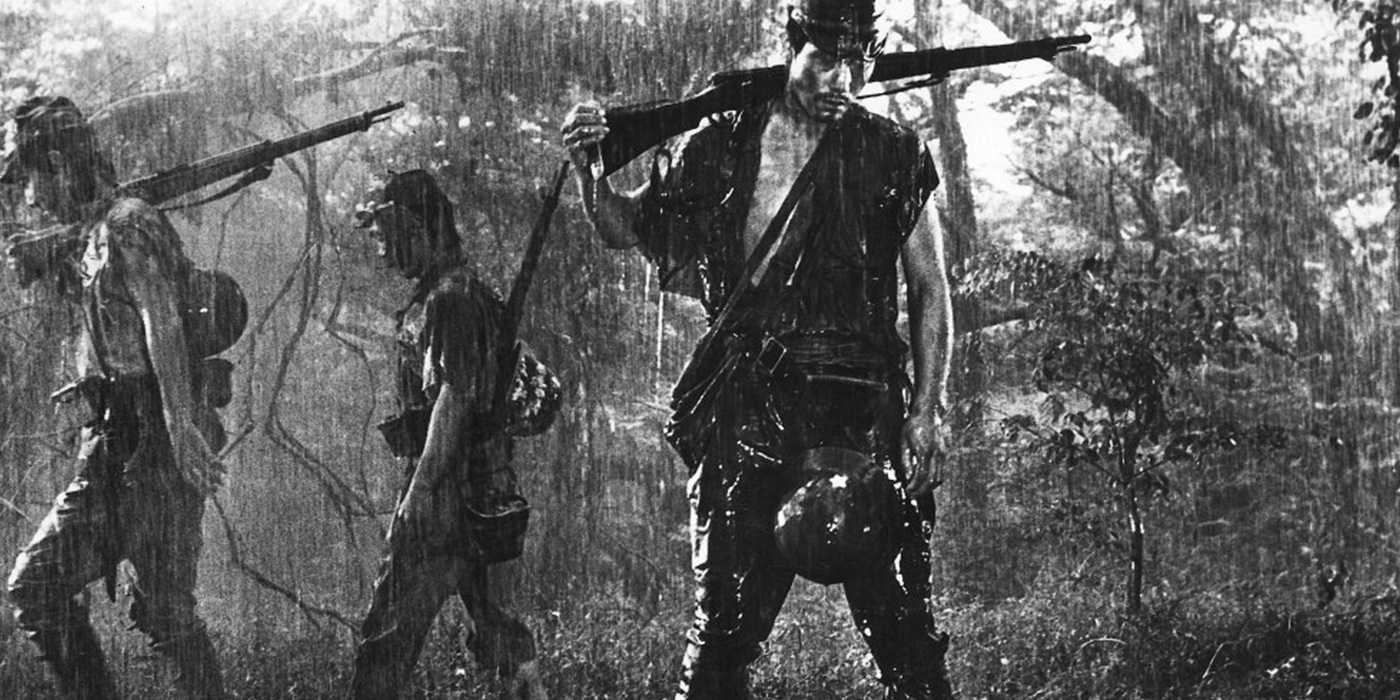
Kon Ichikawa’s Fires on the Plain offers a particularly ugly vision of war’s final stages. Set in the Philippines during World War II, the Japanese film follows Private Tamura (Eiji Funakoshi), a soldier suffering from tuberculosis who is rejected by his own unit and denied proper medical treatment. With Japan’s military position collapsing, Tamura is left to wander through a devastated landscape where his fellow soldiers have largely abandoned any sense of loyalty or discipline.
Starvation gradually becomes the film’s overriding concern, and the desperate measures taken by the surviving soldiers grow increasingly horrifying. Ichikawa depicts an army so thoroughly broken that its members begin viewing one another as potential sources of food. There are no heroic last stands or meaningful sacrifices to soften the experience. The most disturbing aspect is how easily the basic rules of human behavior collapse when survival becomes the only remaining objective. Tamura’s continued existence starts to feel less like a victory than another form of punishment.
4
Apocalypse Now (1979)
<<img src="https://static0.srcdn.com/wordpress/wp-content/uploads/2025/10/martin-sheen-in-apocalypse-now.jpg?q=49&fit=crop&w=825&dpr=2" />
United Artists /Courtesy Everett Collection</figure>
By the time Captain Benjamin Willard (Martin Sheen) reaches Colonel Kurtz’s remote compound in Apocalypse Now, the distinction between military duty and outright madness has practically disappeared. Francis Ford Coppola’s Vietnam War epic follows Willard on a mission to assassinate a rogue American officer (Marlon Brando), whose methods have become too extreme even for the military that trained him. What begins as a dangerous assignment gradually becomes a descent into a world where the usual rules of civilization no longer apply.
Coppola provides some of cinema’s most unforgettable images of war, from helicopters attacking a Vietnamese village to the surreal devastation surrounding the Do Lung Bridge. Yet the most disturbing aspect of Apocalypse Now is the growing realization that Kurtz’s brutality is hardly an isolated aberration. The deeper Willard travels into the conflict, the harder it becomes to distinguish his supposed mission from the madness surrounding him. By the end, any comforting notion of military purpose has been thoroughly dismantled. There may be survivors, but there’s precious little hope left.
3
Johnny Got His Gun (1971)
<<img src="https://static0.srcdn.com/wordpress/wp-content/uploads/2026/05/johnny-got-his-gun.jpg?q=49&fit=crop&w=825&dpr=2" />
</figure>
Imagine surviving a battlefield explosion only to discover that you’ve lost your arms, legs, and nearly every means of communicating with the outside world. That is the nightmare at the center of Johnny Got His Gun, written and directed by Dalton Trumbo from his own novel. Timothy Bottoms plays Joe Bonham, a young American soldier who remains conscious after suffering catastrophic injuries during World War I. The doctors caring for him have little understanding of his awareness, leaving Joe imprisoned inside his own body.
Trumbo makes the experience even more disturbing by moving between Joe’s memories, dreams, and increasingly desperate attempts to understand his condition. When he finally discovers a way to communicate, the possibility of relief briefly seems within reach. The response he receives is devastating. Unlike movies in which death provides an escape from suffering, Johnny Got His Gun imagines a man denied even that basic freedom. Its horror comes from the terrible realization that survival can become an endless sentence.
2
Grave Of The Fireflies (1988)
<<img src="https://static0.srcdn.com/wordpress/wp-content/uploads/2026/03/grave-of-the-fireflies-1.jpg?q=49&fit=crop&w=825&dpr=2" />
</figure>
Isao Takahata tells audiences how Grave of the Fireflies will end almost immediately. The film opens with the death of Seita, a teenage boy who has succumbed to starvation in a Japanese train station shortly after World War II. What follows is the story of how he and his younger sister, Setsuko, arrived at that terrible moment. Their home has been destroyed during the firebombing of Kobe, their mother is gone, and the two children are left struggling to survive in a country devastated by war.
The smallest details make the film almost unbearable. A tin of fruit drops becomes a precious possession, while the children’s attempts to create something resembling a normal life grow increasingly desperate. Seita makes painful mistakes, but he’s still a child trying to care for his little sister without reliable adult support. Takahata refuses to reduce their suffering to a simple lesson about courage or resilience. The war may eventually end, but that knowledge offers no comfort to the children who won’t live to see peace. Few animated films have ever been so emotionally devastating.
Rearrange the covers into the correct US release order.
1
Come And See (1985)
<<img src="https://static0.srcdn.com/wordpress/wp-content/uploads/2025/12/come-and-see-1985.jpg?q=49&fit=crop&w=825&dpr=2" />
</figure>
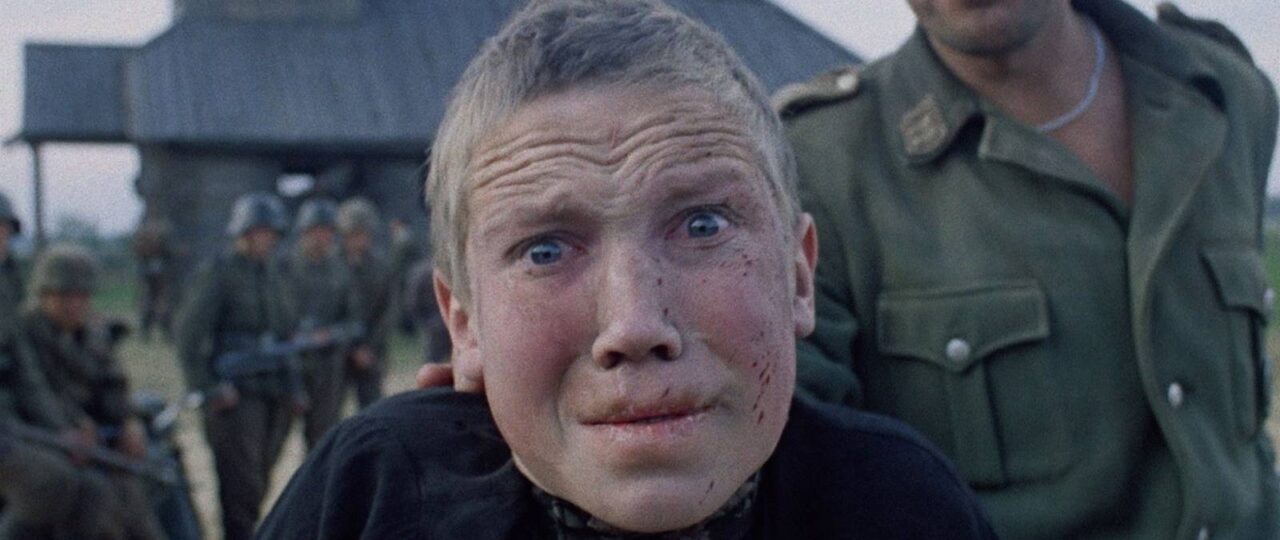
By the end of Elem Klimov’s Come and See, its young protagonist looks as though he has aged decades in a matter of days. Flyora (Aleksei Kravchenko) is a Belarusian teenager who eagerly joins the Soviet resistance during the Nazi occupation, imagining an opportunity to participate in something heroic. Instead, he witnesses a succession of atrocities that progressively destroy his understanding of the world. The transformation is so extreme that his increasingly haunted face becomes one of the film’s most disturbing images.
Klimov’s filmmaking is relentless without relying on conventional battlefield spectacle. An explosion temporarily damages Flyora’s hearing, leaving audiences trapped inside his distorted perception of events. Later, the systematic murder of villagers exposes the horrifying reality of Nazi occupation with an immediacy few filmmakers have matched. There is no grand military victory to counterbalance what Flyora experiences, and his survival provides little sense of relief. The boy who enthusiastically joined the resistance has been psychologically shattered by what he’s witnessed. Come and See is a film about the destruction of innocence on such a complete scale that even imagining a return to normal life feels impossible.
Discover more from NAIRAVOICE.COM.NG
Subscribe to get the latest posts sent to your email.