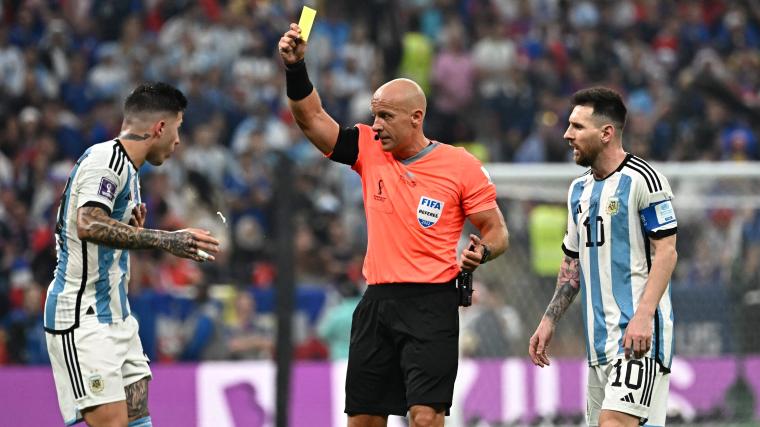

Yellow card vs. red card meanings in soccer, explained: The differences and suspension rules for World Cup games originally appeared on The Sporting News.
Add The Sporting News as a Preferred Source by clicking here.
There are no penalty flags in soccer like there are in the NFL, but that doesn’t mean players are free to do what they want.
Referees police the game with yellow cards and red cards, with each carrying different implications that impact the match.
As you might expect, red cards carry a far more severe penalty than yellow cards — but what is it, and what kind of conduct necessitates each card?
Here’s a complete guide to yellow cards and red cards in soccer.
2026 WORLD CUP HQ:Latest World Cup news | World Cup schedule | Buy World Cup tickets
Yellow card vs. red card differences in soccer
Yellow and red cards are handed out at the referee’s discretion. Here’s what they mean:
What does a yellow card mean?
A yellow card is effectively a warning, brought about by any number of misconduct violations, from an illegal tackle or faking an injury to taking an argument with an official a bit too far.
Unlike penalty flags in the NFL, a yellow card doesn’t directly benefit the opponent, though a warning to a player could change the way he plays.
What does a red card mean?
A red card is an automatic ejection from a game and does not require a yellow card to previously have been issued. The player’s team must then play down a man, dropping from 11 players on the field to 10.
Red cards are the result of more serious misconduct, including violent actions, offensive language, a deliberate handball and, at the World Cup, covering one’s mouth while speaking to an opponent.
MORE:Explaining the World Cup eligibility rules
Red card suspension rules in World Cup
What happens if a player gets a red card in World Cup?
A player who receives a red card at the World Cup is ejected from the game and must serve an automatic one-game suspension the following game, regardless of round. That player’s team must play down a man for the remainder of the game, but the team can return to full strength for the following game even with the player who received the red card suspended.
How long is a red card suspension?
In club soccer, suspensions often vary based on the type of action that led to a red card. For example, violent conduct in some leagues can trigger a three-game ban. That isn’t the case under FIFA rules. Red cards carry an automatic one-game suspension, but there are no automatic triggers for longer suspensions.
Longer suspensions can be handed out, but they are determined at FIFA’s discretion. Qatar’s Assim Madibo, for example, was suspended five games for a tackle that broke the leg of Canada’s Ismael Kone at this World Cup.
Straight red card suspension
According to FIFA rules, players receive a one-game suspension regardless of whether they receive a straight red card or a red card resulting from two yellow cards.
Does red card mean suspension for next game?
A red card at the World Cup carries an automatic suspension for the next game, regardless of when in the game the foul occurred.
MORE:Explaining the expanded World Cup bracket
Yellow card suspension rules in World Cup
How many yellow cards before suspension?
Two yellow cards bring about a suspension in the World Cup, but there are two points in which a player’s yellow card total is reset.
Totals reset after the group stage, so one yellow card in the group stage followed by a yellow card in the Round of 32 wouldn’t necessitate a suspension. The totals reset again after the quarterfinals, so one yellow card in the quarterfinals followed by another in the semifinals also wouldn’t necessitate a suspension.
Do yellow cards carry over to knockouts?
Players’ slates are wiped clean after the group stage and again after the quarterfinals, so players who picked up a yellow card in the group stage won’t simply be one more away from a suspension in the knockout stage.
A yellow card in the Round of 32 followed by another in the Round of 16 or quarterfinals, however, would come with an automatic suspension.
New red card rules for 2026 World Cup
FIFA has added two new ways a player can receive a red card at the 2026 World Cup.
A player who covers his mouth when speaking to an opponent can be sent off, following an incident in which officials couldn’t determine whether Gianluca Prestianni actually made offensive remarks to Vinicius Junior during a Champions League match earlier in 2026.
That rule change already reared its head when Paraguay’s Miguel Almiron was given a red card for covering his mouth while speaking against Turkey.
Additionally, players who intentionally walk off the field and those who encourage players to walk off the field to protest a referee’s call can also now be sent off with a red card.
Discover more from NAIRAVOICE.COM.NG
Subscribe to get the latest posts sent to your email.