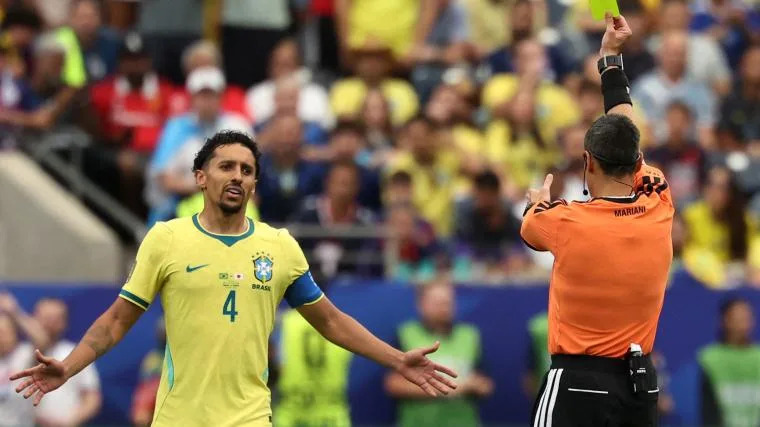

World Cup yellow card warning tracker: Updated list of players in danger of missing knockout games originally appeared on The Sporting News.
Add The Sporting News as a Preferred Source by clicking here.
While yellow cards are sometimes necessary in order to stop a team from scoring, the repercussions of accumulating a pair at the World Cup can be detrimental for a team. If a player gets to yellow cards in nearby games, the player will be subject to a one-game suspension.
With the new 32-team system in the knockout stage at the 2026 World Cup, FIFA has enacted a new system of refreshing a player’s yellow card count. At the beginning of the quarterfinals, the counter will reset, and past yellow cards that count towards a player’s suspension will be nullified.
This reset already occurred for teams that made it into the knockout stage. Players who earned a yellow card during the group stages had no bookings heading into the Round of 32. If a player was carded in the Round of 32, however, they will skate on thin ice until the beginning of the quarterfinals.
Here are the players in the knockout stages who have been booked and are at risk of suspension.
2026 WORLD CUP HQ: Latest World Cup news | Full World Cup schedule | Buy World Cup tickets
List of players at risk of yellow-card suspension for World Cup knockout stages
The following players have each received one yellow card in the knockout stage. A second caution in their quarterfinal match would rule them out of the quarterfinal. The list reflects bookings since the Round of 32.
Table only includes teams to reach the World Cup quarterfinals
TeamPlayer(s) at risk of suspensionGame cardedNorwayAntonio NusaRound of 32 vs. Ivory CoastEngland
Jude Bellingham
Declan Rice
Marc Guehi
Nico O’Reilly
Jordan Henderson
Round of 32 vs. DR Congo
Round of 16 vs. Mexico
Round of 16 vs. Mexico
Round of 16 vs. Mexico
Round of 16 vs. Mexico
BelgiumBrandon MecheleRound of 32 vs. SenegalFrance
Bradley Barcola
Kouadio Kone
Michael Olise
Round of 16 vs. ParaguaySpain
Ferran Torres
Aymeric Laporte
Pau Cubarsi
Round of 16 vs. Portugal
Quarterfinal vs. Belgium
Quarterfinal vs. Belgium
Switzerland
Denis Zakaria
Granit Xhaka
Miro Muheim
Round of 16 vs. Colombia
MORE: Best World Cup 2026 live-betting promotions
How do yellow cards work at World Cup 2026?
Yellow cards are shown to players for offences such as repeated or reckless fouls, deliberately stopping an attacking move, time-wasting, or simulation, or simulating a fall in an attempt to win a free kick or penalty.
If a player receives two yellow cards in the same match, they combine into a red card. The player is then sent off and suspended for their team’s next game. The same automatic one-match ban applies to a straight red card, although a longer suspension can be applied in some cases.
Yellow cards collected in separate matches also add up. Two cautions across different games trigger an automatic one-match suspension, the punishment that most often catches players out during a tournament.
What has changed for 2026 is when those accumulated cards are wiped. To accommodate the expanded 48-team format, FIFA reset all yellow cards after the group stage and will reset them again after the quarterfinals. Under the old system, single cautions carried through until the quarterfinals, meaning a group-stage booking could still cost a player a place in the last 16.
FIFA has also added a couple of new ways to see red. Players can now be dismissed for covering their mouths to hide what they are saying during a confrontation, or for deliberately leaving the field to protest a referee’s decision. On the flip side, VAR can now step in to review and overturn certain mistaken send-offs, including incorrect second yellows and wrongful red cards.
MORE: Best no-sweat bets at the 2026 World Cup
Can players be suspended for World Cup quarterfinals because of yellow cards?
Yes, but the new reset rule narrows the window. Along with being reset after the group stage concluded, yellow cards will be reset to 0 for every player at the end of the quarterfinals. That means individuals cannot be banned for the final based purely on yellow-card accumulation.
A player who already has one yellow and is cautioned again before the quarterfinals reaches two within the first two knockout-stage matches, and that triggers the automatic one-match ban. In other words, any player booked in the earlier knockout rounds who then receives a yellow card in a quarterfinal game will be banned for the semifinals.
Discover more from NAIRAVOICE.COM.NG
Subscribe to get the latest posts sent to your email.