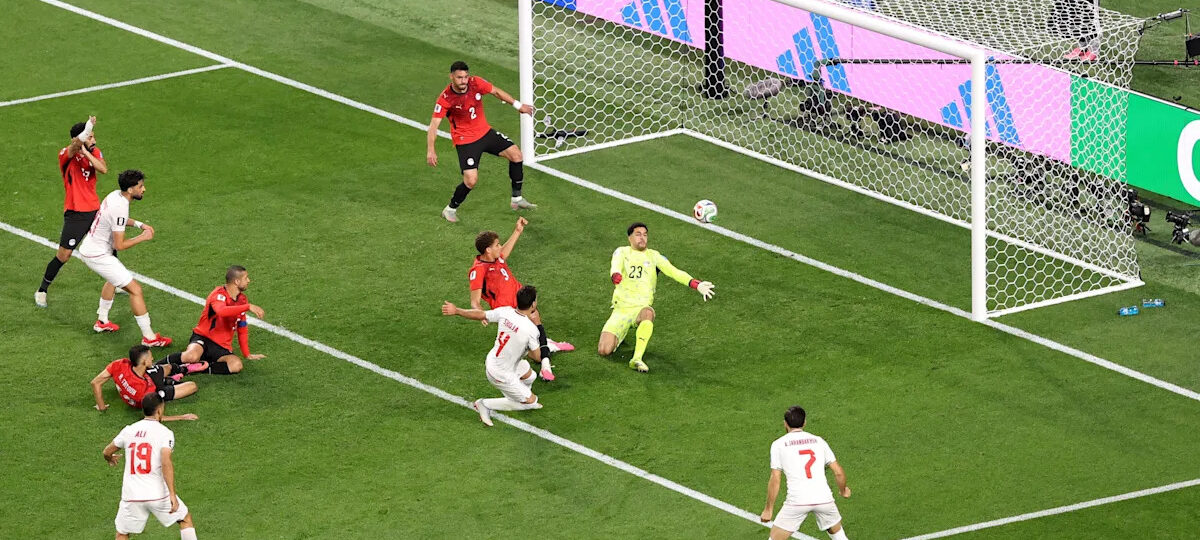

For a brief moment, it looked as if Iran had snatched a dramatic stoppage time winner against Egypt to secure their first ever berth in the FIFA World Cup knockout round. Iranian centerback Shoja Khalilzadeh pounced on a rebound off a free kick, with Egyptian goalkeeper Mostafa Shobier out of his goal and in a mad scramble after saving an earlier shot in the sequence.
Following a lengthy VAR review, the goal was ruled out for offside, much to the disbelief and dismay of Iranian players and supporters and reprieve for the Egyptians inside Seattle Stadium.
After VAR review, Iran is called offside and the goal is disallowed pic.twitter.com/hs9fyB1vqk
— FOX Soccer (@FOXSoccer) June 27, 2026
On the surface, this looks like a blown call given Khalilzadeh (No. 4) was clearly behind Egyptian defender Yassir Ibrahim (No. 2) at the top of the screen:
Have I missed something…
How is that Iran goal offside??? pic.twitter.com/uh4FqKNp9F
— Adriano Del Monte (@adriandelmonte) June 27, 2026
But when VAR overturned the goal, the line drawn was along Khalilzadeh and Hamza Abdelkarim (No. 9).
A closer look at the Iran goal that was called offside pic.twitter.com/8fZAfGuEum
— FOX Soccer (@FOXSoccer) June 27, 2026
This may seem like a massive oversight, but this is actually the correct application of the offside law.
Based on the laws of the game, as maintained and governed by the International Football Association Board (IFAB), Khalilzadeh is offside even though he’s not beyond the last defender. That’s because this is one of those rare times where there’s an offside call in which the goalkeeper is not the last person back.
“A player is in an offside position if:
- “any part of the head, body or feet is in the opponents’ half (excluding the halfway line) and
- any part of the head, body or feet is nearer to the opponents’ goal line than both the ball and the second-last opponent“
Since the Egyptian goalkeeper vacated his net, the last opponent was Ibrahim and the second-last opponent was Abdelkarim. Therefore, Khalilzadeh was marginally beyond Abdelkarim and consequently the goal was chalked off.
Iran hit the crossbar shortly after the restart and the game finished 1-1, which sensationally shifted the Group G standings.
Instead of Iran finishing second behind Belgium and advancing to the Round of 32, they will have to wait for Saturday’s results to determine whether or not they’ll be in the knockout phase.
Egypt began Friday as Group G leaders, briefly dropped to third when the would-be winner by Iran was initially given, and ultimately finished in second. The Egyptians will play Australia on July 3 in Arlington.
The good news for Iran is that they are sixth out of the 12 third-place finishers entering Saturday, so they would advance as things stand. Unfortunately for them, their position is tenuous given three teams can still overtake them. Iran will qualify if any of the following results occur:
- Croatia lose to Ghana
- Algeria vs. Austria does not end in a draw
- DR Congo draw or lose to Uzbekistan
If Croatia draw or beat Ghana, Algeria and Austria draw, and DR Congo beat Uzbekistan, then Iran would be out of the World Cup, and the disallowed goal would go down as one of the most heartbreaking ways to exit the tournament.
Discover more from NAIRAVOICE.COM.NG
Subscribe to get the latest posts sent to your email.