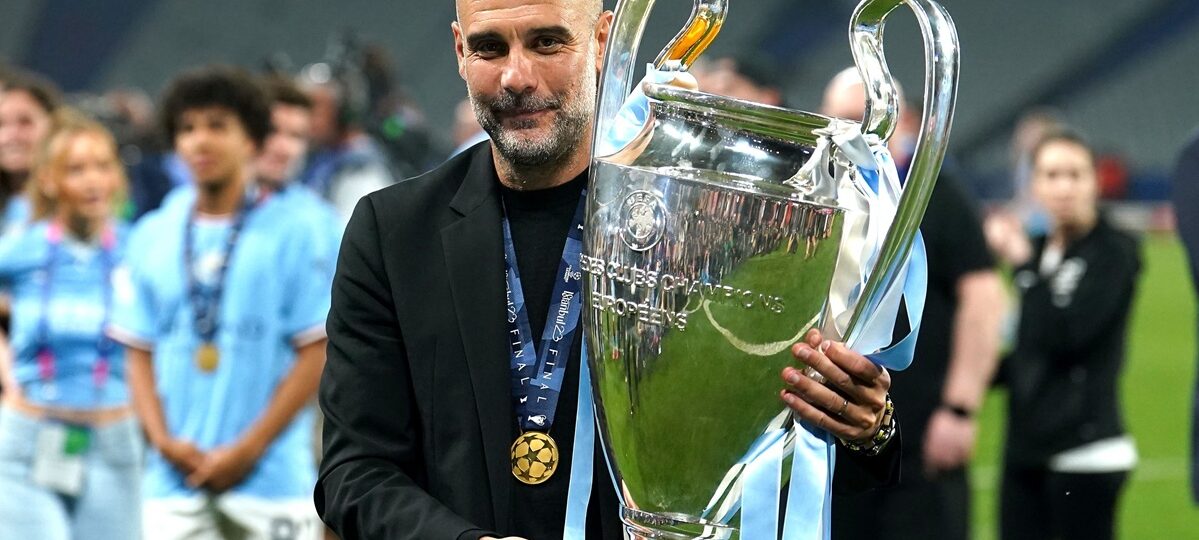
Manchester City are preparing to enter a new era, but according to chairman Khaldoon Al Mubarak, the departure of Pep Guardiola does not signal the end of their dominance. Instead, the club’s leadership believes the foundations built over the last decade are strong enough to ensure continued success, regardless of who occupies the manager’s seat.
In his annual address, Al Mubarak reflected on Guardiola’s transformative impact, describing the Spaniard as a figure who reshaped not only Manchester City but English football as a whole. Over the course of ten seasons, Guardiola delivered an extraordinary haul of trophies and established a style of play that became synonymous with excellence. However, while acknowledging the magnitude of that contribution, the chairman made it clear that the club’s ambitions extend far beyond any single individual.
The relationship between Al Mubarak and Guardiola appears to have been particularly close. The chairman revealed, in a light-hearted manner, that Guardiola had contemplated stepping away from the role on numerous occasions throughout his tenure. According to Al Mubarak, these moments of doubt were frequent, describing them humorously as having occurred “countless times,” while also noting that he often acted as a confidant during the coach’s more difficult periods. That personal connection, he implied, was crucial in helping Guardiola navigate the immense pressures associated with managing a club of City’s stature.
Despite the inevitable void left by Guardiola’s exit, Al Mubarak expressed unwavering confidence in the club’s ability to sustain its winning mentality. Historically, the departure of a legendary manager has often led to a decline. The example of Manchester United following Sir Alex Ferguson’s retirement is a well-known cautionary tale, with the club struggling to regain its former dominance. Yet City believe their situation is different.
Central to this optimism is the stability that exists within the club’s structure. While Guardiola is stepping away, key figures such as chief executive Ferran Soriano and director of football Hugo Viana remain in position, ensuring continuity behind the scenes. Al Mubarak himself continues to oversee operations, forming part of a leadership group that has guided the club through its most successful period. This consistency, he argues, provides a solid platform for the next chapter.
That next chapter is expected to be led by Enzo Maresca. Negotiations are ongoing regarding his appointment, but all indications suggest that the Italian coach is set to take charge. Maresca is no stranger to City, having previously worked within the organization as both an assistant to Guardiola and a coach at academy level. His familiarity with the club’s philosophy and methods is seen as a major advantage, particularly in maintaining the identity that Guardiola instilled.
Al Mubarak emphasized that the selection process for Guardiola’s successor has been methodical and carefully considered. Rather than rushing into a decision, the club has focused on identifying a candidate who aligns with its long-term vision. He reassured supporters that they would soon see the outcome of this process and expressed confidence that the chosen manager would be the right fit.
Beyond the managerial transition, City are also planning to strengthen their squad during the upcoming transfer window. The club has clear priorities, with a central midfielder and an attacking player among the key targets. There is also interest in reinforcing the right-back position to provide additional depth. Early moves in the market suggest a proactive approach, as City look to ensure that the team remains competitive at the highest level.
In midfield, the club has already made an approach for Nottingham Forest’s Elliot Anderson, while Aston Villa’s Morgan Rogers has also been identified as a potential addition in attacking areas. These moves indicate a focus on acquiring players who can contribute both immediately and in the long term. Meanwhile, strengthening the defensive unit is viewed as equally important, particularly to support players who carried a heavy workload in the previous season.
While managerial change often prompts uncertainty among players, City’s leadership is confident that their core squad will remain intact. Speculation linking some of their biggest stars with moves elsewhere has been dismissed internally, with the club determined to retain its top talent. Erling Haaland, in particular, has been highlighted as a cornerstone of the team’s future.
Al Mubarak spoke glowingly about the Norwegian striker, describing him as the best in the world in his position and a player with the mentality required to lead the team forward. Haaland’s growing influence within the squad has been evident, especially after he was included in the leadership group. His development as a figure within the dressing room is seen as a positive sign for the club’s long-term stability.
The chairman also reflected on the broader journey the club has undertaken since the 2008 takeover. He pointed out that success did not begin with Guardiola but has been built incrementally over time. Under Roberto Mancini, City secured their first Premier League title and ended a lengthy trophy drought. Manuel Pellegrini then added further success, continuing the upward trajectory. Guardiola’s tenure, however, elevated the club to an entirely new level, embedding a culture of excellence and a distinct footballing identity.
According to Al Mubarak, the most significant legacy Guardiola leaves behind is not just his trophy haul but the mentality he instilled. Winning, he suggests, is now ingrained in the club’s DNA. This cultural shift is expected to outlast any individual, ensuring that City remain competitive regardless of changes in personnel.
Looking ahead, the chairman insisted that the club has not yet reached its peak. Rather than viewing Guardiola’s departure as a turning point towards decline, City see it as part of a natural evolution. The aim is to continue progressing, building on the foundations that have been laid while adapting to new challenges.
Ultimately, the confidence expressed by Al Mubarak reflects a belief that Manchester City are more than the sum of their parts. While Guardiola’s influence has been immense, the club’s success is attributed to a collective effort spanning players, coaches, and executives. As they prepare for life under new leadership, that sense of unity and purpose will be crucial.
The coming months will provide answers to many questions. How smoothly Maresca transitions into the role, how effectively the squad adapts, and whether the club can maintain its standard of performance are all factors that will shape this new era. Yet, if the chairman’s words are any indication, Manchester City are approaching the future with confidence rather than apprehension.
For a club built on ambition, the expectation remains unchanged: to compete for and win the biggest prizes. Guardiola may be gone, but according to those at the top, the pursuit of success at Manchester City is far from over.
UEFA Women’s Champions League News
‘Bring it on’ – Bright sets sights on glory after Chelsea’s Champions League comeback
Premier League News
‘Best is yet to come’ for Fulham, says Silva
UEFA Conference League News
‘Chelsea fans have to trust us’ – Maresca issues rallying cry to Blues’ faithful
UEFA Conference League News
‘Chelsea are back’ if they win Europa Conference League, Maresca insists
UEFA Nations League News
‘Every Portugal player’ wants to see Ronaldo win World Cup – Dalot
Premier League News
‘Every point is expensive’ in the Premier League, says Iraola
We use cookies to ensure you get the best experience on our website. By using our website you agree to our use of cookies in accordance with our Privacy Policy.
Discover more from NAIRAVOICE.COM.NG
Subscribe to get the latest posts sent to your email.