
Wimbledon and the grass-court season has a special place in the hearts of most tennis players, even the ones who don’t much care for playing on the surface. It’s a journey back to the sport’s roots, to its spiritual home.
For Gaby Dabrowski, the surface has meaning far beyond its feel under foot.
The 34-year-old Canadian doubles star, a two-time Grand Slam winner and two-time Wimbledon finalist, came to the grass two years ago, just weeks after undergoing two surgeries for breast cancer. She and her then-partner, New Zealand’s Erin Routliffe, kind of ran the table — the duo won the Nottingham Open, and reached the final at the Eastbourne Open and at Wimbledon, losing 7-6, 7-6 to Kateřina Siniaková and Taylor Townsend, the top pair in the world, in the latter.
“I’ve always loved the grass, so coming back to the United Kingdom after my surgery in 2024 will always be very special to me,” Dabrowski, the world No. 3 in women’s doubles, said in an email this week. “Last year I missed Queen’s and the middle week of grass because I’d broken my ribs before Roland Garros, and quite frankly I was more devastated to have missed out on a historic Queen’s event (for the women) than even RG!”
At the time she made her sudden comeback in 2024, only a handful of people in Dabrowski’s inner circle knew what she was going through.
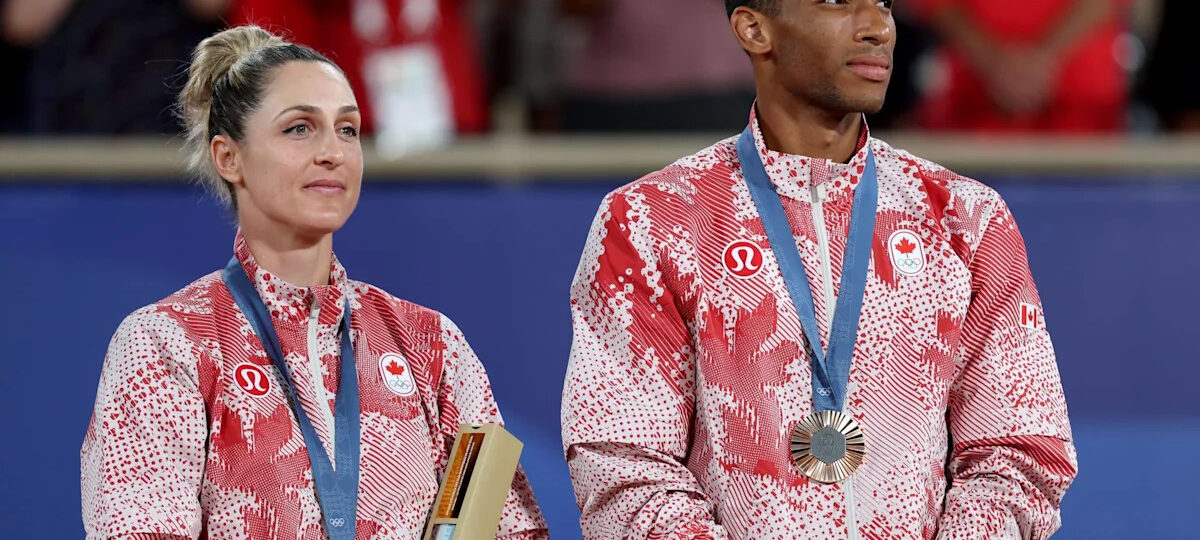
Two weeks after Wimbledon that year, Dabrowski and Félix Auger-Aliassime teamed up to win bronze at the Paris Olympics. It would be another six months before Auger-Aliassime would find out that Dabrowski was in the middle of cancer treatment.
“I was adamant I would not be a victim of my circumstance,” Dabrowski said in an interview earlier this year. “Yes, there were a lot of tough moments, I was like, ‘OK, I’m not going to feel sorry for myself. We have information, we have treatment, and I’m going to go through it, and we’ll see.’ Some people around me probably were freaking out more than I was.”
Two years on, it’s easy to forget what Dabrowski went through and continues to go through. She and her new partner, Luisa Stefani of Brazil, go deep in nearly every tournament they enter. They won the Strasbourg Open last month and lost in the semifinals of the French Open to the eventual champions, Siniaková and Townsend, on a day Stefani was playing with a virus. On the grass, Dabrowski and Stefani are into the Eastbourne Open final, ahead of competing in Wimbledon’s 2026 edition as the No. 3 seeds
Dabrowski is doing all that while managing the side effects of hormone therapy to help keep her cancer in remission. She is still taking a medication called Tamoxafin, which blocks the hormone estrogen from attaching to cancer cells, preventing their growth.
She struggles with sleep and is often restless. There are hot flashes, fatigue and joint pain. When she flies long distances, which tennis players do a lot, she’s at risk of a blood clot so has to take an aspirin and wear compression garments. “It’s kind of like you’re in menopause,” she said.
Cancer survivors often say eventually the disease becomes like background noise; always there, but often you don’t even hear it. That’s not where Dabrowski is, at least not yet. Thoughts of those frightening weeks in the early spring of 2024, and the months that followed, are never far away.
She had felt a lump in her left breast nearly a year before, in 2023. A doctor looked at it and told her it was probably nothing.
But then it didn’t go away. She thought it might be getting larger. She showed it to a doctor during her annual physical, a service the WTA Tour provides to players, at the Miami Open in late March. The doctor, Jennifer Maynard, suggested she have specialists take a closer look. After a mammogram and an ultrasound, she received a call from a radiologist who told Dabrowski that she needed a biopsy and an MRI.
The results came quickly. It was not good news. She had a malignant tumor at about 3 o’clock on her left breast.
About two weeks later, at the end of April, she drove with her father from her home in Tampa to the Mayo Clinic in Jacksonville, Fla. to undergo a lumpectomy.
There was some good news. The cancer had not spread to her lymph nodes and appeared to be localized. The bad news? There were some additional cancer cells in tissue near the tumor that needed to be scraped out. About two weeks after the first procedure, she underwent a second surgery.
Dabrowski also needed to undergo radiation treatment. But she really wanted to play the grass season, and then compete in the Olympics. Her medical team told her it would be safe to wait to have the radiation in August, after the Olympics. She was cleared to play tennis whenever she felt strong enough.
“My initial goal was to be able to play in the Olympics in July, but then it looked like I could be ready for Wimbledon, and somehow my team and I worked hard but also smartly, and I was able to come back for the beginning of the grass season,” Dabrowski said this week.
Her tour coach, Dan Kiernan, is still amazed at what transpired. He never contemplated Dabrowski would return for the grass. He’d shown up at the Madrid Open with Routliffe, trying to find the New Zealander a partner. When people asked why she wasn’t playing with Dabrowski, they said she was out for the clay season and kept their explanations vague. “A lot of prying eyes on all those bits,” he said during a recent interview.
Kiernan assumed the same would be true for the grass season. The lumpectomy and the removal of several lymph nodes, and then the second surgery, had left her sore and bruised. Unloading a dishwasher could be painful.
Before long, Dabrowski told Kiernan she was hitting tennis balls again, though the toss on her serve was an issue and Patrick Daciek, her coach in Florida, had to toss the ball for her.
But then Dabrowski said she was ready to play. Kiernan wasn’t about to argue with her.
“I will always trust Gaby,” he said. “If Gaby tells me she’s ready to play, she is ready to play. She loves England and grass courts,” he said. “Also, she has something a little bit extra special, something only elite performers have, a willpower to get themselves where they want to be.”
In Nottingham, she was still struggling to raise that tossing arm, but managed to get it done. She’d lost some of her fitness, but she was determined to find a way. Being on the grass helped. She likes to serve and volley, and to slice and chip and drop the ball short and soft.
“Grass suits my game style,” Dabrowski said. “I wish the grass season was longer.”
In retrospect, she said, the tennis was the easy part. The emotional toll, the fear of the unknown, were the real challenges. But the thing people don’t realize about tennis players is they are often going through something off the court — business headaches, or problems with boyfriends and girlfriends, their own health issues, or that of family and friends. Still, mid-career cancer seemed like a different animal.
And yet Dabrowski plowed on; through the Paris Olympics and the Canadian Open. She skipped the Cincinnati Open to undergo six days of radiation in Jacksonville. Again, the drive back and forth across the state was with her father. Then she showed up at the U.S. Open, burned, literally, and pretty burned out. But she and Routliffe still made the quarterfinals.
After the loss, sitting on the floor of the gym, she told Kiernan she wanted to win the year-end WTA Tour Finals in Saudi Arabia. They came up with a plan to treat the tournaments in September and October as a training block. Then Dabrowski and Routliffe went to Riyadh and won, beating Siniaková and Townsend this time.
Something else happened that fall. During October, which is breast cancer awareness month, Dabrowski started to think her story could be a part of it and might help someone learn about self-screening, or encourage them to get a mammogram.
In December, she decided to tell her story. When he saw it, Auger-Aliassime sent her a message with a flexed biceps emoji.
Since then, her career has a bit of a different purpose. This year, she has pledged to contribute $20 for every game she wins to The 1 in 3 Foundation, which gets its name from the global statistic that a third of all women over the age of 15 have experienced some form of physical or sexual abuse. She has raised over $10,000 already, which equates to about two years of training in communities to help prevent violence against women.
That feels good. So does the grass under her feet. It always has. Especially now.
This article originally appeared in The Athletic.
Olympics, Tennis, Global Sports, Women’s Tennis
Discover more from NAIRAVOICE.COM.NG
Subscribe to get the latest posts sent to your email.