

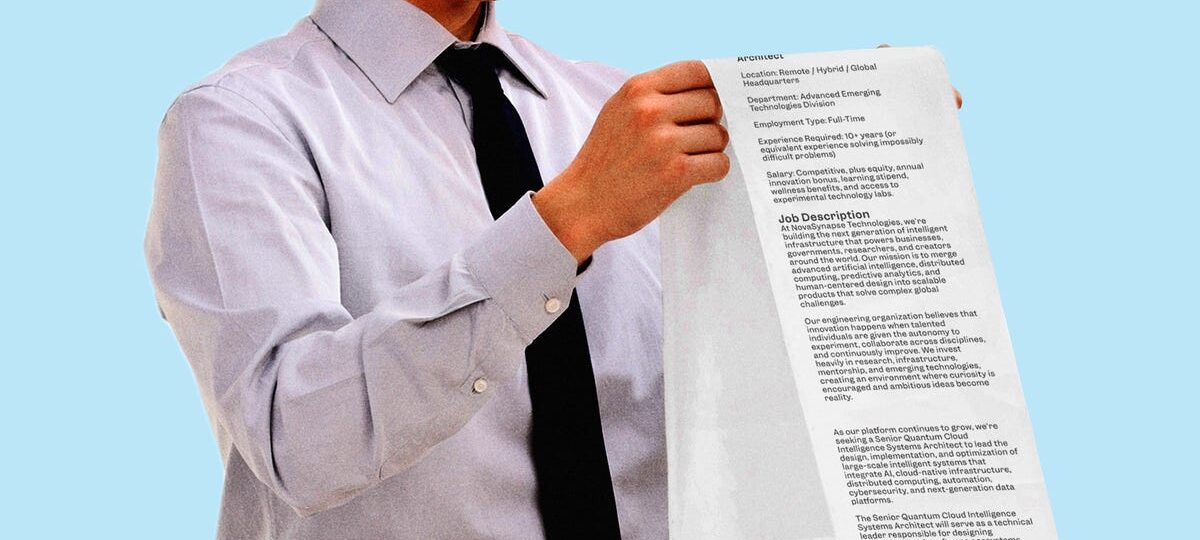
When Robin Olsen started applying for communications jobs three months ago, she noticed a shift: The job descriptions had grown longer.
One combined communications and marketing, typically two separate roles, into one.
Others seemed to have “crazy wish lists,” Olsen says.
One was so overwhelmingly long that it prompted Olsen to shut it from her browser. “My premise is, if you actually think that one person can do all of that, this isn’t the place for me,” Olsen says. “No one could ever succeed at having 27 priorities.” Scrolling through LinkedIn, it’s easy to find job descriptions that rival CVS receipts, with so many responsibilities they’re split under several subheads.
A corporate communications lead listing asks applicants to meet nine qualifications, bolstered by another six “preferred qualifications,” and cover 22 responsibilities.
An AI engineer job has 11 “essential duties and responsibilities,” and another 11 skills (including a “positive energetic attitude”).
A lead of revenue strategy and operations is expected to perform 13 responsibilities and meet a dozen qualifications split into five categories.
The average length of a job title has jumped from 2.4 words in 2013 to four words last year, according to an analysis of job listings from HR software company BambooHR, which found that lengthy, highly specific, niche roles were driving up the character count.
Hiring platform Greenhouse found that the average job description character count has increased 7.4% from 2022 to 2026 — the four years since ChatGPT became widely available.
Over the same period, the number of sections in a job listing grew by nearly 14% and skills sections jumped by almost 16%.
Indeed found that the number of words in a post grew 14.3% from 2021 to 2025.
What’s puffing up the ever-expanding job description?
In some, hiring managers have layered new AI proficiency and pedagogy expectations on top of standard job tasks.
Other listings, recruiters tell me, have inflated because hiring managers generated them with long-winded LLMs. “Managers don’t have to edit themselves, so they’re just dumping the kitchen sink in there,” Marc Cenedella, CEO of career site Ladders, says. “They’re dumping in nice-to-haves, could-haves, and passing thoughts they had in the shower this morning.” The descriptions balloon with input from people without direct oversight over the role, and there’s no benefits to applicants or recruiters, he says.
Recruiters say cover letters and résumés have lost their meaning at a time when anyone can customize their applications to roles by running them through ChatGPT.
When it comes to job descriptions, AI compounds the problem: Its verbosity leads to long bulleted lists centered on corporate jargon-slop buzzwords, but the technology has also shifted expectations rapidly.
Workers are encouraged, and even expected, to take on more with AI at their disposal.
Those looking for work must sort through walls of text to discern whether they’re qualified, adding another barrier to the convoluted, lengthy job hunt. “More paragraphs doesn’t make for a better hire,” says Cenedella. “More bullet points doesn’t make for a more on target fit.
And so these longer and longer job descriptions are hurting candidates and they’re hurting companies.” The signal to the best person for the job might be a concise one.
The earliest known job ad dates back to 1752, placed in a Virginia newspaper by an employer seeking an oysterman.
There were only two qualifications, that the applicant be “a sober person, well recommended.” For more than 200 years, the ads stayed fairly succinct, as employers paid by line to list them in newspapers.
Then online job boards freed them from the confines of the classifieds.
Tedious applicant tracking systems and additional application questions or exams have lengthened the process.
The jump picked up before generative AI became widely available, and BambooHR data shows that job descriptions increased 17% in character length from 2016 to 2025, with the biggest acceleration coming between 2021 and 2022. “We’ve gotten so far away from what the actual intent of a job description is and what it should be,” says Trent Cotton, head of talent insights at recruiting software company ICIMS.
Companies started adding lines about company culture and seeking to “sell the job,” Cotton says, but that kind of culture fit talk better suits a job interview.
The listing, he says, should act like a scorecard, where the candidate, recruiter, and hiring manager can evaluate a person’s skills and compatibility to the job. “Hiring managers and recruiters are trying to make it so verbose to try and create some type of way to siphon out candidates, but they’re going about it the wrong way,” he says. “They’re just adding a lot of paragraphs but not a lot of substance.” Many companies now prioritize skills-based hiring, weighing practical abilities over prestigious degrees and experience at top-tier companies.
This shift has also led the skills sections of job listings to swell. “To match a job to talent or talent to a job, they’re putting as much information into that job post as possible” to help AI match the skills listed on a résumé to those in a job post, Tara Marcelle, vice president of recruiting for staffing firm Manpower’s US operations, says. “It can really help to rank those candidates.” Some of the rambling job descriptions reflect the major upheaval coming for white collar work.
Marketers now vibe code, software engineers review more code, and companies like Meta have promoted a future where one person may do the work once handled by a whole team, as some people are wrangling agents. “There’s a lot of unknown here,” says Michelle Volberg, founder and CEO of recruiting company Twill.
The posts are padded, and become “like an umbrella, where they’re just putting in all the possible scenarios that this person will do within the next six to nine months, because they don’t know who they’re going to need six months from now.” The burgeoning job description isn’t just a nuisance.
Women are less likely to apply for jobs if they don’t meet every stated qualification, and are less likely to apply for jobs with vague language in the listing, because they fear they will be underqualified for a job.
Men worry less about having an exact skills match before clicking to apply, research from Harvard Business School shows.
This imposter syndrome can perpetuate low numbers of women in leadership positions and in male-dominated fields.
A job listing in search of a unicorn could spook qualified applicants from applying.
Applicants have AI in their arsenal, too.
They ask large language models to customize their résumés and cover letters to include the buzzwords and skills, and recruiters then have to suss out who can really do the job.
Getting a set of applicants who bring an authentic, AI-free application to the table might require standing out amidst the corporate AI slop in other job posts.
Jamie Hodari, the CEO and cofounder of coworking space Industrious, is looking for someone to take his CEO job.
The description he wrote isn’t brief, but it swaps typical corporate speak for a list of cheeky list of the people the CEO will manage, from members of a book club to two people duking it out over control of the thermostat, and ends with how the job will come with decision making about managing people who may experience difficult personal situations (“the truest description of this job isn’t a list of responsibilities, it’s a list of people,” it reads).
Hodari tells me he thought of the description as a note to his successor, the way an outgoing president leaves one to the incoming president-elect.
He also says that authentic, less-scripted approach became the “single most effective recruiting-related thing I’ve ever done in my career,” and applicants have met the message with their own deeply personalized applications and responses.
In a job market where AI writes the job descriptions, edits résumés, and evaluates them, recruiters and applicants are growing frustrated, as it seems employers hold the power in the job market. “Once it returns to a demanding market and you’re competing for talent, all these things get fixed,” Cenedella says.
Just as applicants are encouraged to keep their résumés and cover letters to a page each, those penning job ads may want to do the same.
Amanda Hoover is a senior correspondent at Business Insider covering the tech industry.
She writes about the biggest tech companies and trends.
Discover more from NAIRAVOICE.COM.NG
Subscribe to get the latest posts sent to your email.