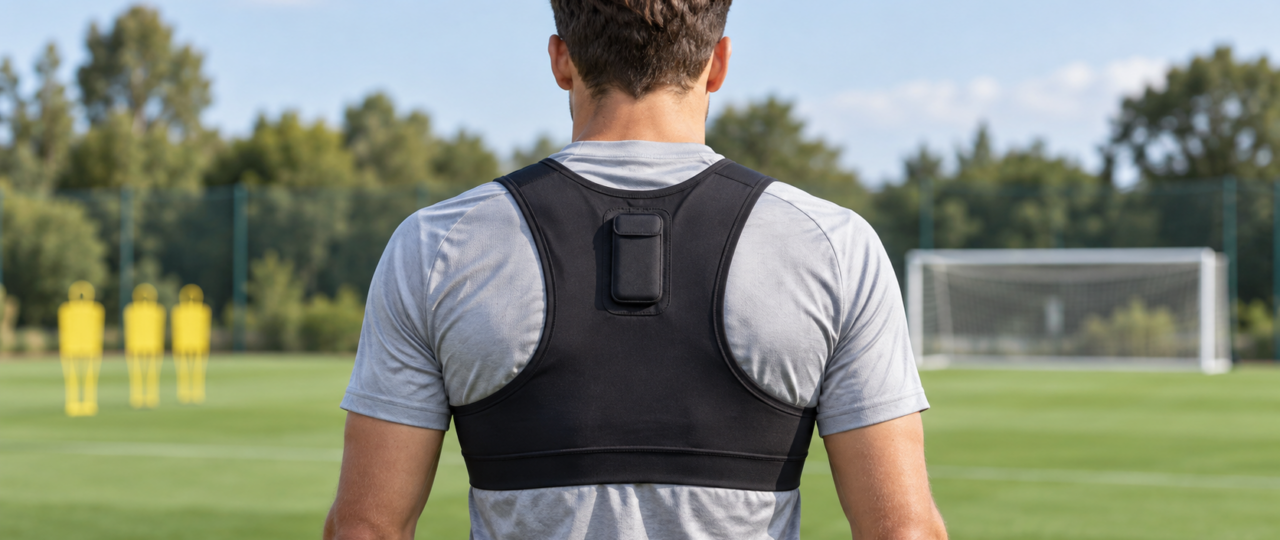
Soccer players wear bra-like GPS tracking vests to keep a small monitoring device secure on the upper back, usually between the shoulder blades. The device collects movement data that helps coaches assess distance covered, running speed and training workload. Its exact capabilities depend on the equipment being used.
The short shape makes the garment resemble a sports bra, particularly when a player removes or swaps a jersey after a match. The small pouch on the back explains its purpose: it gives the tracking unit a secure place to sit throughout the session.
What are the bra-like vests soccer players wear?
They are usually called GPS vests, tracking vests or performance vests. The garment holds the hardware close to the body while the player runs, turns and changes direction.
A tracking vest and a sports bra serve different purposes, although a player can wear both.
Women also use tracking vests. For example, Catapult’s garment documentation describes its Women’s Vector Elite 2.2 vest as designed to be worn over a sports bra. That allows an athlete to use both garments together.
What does a soccer GPS vest measure?
The device inside the vest provides the tracking data. In a GPS system, satellite signals allow the unit to calculate its position and speed. Some units also contain motion sensors, including accelerometers and gyroscopes, which capture acceleration forces and rotation.
Catapult’s technical explanation of wearable tracking describes how these inputs work together. Software processes the readings into figures that coaches can review during or after a session, depending on the system.
These figures involve different calculations. Acceleration can be derived from changes in velocity, while a movement-load score may combine accelerometer readings. Sprint totals also depend on the speed threshold being used, so comparisons require consistent definitions. Catapult’s glossary explains these distinctions.
Heart rate requires compatible equipment. Some setups use a separate monitor, while certain vests have integrated electrodes that work with the tracking unit. Other garments have no heart-rate integration. Seeing a GPS vest therefore tells you little about whether that player’s pulse is being recorded.
Why do coaches use tracking data?
Coaches use tracking data to understand the physical demands of training and compare them with match demands. That can help staff plan sessions, set individual targets and monitor a player’s progression through rehabilitation.
A Newcastle United case study published by Catapult in September 2017 offers a practical example. Jamie Harley, then a sports scientist at the club, described checking each player’s distance, maximum speed and high-intensity running.
He explained that Newcastle compared training weeks with match performances to identify preparation that suited individual players. Tracking also continued through rehabilitation and the return-to-play process.
Consider a simple example: two players finish a session with similar total distances, but one has completed considerably more fast runs. Looking at the distance figure alone would hide that difference. Reviewing several metrics gives the coach more context when deciding what each player should do next.
The same care applies during rehabilitation. Staff can use recorded workloads to follow a planned progression, alongside medical assessments and the player’s feedback. A tracking report cannot guarantee that an injury will be avoided or determine readiness on its own.
Why is the tracker worn between the shoulder blades?
The small pocket on the upper back is designed to hold the unit securely. The fitted garment helps maintain its position as the player moves.
For example, STATSports describes its vest as having a secure outer pocket for the tracking pod. Its instructions allow the garment to be worn over or under a training top.
The device must also be inserted correctly. Catapult’s Vector instructions warn that incorrect orientation can produce inaccurate readings or data dropouts. Fit, pocket design and device orientation all form part of the setup.
Do players wear GPS trackers during matches?
Players can use wearable trackers in training and in matches where the equipment is permitted.
Under IFAB Law 4, wearable tracking technology used in official competitions under FIFA, confederations or national associations must be safe and meet the relevant FIFA Quality Programme requirements. The competition organizer is responsible for ensuring those conditions are met.
Wearables are also one part of a wider category called electronic performance and tracking systems, or EPTS. That category includes camera-based tracking, which follows players from equipment installed around the field.
At the 2022 World Cup, for example, the physical metrics supplied through the FIFA Player App came from a stadium system using multiple cameras. Those metrics included distance at different speeds and maximum speed.
A distance statistic shown during a broadcast therefore does not establish that it came from a device in the player’s vest. The source depends on the tracking system used.
Do all soccer players have to wear GPS vests?
GPS vests are absent from the compulsory equipment listed in IFAB Law 4. Their use depends on the team’s arrangements and the competition’s requirements, rather than a universal obligation for every player.
Tracking equipment is available outside professional soccer too. Consumer systems such as Catapult One provide metrics including distance, sprint distance and top speed, although the available functions depend on the product.
For anyone interpreting those figures, minutes played, position and the purpose of the session matter. A higher running total alone cannot tell you whether a player made better decisions, followed the tactical plan or performed more effectively.
Women’s Football
‘Bring it on’ – Bright sets sights on glory after Chelsea’s Champions League comeback
Premier League News
‘Best is yet to come’ for Fulham, says Silva
UEFA Conference League News
‘Chelsea fans have to trust us’ – Maresca issues rallying cry to Blues’ faithful
UEFA Conference League News
‘Chelsea are back’ if they win Europa Conference League, Maresca insists
Nations League
‘Every Portugal player’ wants to see Ronaldo win World Cup – Dalot
Premier League News
‘Every point is expensive’ in the Premier League, says Iraola
We use cookies to ensure you get the best experience on our website. By using our website you agree to our use of cookies in accordance with our Privacy Policy.
Discover more from NAIRAVOICE.COM.NG
Subscribe to get the latest posts sent to your email.