

Why are There Hydration Breaks at World Cup 2026? Rules, Timing and TV Commercials Explained originally appeared on NESN.
Add NESN as a Preferred Source by clicking here.
The 2026 FIFA World Cup comes with a noticeable change to the usual rhythm of a soccer match.
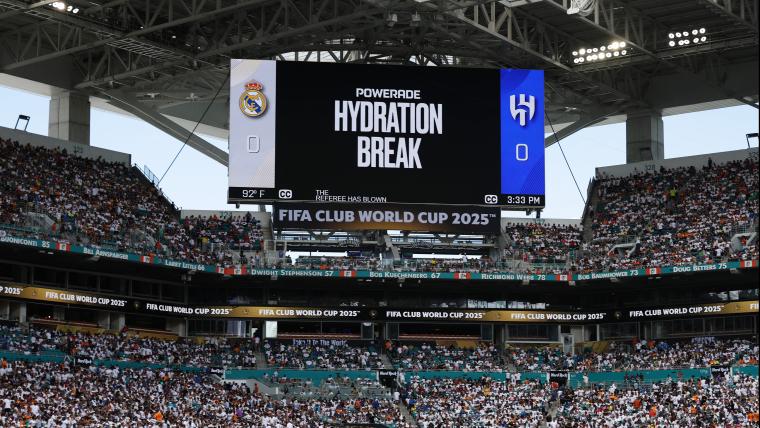
Every game will include two scheduled hydration breaks: one midway through the first half and another midway through the second half.
These are not occasional pauses that only happen during especially hot afternoon matches. The breaks are mandatory for every World Cup game, regardless of the weather, kickoff time, stadium roof or cooling system.
The idea is to give players a consistent opportunity to drink, cool down and briefly recover during a tournament being played across Canada, Mexico and the United States. The pauses also give coaches a chance to deliver quick tactical instructions — and broadcasters an opportunity to decide whether they want to remain with the action or cut away to commercials.
Here is everything fans need to know about hydration breaks at the 2026 World Cup.
What is a hydration break in soccer?
A hydration break is a scheduled pause that allows players to drink water and briefly recover without having to wait until halftime.
During most soccer matches, players can grab a quick drink near the sideline when play is already stopped. A formal hydration break is different because the referee stops the match specifically so both teams can rehydrate.
For the 2026 World Cup, FIFA has standardized those pauses across the entire tournament. Every match has one hydration break in each half, even if the temperature is comfortable or the game is being played inside a stadium with a closed roof.
That makes the system predictable for players, teams, referees and broadcasters rather than leaving the decision to the conditions surrounding each game.
When are the World Cup hydration breaks?
The referee is scheduled to stop play 22 minutes into each half.
That means fans should expect the breaks at approximately:
- 22nd minute of the first half
- 67th minute of the match, or 22 minutes into the second half
The whistle may not come at exactly 22:00 or 67:00. The referee generally needs an appropriate stoppage before pausing the game.
For example, if an injury delay is already happening around the 20th or 21st minute, the referee may handle the hydration period as part of that stoppage rather than stopping play again immediately afterward.
How long is a World Cup hydration break?
Each World Cup hydration break lasts three minutes from whistle to whistle.
That means the three-minute period begins when the referee stops play and ends when the referee signals for the match to resume.
With one break in each half, every game will include approximately six scheduled minutes of hydration time before accounting for halftime, substitutions, injuries, VAR reviews and other delays.
Players can drink, cool themselves down and gather with teammates. Coaches can also use the pause to discuss tactics, correct positioning or prepare their teams for the next stretch of the match.
Fox commercials vs. Telemundo coverage during World Cup hydration breaks
American viewers may have a very different experience depending on whether they watch the World Cup in English or Spanish.
Fox, the tournament’s English-language broadcaster in the United States, began the World Cup by cutting away to full-screen commercials during hydration breaks. That approach produced immediate criticism during the tournament opener between Mexico and South Africa. Fox returned from one second-half commercial break after play had already restarted, causing viewers to miss approximately 10 seconds of live action.
Telemundo made a different choice for its Spanish-language broadcasts.
The network committed to staying with the live match feed during hydration breaks rather than cutting away to full-screen commercials. Its coverage can show player huddles, coach interactions, replays and analysis while the teams prepare to resume play.
That does not necessarily mean Telemundo’s breaks are completely free from sponsorship. The network may use commercial graphics, branded integrations or double-box presentations. The main difference is that viewers can still see the field rather than losing the live picture entirely.
Does the clock stop during a World Cup hydration break?
No. The game clock continues to run during the hydration break.
Soccer does not normally stop its official clock for injuries, substitutions, video reviews, goal celebrations or other interruptions. Hydration breaks follow the same basic system.
Instead, the referee accounts for the time lost by adding it at the end of the half as stoppage time.
For example, the first half may reach 45:00 on the stadium clock, but the fourth official could show several minutes of additional time. Part of that added time will account for the three-minute hydration break, along with any other delays that occurred during the half.
Why does every 2026 World Cup match have a hydration break?
FIFA introduced the mandatory breaks as a player-welfare measure.
The World Cup is being staged during the summer across 16 host cities in three countries, with matches played in a wide range of climates and stadium conditions. Some games may be held in intense heat and humidity, while others will be played at night, indoors or in relatively mild weather.
Instead of using a temperature threshold and deciding match by match, FIFA chose one system for the entire tournament. Every team receives the same three-minute break at roughly the same point of each half.
FIFA said the approach was informed by its experience at previous competitions, including the 2025 Club World Cup in the United States, where high temperatures became a major player-welfare concern.
The automatic system also avoids late decisions about whether conditions are hot enough to require a break. Players and coaches know before every match that the pauses are coming.
Is a hydration break the same as a cooling break?
The terms “hydration break,” “drinks break,” “water break” and “cooling break” are often used interchangeably by fans and broadcasters, but there is technically a difference under soccer’s Laws of the Game.
A traditional drinks break is primarily intended to let players rehydrate and should generally last no longer than one minute.
A cooling break is designed to help lower players’ body temperatures and may last between 90 seconds and three minutes.
FIFA calls the scheduled World Cup pauses hydration breaks, but its tournament-specific format lasts three minutes. That is longer than the standard one-minute drinks break described in the general Laws of the Game.
Discover more from NAIRAVOICE.COM.NG
Subscribe to get the latest posts sent to your email.