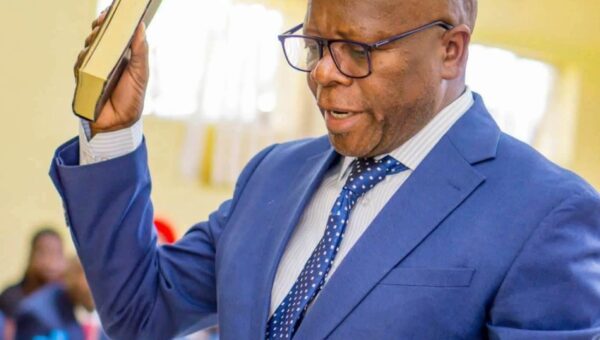
Zambia has appointed Harry Kazimete S. Kamboni as its new Minister of Education, bringing an experienced parliamentarian with a background in education and legislative oversight into one of the country’s most important public offices.
President Hakainde Hichilema appointed Kamboni during a Cabinet reshuffle announced on October 28, 2026. The Zambian Ministry of Education subsequently introduced him publicly as its new minister, identifying him as the Member of Parliament for Kalomo Central Constituency.
Zambia’s new Minister of Education, Harry Kazimete S. Kamboni, arrives at the ministry with a career that connects classroom training, parliamentary scrutiny and international legislative engagement. His appointment places him in charge of a sector where the government’s promise of wider access to education must be matched by adequate teachers, better learning outcomes and schools equipped to meet the needs of a changing society.
Kamboni’s story is not one of a political newcomer suddenly handed responsibility for education. He has represented Kalomo Central Constituency in Zambia’s National Assembly since 2016, served on parliamentary committees concerned with education and public administration, and chaired the Committee on Education, Science and Technology. He has also represented Zambia in an international parliamentary body concerned with human rights.
President Hakainde Hichilema appointed Kamboni as Minister of Education during a Cabinet reshuffle announced on October 28, 2026. The Ministry of Education publicly welcomed him in the role, identifying him as the Member of Parliament for Kalomo Central.
His appointment raises an important question for Zambia’s education sector: how will a minister with experience examining education policy from Parliament translate that background into improvements for teachers, learners and schools?
From teacher training to national politics
Born on February 15, 1966, Kamboni is described in the National Assembly’s official records as an academician and businessman. His educational background includes secondary education, an Art Teacher’s Diploma from Evelyn Hone College and a Bachelor of Arts in Education from the University of South Africa.
These qualifications establish his formal preparation in education. However, publicly accessible biographical records provide limited information about his early life, family background, teaching appointments or the precise stages of his professional career before entering politics. A detailed profile should acknowledge those gaps rather than fill them with unverified personal stories.
His training is nevertheless relevant to his ministerial responsibilities. Teacher education involves more than subject knowledge; it also concerns how learners acquire skills, how classroom instruction is organised and how schools support children with different learning needs. A minister with a formal education background has an academic foundation relevant to these questions, although qualifications alone do not determine the effectiveness of policy implementation.
Kamboni entered Parliament in 2016 as the representative of Kalomo Central Constituency under the United Party for National Development (UPND). He retained the seat in the 2021 and 2026 elections, establishing a decade-long record of parliamentary representation by the time he joined the Cabinet.
His continued representation of Kalomo Central gave him experience working within Zambia’s national legislature across successive parliamentary terms. His political career also provided a route into committee work, where members examine government programmes, review proposed legislation and make recommendations on public policy.
Although his parliamentary record documents committee responsibilities and policy contributions, there is less publicly available evidence detailing his earlier business activities or the extent of his work in academic institutions. Those aspects of his background would require further documentation before specific achievements could be attributed to him.
His record in education policy
One of Kamboni’s most directly relevant achievements before becoming minister was his work as chairperson of the National Assembly’s Committee on Education, Science and Technology, a position he held from September 2023. The committee examines the management and operations of relevant ministries and agencies, scrutinises government activities and recommends policy or legislative changes where necessary.
This role gave him exposure to education policy from an oversight perspective. Rather than directly managing schools or employing teachers, the committee examines how institutions operate, whether policies are being implemented and what changes may be required.
A notable example came in July 2025, when Kamboni presented a committee report examining the operations of Zambia’s Higher Education Authority. The report considered the authority’s statutory responsibilities under the Higher Education Act of 2013 and its 2021 amendment, drawing on contributions from universities, colleges, professional bodies and regulatory agencies.
The Higher Education Authority plays an important role in regulating and assuring the quality of higher education. Scrutiny of its operations is therefore relevant to questions about institutional standards, oversight and the quality of programmes offered by tertiary institutions.
Kamboni’s involvement in this process is evidence of his engagement with higher education governance. However, the report was a committee undertaking, and its findings should not be treated as his personal achievements alone. Its significance lies in the oversight process and the recommendations developed through parliamentary work.
His committee also examined Zambia’s 2013 school curriculum, considering its implementation, opportunities and challenges. The review addressed the need for sustainable, quality education and a curriculum capable of responding to the country’s changing educational and development needs.
Curriculum policy has direct consequences for classrooms. Changes to what children learn must be accompanied by appropriate textbooks, teacher preparation, assessment methods and the resources needed to deliver lessons. Without these, even well-designed reforms can be difficult to implement consistently.
Kamboni’s experience examining curriculum implementation is particularly relevant as Zambia continues to adjust its education framework. His new role will require him to work with ministry officials and other stakeholders to ensure that national policies are translated into practical arrangements that schools can sustain.
Teacher regulation and foundational learning
Kamboni’s parliamentary record also includes work on the Teaching Profession Bill, National Assembly Bill No. 14 of 2025. In a committee report presented in November 2025, the committee supported the proposed legislation subject to amendments and raised concerns about provisions requiring refinement, including issues involving overlapping responsibilities, management conflicts and the protection of teachers’ rights.
The work is significant because teacher regulation affects professional standards, accountability and the conditions under which educators carry out their duties. Legislation must establish clear responsibilities without creating unnecessary administrative complications or weakening the rights and professional standing of teachers.
For a minister responsible for education, these issues require balancing several interests: maintaining professional standards, supporting teachers’ development, ensuring accountability and creating conditions in which educators can concentrate on teaching.
Kamboni has also spoken publicly about foundational learning, particularly literacy and numeracy. In remarks published by the International Parliamentary Network for Education in July 2026, he highlighted the role parliamentarians could play through education financing, access to books, teacher support and oversight of government action.
Foundational learning is central to educational progress because children who struggle to read, write or perform basic mathematical operations may find it increasingly difficult to understand more advanced subjects as they progress through school.
His public emphasis on these issues provides an indication of his previous engagement with learning outcomes. It does not, however, establish what specific interventions he will introduce as minister. That will become clearer through formal policy announcements, funding decisions and implementation plans.
An international parliamentary achievement
Kamboni’s public service has extended beyond Zambia’s National Assembly. In October 2022, he was elected to serve on the Inter-Parliamentary Union’s Committee on the Human Rights of Parliamentarians during the organisation’s 145th Assembly in Kigali, Rwanda. He was one of four successful candidates in a contest involving seven candidates.
The committee comprises parliamentarians from different regions of the world and addresses reported violations of the human rights of members of parliament. Its work can include examining complaints, conducting hearings and undertaking missions where necessary.
Kamboni’s election gave him an international parliamentary responsibility in an area distinct from education policy. It is a documented achievement in his public career and demonstrates that his legislative work has included participation in international parliamentary structures.
He also served as First Vice-President of the Zambia National Group at the Inter-Parliamentary Union, according to the National Assembly’s report on his election.
While this international role does not directly establish his effectiveness as an education administrator, it adds another dimension to his experience in public service, institutional oversight and engagement with parliamentary issues.
Read also:
The education challenges confronting him
Kamboni takes over at a time when Zambia must address the consequences of expanding access to public education while ensuring that the quality of learning keeps pace.
The government’s Free Education Policy, introduced in 2021, has removed school and examination fees in public schools, widening access for families that previously faced financial barriers. The Ministry of Education reported in July 2026 that more than 2.6 million additional learners had accessed education since the policy was introduced.
The expansion represents an important change in access, but a growing school population also places additional demands on classrooms, teaching staff, learning materials and school infrastructure.
Teacher shortages are one of the most pressing concerns. A response presented in the National Assembly in November 2025 reported an approved teacher establishment of 264,725 against 146,366 teachers on the payroll, indicating a gap of 118,359. The same response highlighted disparities in staffing, including rural primary schools with teacher-to-pupil ratios as high as one to 70.
These figures underline the scale of the staffing challenge confronting the education system. However, they are figures reported for 2025, not a verified current count of vacancies under Kamboni’s administration.
Addressing the problem will require more than recruitment. Teacher distribution, training, professional development, working conditions and the availability of classroom resources will all influence whether learners receive adequate attention.
Learning outcomes will be another measure of progress. Increased enrolment does not automatically mean that children are acquiring the literacy, numeracy and problem-solving skills expected at their level. The new minister will need to work within existing policy frameworks to ensure that education delivers both access and meaningful learning.
Zambia’s National Education Policy 2025 identifies quality, equity, access, excellence, partnerships and efficiency among its strategic pillars. It also addresses literacy, numeracy, infrastructure, digital technology and skills development.
These priorities provide an established framework for assessing the ministry’s work. Kamboni’s challenge will be to support implementation, coordinate the relevant institutions and ensure that policy commitments are reflected in the everyday experience of learners and teachers.
Digital learning is another area requiring attention. On October 28, 2026, the Ministry of Education announced a three-year connectivity and digital-learning programme involving the Presidential Delivery Unit and Ignite Access Zambia Limited, covering 70 public schools.
The programme illustrates the government’s interest in technology-supported education. Its long-term value, however, will depend on reliable connectivity, suitable devices, teacher preparation and the ability of schools in underserved areas to benefit.
What his appointment means for Zambia
Kamboni’s appointment brings a minister with formal education qualifications and substantial parliamentary experience into the leadership of Zambia’s education sector. His record includes work on curriculum implementation, higher education oversight, teacher regulation and foundational learning.
Those experiences provide relevant preparation for the role, but the responsibilities of a minister differ significantly from those of a legislator. Parliamentary oversight involves investigating issues and recommending changes; executive leadership requires setting priorities, managing resources, coordinating institutions and delivering results.
The most meaningful assessment of Kamboni’s tenure will therefore depend on measurable developments: whether teacher shortages narrow, whether learning outcomes improve, whether curriculum changes are properly supported and whether children in rural and underserved communities receive more equitable educational opportunities.
As of October 29, 2026, the official material reviewed confirms his appointment but does not yet provide a comprehensive new ministerial action plan. It would be premature to attribute specific new policies or promises to him without further announcements.
For now, Kamboni’s record offers a documented starting point for understanding the new minister. His educational qualifications, committee leadership and international parliamentary service establish the experience he brings to the office. The next stage of his career will show how that experience translates into decisions affecting Zambia’s schools, teachers and learners.
Discover more from NAIRAVOICE.COM.NG
Subscribe to get the latest posts sent to your email.