ATLANTA – “We don’t want to have to come back to Ballhalla.”
It was part of a longer answer Kiah Stokes gave to reporters during Wednesday’s practice availability. Stokes, and the Golden State Valkyries at large, obviously love their home crowd. It’s one of, if not the most electric home court advantage in the WNBA. But going back would signal a Game 6 loss; within that lens, why play in front of that crowd again if you could handle business beforehand?
Ultimately, the Valkyries weren’t able to get it done. Save any bail you want to shoot for the earlier-than-expected 12:30 ET tip-off time — nobody on the Golden State side wants it, nor will they use it as an excuse.
A barrage of 3-pointers (6-of-8 in the opening frame), timely drives, and stellar defense sparked a 32-15 first quarter lead for the Atlanta Dream, one they ultimately never relinquished. The Dream were able to notch an impressive 80-69 victory to tie the series, setting up the two most exciting words in sports: Game 7.
Here are three numbers that popped in the Dream’s Game 6 win, numbers the Valkyries need to flip in order to bring home their first championship.
Let’s dig in, shall we?
All stats come courtesy of WNBA.com or Second Spectrum/Genius IQ unless otherwise noted.
46% — rate of help defenders shown on Atlanta’s drives
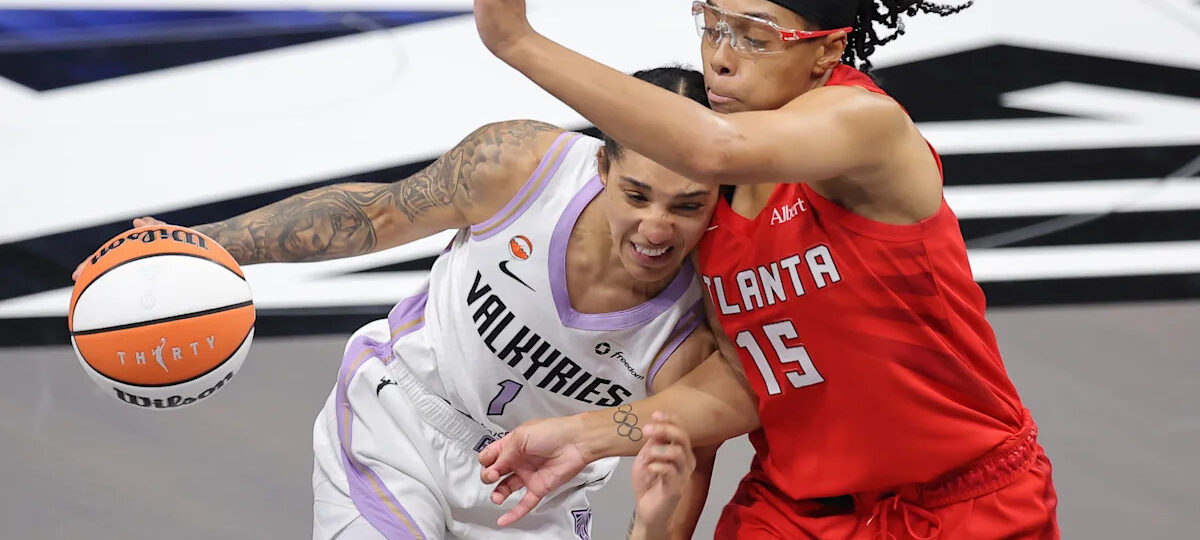
The Valkyries’ historic defense is headlined by elite defenders — they certainly have those in Gabby Williams, Veronica Burton, and Kiah Stokes, for starters — but their talents are accentuated by the strong help principles around them.
It’s hard enough to beat Burton or Williams off the bounce; having to deal with a thicket of arms if you do beat them has to be incredibly annoying. If you make it through that, you also have to deal with Stokes at the rim.
Teams simply don’t have fun driving against the Valkyries. Only the Washington Mystics (0.9 PPP) allowed a lower per-possession mark than the Valkyries (0.91 PPP) during the regular season. In terms of having help defenders present on drives, only the Minnesota Lynx (78.4%) and Portland Fire (73.3%) had them available at a higher rate than the Valkyries (72.7%).
It’s what made Game 6 such an impressive showing for the Dream offense, and such a weird one to absorb from the Valkyries side. A 46% clip wasn’t just the lowest of the series; it was their second-lowest mark in a game all season.
The Dream being able to get out in transition, particularly in the first half, helps explain some of the lack of, well, help. It’s hard to build a shell when you’re retreating and trying to claim a matchup. Beyond that, the Dream did a great job of mixing their spacing alignments initially — sometimes it was a classic 5-out look, other times they’d start with a “flat” look with the corners filled, plus someone lurking in the dunker spot — and relocating during action to occupy help defenders.
Go back through the Dream’s offensive possessions, and you’ll see plenty of trips where a player may start in the dunker spot, but they’d backtrack to the corner during a drive. The Dream love “looping” a player from the corner to the wing behind a pick-and-roll, something Angel Reese briefly mentioned during Wednesday’s media availability.
Regardless, the Valkyries will need to be more diligent setting up their shell defensively to make life more difficult for Atlanta’s offense. The screws tightened after the first quarter, but they’re going to need (close to) a full 40 minutes in Game 7.
71.4% — Angel Reese’s field goal percentage on shots contested by Kiah Stokes
Reese dusted Stokes midway through the first quarter, attacking her top foot and immediately getting to the basket.
It happened again late in the third, with Reese jabbing to her right before beating Stokes with another lefty drive.
Early in the fourth, it was Reese attacking off a handoff before delivering a bump to Stokes, pivoting, then finishing over her.
It was the most confident and (consistently) aggressive we’ve seen Reese be against the matchup all series long.
After converting just six of her 25 attempts (24% FG) contested by Stokes through the first five games of the series, Reese went 5-of-7 (71.4%) on those looks in Game 6.
One of the more fascinating stories of the Finals — heck, of the postseason — has been the defensive work of Stokes. As mentioned in this space, she’s been on a historic run of interior defense, stifling multiple All-Star bigs to the point where a Finals MVP candidacy was (and probably still is, depending on how Game 7 goes) a very real thing.
She’s been a menace to Reese in this series, shutting down post-ups and corralling drives. Contesting shots at a high level, sending others out of bounds — with either hand.
Stokes just didn’t have it today, which led to head coach Natalie Nakase limiting her minutes (series-low 20) in favor of former Dream forward Laeticia Amihere, a callback to the first half of Game 1.
“Yeah, I just think her legs weren’t moving as well as [Laeticia Amihere’s], so that was the decision that we made,” Nakase told reporters after Game 6.
Seems straightforward enough.
The big question now is if Reese has truly flipped things in the matchup, or if she simply (and finally) got the best of Stokes today. The Valkyries have to hope it’s the latter.
-16.7%: How much Gabby Williams underperformed her expected shot efficiency in the half-court
Second Spectrum has a shot quality metric that factors in shot type, shot distance, the level of shot contest being given by a defender and more. Based on that metric, Williams was expected to have an effective field goal percentage of 50%. Instead, she logged a 33.3% — an “underperformance” of nearly 17 percentage points.
Williams has shot very poorly for most of this series; at the end of the day, 35.3% on 2s and 22.7% on 3s isn’t what you want from your top scoring option. But it’s hard to say she’s played poorly; this hasn’t been a high-turnover experience (she has four in her last three games), she’s gotten to the spots and shots she’s wanted, and she’s largely been great defensively.
Among the few silver linings for the Valkyries in Game 6 was Williams finding some semblance of a rhythm in the second half, particularly the fourth quarter.
Williams got especially busy on drives, cycling through defenders — Jordin Canada, Naz Hillmon, DeWanna Bonner and Howard — for buckets, free throws, or both. She splashed home a corner 3 while the Valkyries were attempting to make a furious comeback.
It was nice to see her look more like herself, ultimately finishing with a game-high 26 points (15 in the 4th).
It’s a very “no, duh” thing to say, but the Valkyries have to hope that the late shot-making (and foul-drawing) from Williams is able to carry over into Game 7. A true bounceback from her could be enough to put the Valkyries over the top; at the very least, it should bring them much closer to where they want to be offensively.
Discover more from NAIRAVOICE.COM.NG
Subscribe to get the latest posts sent to your email.