
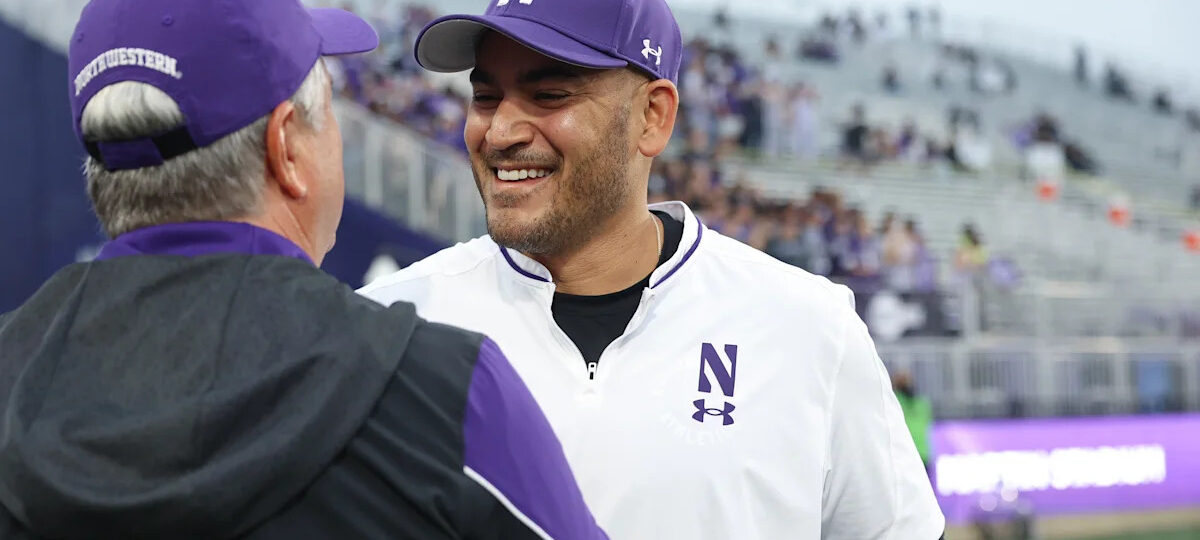
When Christian Sarkisian was considering leaving his scouting job with the Cincinnati Bengals to join Northwestern as its general manager in the winter of 2025, he asked himself which college jobs might persuade him to depart from the NFL.
He knew the challenges that come with helping to lead a college athletic department now, the ever-changing rules and frequent lawsuits that affect player eligibility, contracts and salary caps.
But he also recognized the opportunity that such a job presented for someone like him, who had learned the scouting and roster management ropes over nearly seven years with the Bengals. Many universities have gone to the NFL ranks to fill their football GM jobs, which have rapidly evolved into crucial positions.
And that chance also came at a place that meant a lot to him.
“The answer was Northwestern was the only school in the country that would take me out of the NFL,” Sarkisian said. “And do I believe that Northwestern can be a winner? Absolutely, I believe it can be a winner.”
Sarkisian grew up in Wilmette wearing Northwestern jerseys to school and decorating his bedroom in purple. He has a master’s degree in sports administration from the school — the third generation of his family to attend — and began his career as an assistant director of player personnel and recruiting assistant for the Wildcats under Pat Fitzgerald.
Sarkisian’s knowledge of Northwestern football goes beyond the more recent historical success, such as the 1996 Rose Bowl, to the teams of the 1930s through ’60s.
His grandfather, Alex Sarkisian, was an offensive lineman, linebacker and captain of the 1948 Northwestern team that won the Rose Bowl. Alex Sarkisian was an All-American and is in the College Football Hall of Fame. Christian knew what winning the Rose Bowl meant to his grandfather.
His goal since being named GM in May 2025 is to help Northwestern under coach David Braun get back there.
That’s an uphill climb for most universities outside of the handful that are shelling out $40 million or more on football rosters, according to recent reporting by The Athletic. The group of big spenders includes No. 5 Indiana, the defending national champion, which Northwestern plays Friday night in Bloomington, Ind.
But Sarkisian also embraces the test.
“When there’s chaos, you have to see the opportunity in it,” he said of the college sports world. “It felt like, hey, if you have a deep understanding of how a front office should operate and how relationships between the front office and coaches should operate, and the benefits that has to the team and organization overall, you could have an upper hand in this. So it was like the stars aligned for that.”
When Northwestern hired athletic director Mark Jackson in August 2024, college sports was nearing massive change with the implementation of revenue sharing with athletes. As Jackson and Braun discussed what lay ahead, they knew they needed to make the right hire to help the department navigate it.
When Sarkisian visited Northwestern in the fall of 2024, he talked with Braun about the state of the program and then connected with Jackson. He believed in their vision and the support Northwestern had in place for its athletes.
Now, 16 months after the hire, Braun said Sarkisian’s NFL experience and forward thinking are invaluable as they try to push Northwestern ahead in the new era.
“There’s no way this program is in the position it is right now if it wasn’t for Christian Sarkisian being here over the last year and a half,” Braun said. “And I cannot overstate how critical of a role he plays not only in our scouting and recruiting, but staying ahead of the trends and making sure we’re competing to win Big Ten championships but also doing it in a way that aligns with Northwestern values.”
Athletic departments have varying structures for their front offices, and Sarkisian’s job is unique.
As the GM for the entire athletic department, he works with the seven sports in which Northwestern pays its athletes: football, men’s and women’s basketball and women’s lacrosse, field hockey, volleyball and softball.
Because his expertise is in football — which is the revenue generator — his work with Braun and his staff is different than with other sports. He enjoys being a part of the roster-building process with experienced coaches such as field hockey’s Tracey Fuchs, lacrosse’s Kelly Amonte Hiller and softball’s Kate Drohan. But he said their conversations are broader, more in terms of strategy. He also works with any star players from those teams who might have agents and require negotiations.
He worked with basketball frequently during the retention cycle and transfer portal and high school recruiting windows. But he said Northwestern is working to build up its basketball staff and resources so that it has a “modern personnel department.” Men’s basketball coach Chris Collins said before last season that Sarkisian had been a good resource but that he eventually would like a basketball-specific GM.
For local comparison, Notre Dame — which hired former Detroit Lions personnel man Mike Martin to be its GM two months before Northwestern hired Sarkisian — has separate GMs for football and basketball, as does Illinois.
Being in charge of multiple sports has its challenges. It’s more work, more conversations for Sarkisian. The questions one team has about rules might be completely different from another team’s.
But he also sees that as expanding his knowledge base. For example, he might be able to use what he knows about international athletes from his work with field hockey and apply it to other sports’ rosters.
“Are there complications to working with multiple teams? There are,” Sarkisian said. “But for all the complications, I feel like I am better at my job because of it.”
On the football side, Sarkisian has eight full-time personnel staffers along with interns. He is more intricately involved in the staff and roster building with Braun, including identifying players they will recruit based on fit with the scheme and university and whom they will offer scholarships.
Beyond that, he has daily conversations with agents, including those who represent players Northwestern wants to retain, and works on player contracts and negotiations. And he also enjoys maintaining relationships with players and helping them chart their course at Northwestern and in the future.
He believes many of his experiences in Cincinnati benefit him now.
His Bengals job initially focused mostly on scouting, but he learned more as he went along, including dabbling in analytics and organizing the team’s trade calculator. He believes the Bengals prepared him well for salary-cap management through his exposure to executive vice president Katie Blackburn and his observation of live cap management during the undrafted free agent process.
He drew from the structure created by Bengals director of player personnel Duke Tobin, who wants his scouts to be able to work in the college and pro spaces. Sarkisian said he wants NU scouts to evaluate both high school and college talent so they understand what the projection looks like three years down the line.
“Interconnectedness was a major theme of what we did in Cincinnati,” Sarkisian said. “Whether that’s players, coaches, personnel, front-office people, it was everyone was on the same page and there was signage all over the place to remind you of that.”
Sarkisian said he has a “great partnership” with Braun that has allowed them to have hard conversations as they address changes.
Braun, who recently signed a three-year contract extension through 2031, speaks frequently about athletic department alignment, and that extends to his work with Sarkisian.
“Where this can be broken in this new age of college football is when it becomes egos and my decision or Christian’s decision,” Braun said. “It’s like, no, how do we create this level of continuity where we’re on the same page and there’s a lot of trust going back and forth?
“He’s pushed me in some ways, and I’ve pushed him in some ways. But this is Team Northwestern. What do we need to do to navigate this new landscape?”
The scouting process of high school and now transfer portal talent is a massive undertaking for college programs.
At Northwestern, the process starts with the personnel department asking if this athlete is a Big Ten player. If they agree it is, they begin to dive in on a character report, talking to coaches and teachers about the good and bad that encapsulate the player. Sarkisian’s time in the NFL made him understand its importance.
“In scouting, the misses aren’t on tape,” he said. “The misses are in the character report, meaning when you misevaluate a player — you bring in a player who you had high hopes for and he doesn’t actualize those — it tends to be something with the character of the player, not just the talent level.”
When it comes to the portal, Sarkisian said Northwestern operates a little more like an NFL organization with draft meetings and a big board. The personnel department evaluated about 3,000 athletes this past year and spent two weeks trimming it to 150 players. They brought that list to the coordinators and position coaches and then brought in 70 players for visits. Northwestern had 18 players from this year’s portal class on its roster for its Week 3 game against Colorado.
Sarkisian has tried to implement measures that will help those processes.
When he arrived at Northwestern, one of his first calls was to Bill Rees, a longtime NFL and college football personnel man. Along with an NFL career that included time as the Chicago Bears director of college scouting, Rees — the father of Atlanta Falcons offensive coordinator Tommy Rees — worked at Notre Dame and Northwestern and was recently on staff at Texas.
Rees trains Northwestern’s young scouts so that if Sarkisian is focusing on contracts or the salary cap, he feels comfortable knowing the scouting side is handled.
“I know from a player evaluation side we’re making significant improvements of our process on a department-wide level in the personnel department,” Sarkisian said. “And that’s all translating overall to the team for our whole evaluation process.”
Sarkisian also worked on making sure Northwestern’s database was up to speed so its scouting process was streamlined. He said the department partners with the Kellogg School of Management to explore the AI and analytics spaces.
“I put a lot on some of those alterations that we made with our process and really being able to identify guys the right way,” Sarkisian said. “Because now that money is in the equation, it goes back to limiting your misses. Because now you get burned not only from the roster spot, but also the investment that you make, and those can knock you out of going after another player. So we’re just professionalizing our process.”
Sarkisian is hopeful those processes can make a difference for Northwestern.
After two years with high school recruiting classes ranked No. 17 in the Big Ten and 80th and 66th nationally, according to 247 Sports’ composite rankings, the 2026 class was ranked No. 13 in the conference and No. 52 overall. And Sarkisian hopes to keep climbing with the 2027 class.
He pointed to Northwestern’s offseason retention rate as another positive. The Wildcats had 27 of 30 eligible players who played 100-plus snaps return, including All-Big Ten safety Robert Fitzgerald and wide receiver Griffin Wilde.
And the Wildcats, who The Athletic estimated spent between $21 million and $25 million on this year’s roster, were No. 10 in the conference transfer portal rankings and No. 42 nationally in 2026. Their highest-profile acquisition was former Michigan State quarterback Aidan Chiles, who was named Big Ten offensive player of the week after his performance in a 41-7 win against Colorado.
Sarkisian was happy with some of the other high-character players the Wildcats brought in from the portal, naming linebacker Kobie McKinzie, tight end Alex Honig, defensive lineman Jamaal Johnson and defensive back Montae Pate as examples.
“That’s what I’m proudest of is that we’re bringing in guys who are good Big Ten football players, who are great locker room and culture guys to build around,” he said.
Northwestern football has made recent headlines about the amount of money being poured into the program. The Ryan family privately funded the new $875 million Ryan Field, which opens Oct. 2, while the Uihlein family recently committed $35 million over three years to support the team.
Sarkisian can play a role in fundraising by explaining the roster construction process to donors who need to know how their money is working in an uncharted era.
“The value that somebody like Christian brings is just explaining the growth of our football program and why we have selected certain athletes, especially in the transfer portal era,” said Savanna Wood, Northwestern’s chief communications and branding officer. “It’s something that all donors are really interested in. … The GMs, they’re able to get in front of them and add so much value to just explaining the direction of building a football program.”
Sarkisian also can talk to them about the team’s big-picture goals. It’s a belief he shares with Braun — that those within the program need to talk about their lofty expectations if they want to reach them.
Braun, who went 8-5, 4-8 and 7-6 in his first three seasons, has frequently mentioned his goals of a Big Ten championship and College Football Playoff berth, including this week as the Wildcats prepared to face Indiana. Multiple Big Ten coaches said in the preseason that what the Hoosiers have done in two years under Curt Cignetti shows that massive turnarounds can be made — with the right investment and coaching.
“That it can be done,” Braun said. “That’s the biggest lesson you can learn.”
When Sarkisian arrived in Cincinnati in the middle of a five-year playoff drought, the organization — which had drafted Joe Burrow with the No. 1 pick in 2020 — wanted to start operating like there was only one endgame. The Bengals advanced to the Super Bowl in the 2021 season.
“We had to become comfortable talking about winning a Super Bowl,” Sarkisian said. “Daily conversations about that. Are our processes Super Bowl-worthy? And that’s something that Coach Braun and I see eye to eye on here, where we have goals to win the Big Ten and to compete for a national championship.
“We need to be comfortable talking about that in all of our processes, whether that’s from the player evaluation side, the player development side, the coaching side, the medical staff side and the sports performance side. These processes, we have to be operating at a 12-0 level.”
Discover more from NAIRAVOICE.COM.NG
Subscribe to get the latest posts sent to your email.