
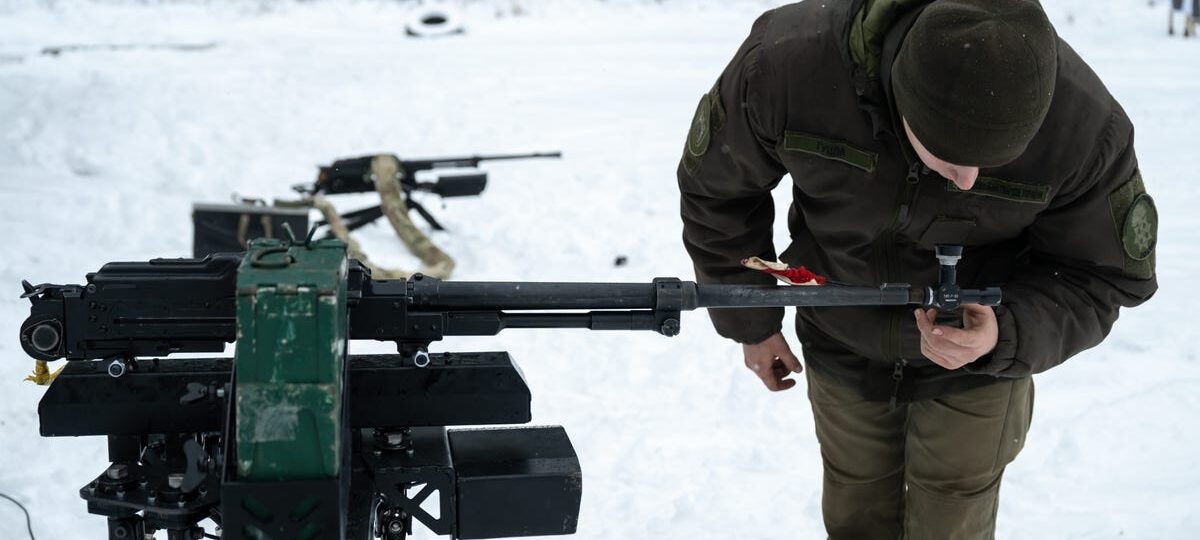
Western arms makers are increasingly working with Ukrainian weapons companies, looking to learn from them how to build effectively in wartime conditions.
Many Western companies, including major players, have entered into agreements to develop products with Ukrainian manufacturers, reflecting growing interest in Ukraine’s wartime manufacturing experience.
Western firms are interested in partnering with Ukrainian companies “to have those lessons learned that they have gained since the beginning of the full-scale invasion,” Davyd Aloian, deputy secretary of the National Security and Defense Council of Ukraine, told Business Insider.
Ukraine’s defense industry has expanded rapidly since Russia’s full-scale invasion, producing more weapons domestically and attracting greater interest from foreign governments and companies.
Aloian described a shift, from Ukraine taking any aid allies could spare, including decades-old equipment, to foreign partners now studying its defense sector.
Western officials say Ukraine’s manufacturing processes are central to what they want to learn from Ukraine, and they have encouraged their defense companies to partner with Ukrainian firms.
Aloian said Western firms are interested in how Ukrainian companies operate under attack and move quickly enough to respond to a battlefield changing faster than anything most Western manufacturers have faced in decades.
Western leaders have praised Ukraine’s defense industry for its ability to develop some weapons more quickly and cheaply than many NATO-based manufacturers, even while under threat.
They say they want their own countries’ companies to adopt some of those practices.
Ukrainian companies can develop, field, and modify some weapons within weeks, particularly drones and other relatively inexpensive systems.
Sir John Stringer, NATO’s Deputy Supreme Allied Commander for Europe, told Business Insider recently that “one of the things you’re seeing in Ukraine is a sheer pace of adoption and adaptation in technology.
It is measured in weeks.” That pace, he said, is something Western militaries should study.
German defense company Quantum Systems has started co-producing drones with Ukrainian defense company Frontline Robotics with a joint venture called Quantum Frontline Industries, which it described as “a major step toward a new European drone industrial base driven by Ukrainian frontline innovation and German engineering.” Mykyta Rozhkov, Frontline Robotics’ chief business development officer, described it to Business Insider as a “win-win” that gives Ukraine more of the drones it needs and lets German industry learn some wartime lessons that mean it can “level up their own industry and be prepared.” He said his company could learn from German manufacturing methods while sharing its own “unique approaches to manufacturing” that allow it to move faster and take more risks than some Western firms.
Jørgen Bull, the senior vice president for land systems at Norway’s Kongsberg Defense & Aerospace, said when his company announced plans to work with Ukrainian robotic systems maker DevDroid that partnerships with Ukrainian industry are important for building future defense capabilities because “the speed of defense technology development in Ukraine today has no equal.” He said working with DevDroid combines its “battle-proven solutions” with his company’s decades of experience.
Ukrainian companies have also learned how to maintain production under wartime threats.
Many are expanding some production elsewhere in Europe, but allies preparing for a possible large-scale war want to understand how Ukrainian firms have continued operating under attack.
Aloian said that Western companies also want to learn how Ukrainian companies have scaled so hugely, especially working in such tough conditions. “The industry has been developed under the most harsh conditions that are currently in the world.” Aloian said Western companies want to learn from Ukraine about the “resilience of the production sites, how rapidly they can restore and regenerate their production volumes after shelling and after hits,” and how they’re duplicating production lines and relocating manufacturing without decreasing delivery volumes.
Ukrainian companies have split manufacturing across multiple sites.
That makes production more difficult but reduces the risk that a single attack could wipe out an entire operation.
Karmo Saar, the head of sales for Estonian company Krattworks, which makes drones used by Ukraine, told Business Insider that European companies need to disperse more, or otherwise, “I think we’re going to be punished.” Aloian said that some countries should definitely spread out their manufacturing like this.
Ukrainian drone maker General Cherry announced a joint venture with American defense manufacturer Wilcox Industries to produce FPV and interceptor drones for the US.
Wilcox Industries founder and CEO James Teetzel cited Ukraine’s working under threat, saying that “to work with a company that withstood the impossible and entered the fight when Ukraine’s sovereignty was under threat is exactly the spirit Wilcox would like to be part of.” He said he wanted to combine his company’s strengths with the battlefield tech that General Cherry had developed, and he had no doubt that it would “bring considerable benefit to the United States.” Stanislav Hryshyn, co-founder of General Cherry, told Business Insider that the US has a larger manufacturing base that’s beneficial for Ukrainian companies to work with, but that also for Western companies, “our experience and expertise is pretty valuable for them.” General Cherry is also co-producing with ORQA, a Croatian drone technology company.
Srđan Kovačević, ORQA’s CEO, told Business Insider that General Cherry has “been living through a reality of having to defend against massive daily attacks by unmanned capabilities of the enemy.
That pressure, he said, has forced the company to quickly adapt available technology for operational use.
He said that working together “is a two-way street.
But when it comes to operational excellence, they have operational excellence that we don’t have simply because we had the privilege of not needing to have an existential threat daily.”
Discover more from NAIRAVOICE.COM.NG
Subscribe to get the latest posts sent to your email.